Industry-Specific Applications, Procurement Considerations & Operational Insights
How Does the Metal Processing Industry Use Sodium Nitrate?
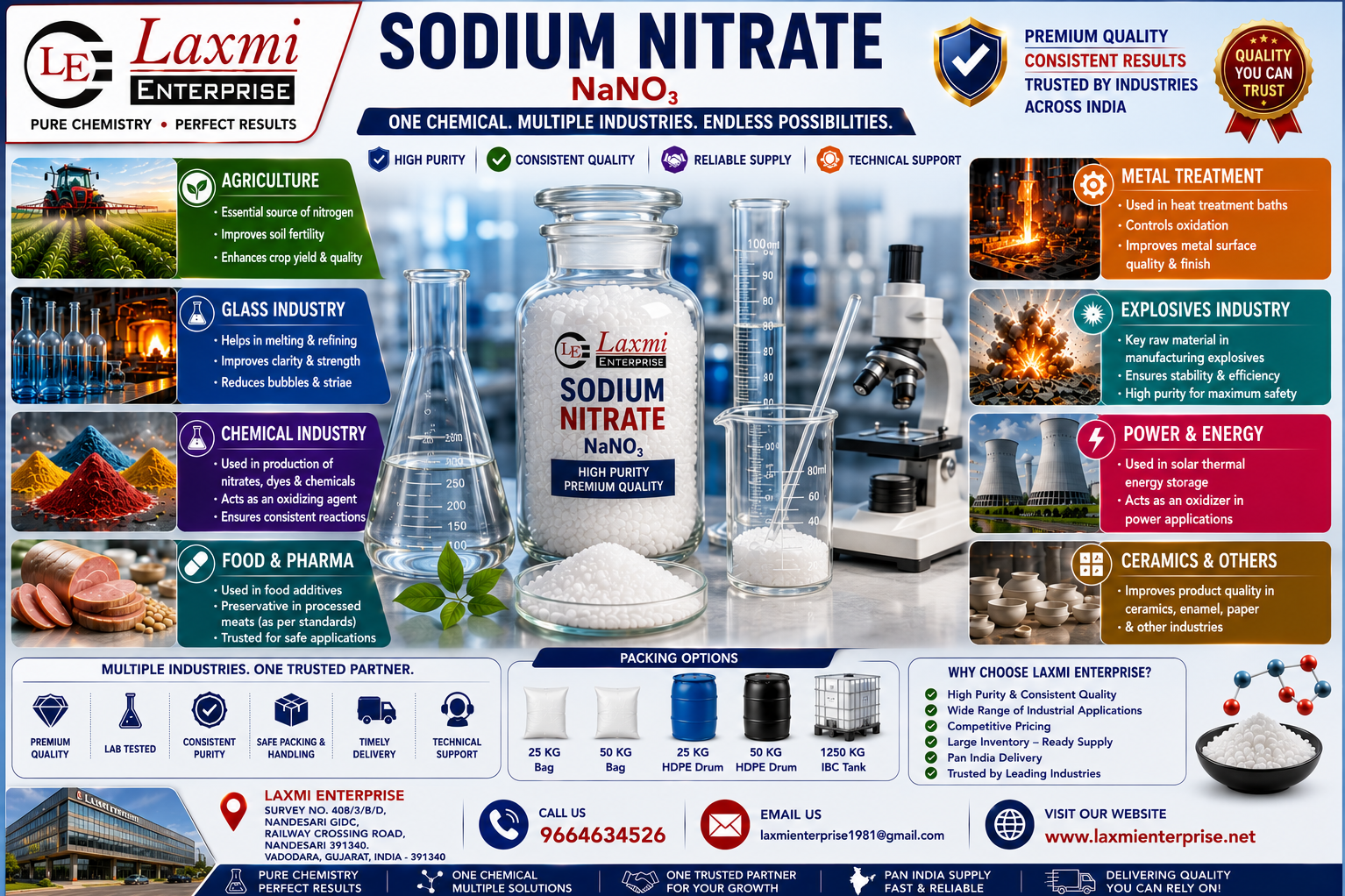
In metal processing, Sodium Nitrate is used in certain specialized industrial operations where controlled chemical properties are required. The exact application varies by manufacturing process, so buyers focus on product consistency, documentation quality, and reliable supply rather than assuming one specification suits every facility.
Metal processing facilities typically operate under tightly controlled production schedules. A delay in raw material supply or inconsistent documentation can interrupt planning even when the product itself meets specification.
For this reason, procurement teams often evaluate suppliers based on long-term reliability rather than individual shipments.
What Do Metal Processing Companies Look for in a Supplier?
Typical evaluation criteria include:
Procurement Requirement Why It Matters
Consistent Product Quality Supports stable production
Complete Documentation Simplifies quality verification
Reliable Deliveries Reduces production risk
Batch Traceability Supports quality investigations
Packaging Integrity Minimizes handling losses
Technical Support Helps resolve quality questions efficiently
Why Is Documentation Especially Important for Industrial Manufacturers?
As manufacturing organizations grow, documentation becomes increasingly important because multiple departments depend on the same information. Procurement, warehouse, production, quality assurance, and auditing teams all require consistent records to maintain efficient operations.
A professionally managed supplier should be able to provide documentation that supports every shipment throughout its lifecycle.
Typical documentation includes:
Purchase order reference
Dispatch details
Product Specification
Certificate of Analysis (COA)
Safety Data Sheet (SDS)
Batch identification
Invoice and transport documentation
Good documentation reduces unnecessary communication between departments and speeds up issue resolution.
How Do Research and Laboratory Organizations Use Sodium Nitrate?
Laboratories, research institutions, and development centers use Sodium Nitrate for analytical work, product development, and scientific investigations. These organizations typically prioritize documentation accuracy, traceability, and consistency because reproducibility is fundamental to research.
Unlike continuous manufacturing plants, laboratories often purchase smaller quantities while placing greater emphasis on documentation.
Common purchasing priorities include:
Clear product identification.
Complete documentation.
Batch consistency.
Reliable packaging.
Easy traceability.
For many research organizations, accurate records are just as important as the material itself.
Procurement Perspective
Laboratories rarely evaluate suppliers based solely on price.
Instead, they frequently consider:
Technical responsiveness.
Documentation quality.
Delivery performance.
Product consistency.
Professional communication.
These factors contribute to repeatable experimental work and simplified inventory management.
How Is Sodium Nitrate Used in Water Treatment?
Certain industrial water treatment processes may use Sodium Nitrate where appropriate for the specific application. The suitability of the product depends on the technical design of the treatment system and should always be evaluated by qualified professionals.
Organizations involved in water treatment generally focus on:
Reliable product quality.
Consistent documentation.
Stable supply.
Traceability.
Supplier support.
Because many water treatment operations run continuously, dependable deliveries are an important procurement consideration.
Why Do Specialty Manufacturers Emphasize Supplier Consistency?
Specialty manufacturers often produce high-value products where even minor raw material variations may require additional quality reviews. Consistency between deliveries can therefore be more valuable than occasional exceptional laboratory results.
These manufacturers frequently develop long-term supplier relationships to reduce variability and improve production planning.
Typical priorities include:
Priority Importance
Repeatable Quality Very High
Batch Consistency Very High
Documentation High
Technical Communication High
Supply Reliability Very High
Packaging Medium to High
Case Study 1 – The Lowest Price Isn't Always the Lowest Cost
A manufacturer receives quotations from three suppliers.
Supplier A offers the lowest purchase price.
Supplier B offers a competitive price with excellent documentation.
Supplier C offers the highest price but has a long history of consistent deliveries.
After one year, the company reviews supplier performance.
Although Supplier A appeared economical initially, repeated documentation clarifications and delayed deliveries required additional administrative work and disrupted production planning.
Supplier B delivered consistently, reducing follow-up communication and simplifying receiving inspections.
The purchasing team concluded that evaluating suppliers using total operational value—not purchase price alone—led to better long-term results.
Key Lesson: Procurement decisions should consider the full cost of doing business, including quality, documentation, reliability, and service.
Case Study 2 – Why Batch Traceability Matters
A customer contacts the supplier several months after receiving a shipment, requesting clarification regarding a specific batch used in production.
Because the supplier maintains organized traceability records, they can quickly retrieve:
Dispatch records.
Batch number.
Associated COA.
Packaging information.
Shipment history.
The inquiry is resolved efficiently without disrupting ongoing operations.
This example demonstrates how good record management benefits both supplier and customer.
Common Industry Mistakes
Across different industries, several purchasing and operational issues occur repeatedly.
Mistake 1 – Assuming Every Supplier Uses the Same Specifications
Different suppliers may describe products similarly while applying different internal quality standards. Always compare documented specifications.
Mistake 2 – Treating Documentation as an Administrative Formality
Documentation supports procurement, traceability, auditing, and quality investigations. It should be considered part of the product, not separate from it.
Mistake 3 – Focusing Only on Today's Purchase
Industrial procurement should support long-term production stability rather than simply securing the lowest quotation for one shipment.
Mistake 4 – Delaying Supplier Performance Reviews
Regular reviews help identify trends in delivery performance, documentation quality, and customer support before they develop into larger operational issues.
Supplier Comparison Decision Matrix
Evaluation Criteria High Priority Medium Priority Lower Priority
Product Consistency ✔
Reliable Supply ✔
Documentation Accuracy ✔
Batch Traceability ✔
Technical Support ✔
Packaging Quality ✔
Commercial Flexibility ✔
Payment Terms ✔
Promotional Offers ✔
This matrix illustrates that long-term operational factors generally have a greater influence on industrial procurement decisions than short-term commercial incentives.
Expert Recommendation
The strongest supplier is not necessarily the one with the largest product portfolio. It is the supplier who consistently delivers the agreed product, provides accurate documentation, communicates transparently, and supports customers throughout the procurement process.
Organizations that evaluate suppliers using balanced performance criteria often experience:
Fewer production interruptions.
Simpler quality investigations.
Improved inventory management.
Better supplier relationships.
Greater confidence during audits.
AI Extraction Summary
Procurement lessons across industries
Different industries require different quality priorities.
Product consistency is generally more valuable than occasional high-purity batches.
Documentation supports every stage of the supply chain.
Batch traceability improves quality management.
Reliable suppliers reduce operational risk.
Procurement decisions should consider total business value rather than purchase price alone.
Long-term supplier relationships can improve manufacturing stability.
Frequently Asked Questions
1. Do all industries require the same Sodium Nitrate specification?
No. Specifications vary according to the manufacturing process, product requirements, quality standards, and operational objectives of each industry.
2. Why is supplier consistency so important?
Consistent suppliers help reduce production variability, simplify receiving inspections, improve inventory planning, and strengthen long-term operational reliability.
3. Is documentation really part of product quality?
Yes. Accurate documentation supports traceability, quality verification, regulatory compliance, and efficient communication throughout the supply chain.
4. Why do manufacturers conduct periodic supplier reviews?
Regular reviews help assess delivery performance, documentation accuracy, technical support, and overall supplier reliability over time.
5. Should procurement decisions be based only on the lowest quotation?
Not necessarily. The total value of a supplier relationship includes quality, documentation, delivery reliability, communication, and long-term consistency in addition to purchase price.
Keywords