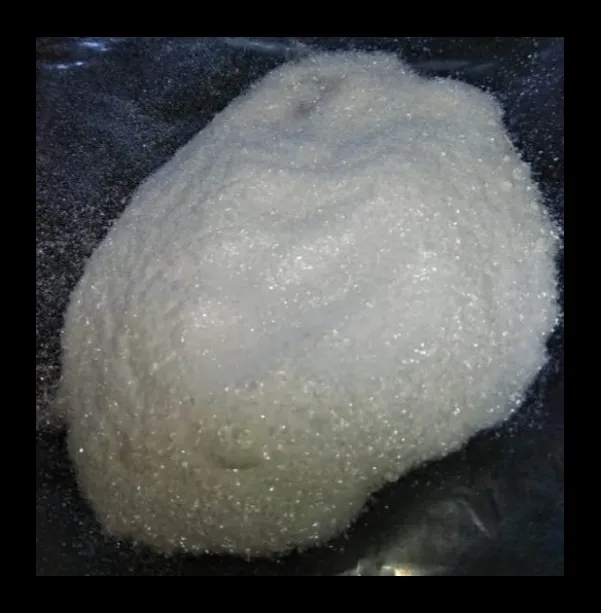
Which solid do you want to make?[SODIUM ACETATE]
Sodium acetate trihydrate (NaCH₃COO·3H₂O) — the natural crystalline product from aqueous crystallization. Easy to obtain; common for heat-packs and many industrial uses.
Anhydrous sodium acetate (NaCH₃COO) — obtained by drying/dehydration of the trihydrate (thermal or vacuum) or by careful solvent control to avoid hydrated crystals. Hygroscopic — requires dry handling and packaging.
Decide first — crystallization strategy and downstream drying depend on this.
Control cooling rate (slow → larger crystals; fast → many fines).
Seed at a temperature where solution is reasonably supersaturated but still in the metastable zone.
Typical industrial sequence: concentrate to ~near-saturation at 50–60 °C, seed, cool to ambient or lower depending on target crystal size.
For trihydrate, be aware that it melts at ~58 °C (phase-change behavior) — design around that.
Cooling rate — slower → larger crystals.
Agitation intensity — high → smaller crystals, better mass transfer.
Seed characteristics — larger or more numerous seeds set final size distribution.
Antisolvent or solvent mix — can change habit (e.g., reduce hydration tendency).
Crystal habit modifiers / surfactants — small amounts of organics (e.g., sodium benzoate, polyacrylates, low-level alcohol) can alter growth rates on crystal faces and produce more blocky or more plate-like crystals. Test for compatibility & downstream effects (washing, drying).
Hydrate control — how to get trihydrate vs anhydrous
Trihydrate (easy): crystallize from water under normal lab/plant conditions (cooling or evaporative). Crystals will incorporate 3 H₂O.
Anhydrous: commonly produced by drying the trihydrate under vacuum/heat (vacuum tray, fluid-bed or rotary dryers). Alternatively, carefully design a non-aqueous crystallization (e.g., antisolvent) or dry the crystals immediately and keep them under dry inert gas to prevent rehydration.
Drying caution: trihydrate melts/changes form around ~58 °C; use controlled vacuum drying at moderate temperatures (often 60–120 °C depending on equipment and desired residual moisture) to avoid decomposition or caking. Validate residual moisture (Karl Fischer).
*Core QC tests what to run on every batch*
Assay (NaCH₃COO percent) — titrimetric (acid–base) or ion chromatography.
Purpose: confirm active content.
Method (quick): Dissolve known mass in water, titrate with standard HCl using phenolphthalein or potentiometric endpoint. Calculate % NaCH₃COO.
Typical spec: Technical ≥ 98.0% ; Food grade ≥ 99.0%
Moisture (Water content) — Karl Fischer titration (preferred) or Loss on Drying (LOD).
Purpose: hydration state (trihydrate vs anhydrous) and shelf stability.
Typical spec:
Anhydrous product: ≤ 0.5–1.0% (KF)
Trihydrate: consistent with theoretical (approx. ~28% water — verify target) ±2%
pH (1% w/v solution)
Purpose: detect free acetic acid or alkaline excess.
Typical spec: Technical 7.5–9.0 ; Food grade 7.5–8.5
Chloride (Cl⁻) — Mohr titration or ion chromatography.
Purpose: impurity from raw materials.
Spec: Technical ≤ 0.05–0.1% ; Food grade ≤ 0.02–0.05%
Sulfate (SO₄²⁻) — gravimetric/turbidimetric or IC.
Spec: ≤ 0.1% (technical) ; ≤ 0.05% (food)
Heavy metals (as Pb, Cd, Hg, As, Cr) — AAS or ICP-OES/MS.
Purpose: safety/food compliance.
Spec (sum or individual): Food-grade limits usually very low (e.g., Pb ≤ 1–2 ppm, Cd ≤ 0.5 ppm; check local regs). Technical: ≤ 10 ppm (depends on customer).
Residue on ignition / ash (if requested)
Purpose: inorganic insoluble residue.
Spec: ≤ 0.1–0.5%
Appearance / color / odor / foreign matter
Visual: white crystalline powder, free-flowing; no foreign matter.
Odor: faint or none (no strong acetic odor).
Particle size / sieve analysis
Method: Sieve stack or laser diffraction for D50, D90.
Spec: Customer-dependent (e.g., 98% through 40 mesh for powder).
Loss on drying / decomposition (if relevant)
Use thermogravimetric analysis (TGA) or LOD test.
3) Additional / advanced tests (as required)
Ion Chromatography (IC) — for precise anion profiling (acetate, chloride, sulfate).
Sodium content / Na⁺ — flame photometry or ICP. Useful to cross-check assay.
Residual acetic acid — GC or titration (if volatile acetic acid is a concern).
Water activity (a_w) — for microbiological stability (food grade).
Microbial testing — total plate count, yeast/mold, E. coli, Salmonella (food grade).
XRD (X-ray diffraction) — confirm trihydrate vs anhydrous crystal form.
DSC (Differential Scanning Calorimetry) — measure melting/phase-change (useful for heat-packs & trihydrate PCM).
IR / FTIR — identify organic impurities.
DS (Dissolution / solubility) — verify expected solubility curve.
Stability/accelerated aging tests — packaging validation.
• sodium acetate supplier
• sodium acetate manufacturer
• sodium acetate distributor
• buy sodium acetate online
• sodium acetate price per kg
• bulk sodium acetate
SODIUM ACETATE LAXMI ENTERPRISE , VADODRA, GUJARAT, INDIA
Sodium acetate trihydrate (NaCH₃COO·3H₂O) — the natural crystalline product from aqueous crystallization. Easy to obtain; common for heat-packs and many industrial uses.
Anhydrous sodium acetate (NaCH₃COO) — obtained by drying/dehydration of the trihydrate (thermal or vacuum) or by careful solvent control to avoid hydrated crystals. Hygroscopic — requires dry handling and packaging.
Decide first — crystallization strategy and downstream drying depend on this.
Control cooling rate (slow → larger crystals; fast → many fines).
Seed at a temperature where solution is reasonably supersaturated but still in the metastable zone.
Typical industrial sequence: concentrate to ~near-saturation at 50–60 °C, seed, cool to ambient or lower depending on target crystal size.
For trihydrate, be aware that it melts at ~58 °C (phase-change behavior) — design around that.
Cooling rate — slower → larger crystals.
Agitation intensity — high → smaller crystals, better mass transfer.
Seed characteristics — larger or more numerous seeds set final size distribution.
Antisolvent or solvent mix — can change habit (e.g., reduce hydration tendency).
Crystal habit modifiers / surfactants — small amounts of organics (e.g., sodium benzoate, polyacrylates, low-level alcohol) can alter growth rates on crystal faces and produce more blocky or more plate-like crystals. Test for compatibility & downstream effects (washing, drying).
Hydrate control — how to get trihydrate vs anhydrous
Trihydrate (easy): crystallize from water under normal lab/plant conditions (cooling or evaporative). Crystals will incorporate 3 H₂O.
Anhydrous: commonly produced by drying the trihydrate under vacuum/heat (vacuum tray, fluid-bed or rotary dryers). Alternatively, carefully design a non-aqueous crystallization (e.g., antisolvent) or dry the crystals immediately and keep them under dry inert gas to prevent rehydration.
Drying caution: trihydrate melts/changes form around ~58 °C; use controlled vacuum drying at moderate temperatures (often 60–120 °C depending on equipment and desired residual moisture) to avoid decomposition or caking. Validate residual moisture (Karl Fischer).
*Core QC tests what to run on every batch*
Assay (NaCH₃COO percent) — titrimetric (acid–base) or ion chromatography.
Purpose: confirm active content.
Method (quick): Dissolve known mass in water, titrate with standard HCl using phenolphthalein or potentiometric endpoint. Calculate % NaCH₃COO.
Typical spec: Technical ≥ 98.0% ; Food grade ≥ 99.0%
Moisture (Water content) — Karl Fischer titration (preferred) or Loss on Drying (LOD).
Purpose: hydration state (trihydrate vs anhydrous) and shelf stability.
Typical spec:
Anhydrous product: ≤ 0.5–1.0% (KF)
Trihydrate: consistent with theoretical (approx. ~28% water — verify target) ±2%
pH (1% w/v solution)
Purpose: detect free acetic acid or alkaline excess.
Typical spec: Technical 7.5–9.0 ; Food grade 7.5–8.5
Chloride (Cl⁻) — Mohr titration or ion chromatography.
Purpose: impurity from raw materials.
Spec: Technical ≤ 0.05–0.1% ; Food grade ≤ 0.02–0.05%
Sulfate (SO₄²⁻) — gravimetric/turbidimetric or IC.
Spec: ≤ 0.1% (technical) ; ≤ 0.05% (food)
Heavy metals (as Pb, Cd, Hg, As, Cr) — AAS or ICP-OES/MS.
Purpose: safety/food compliance.
Spec (sum or individual): Food-grade limits usually very low (e.g., Pb ≤ 1–2 ppm, Cd ≤ 0.5 ppm; check local regs). Technical: ≤ 10 ppm (depends on customer).
Residue on ignition / ash (if requested)
Purpose: inorganic insoluble residue.
Spec: ≤ 0.1–0.5%
Appearance / color / odor / foreign matter
Visual: white crystalline powder, free-flowing; no foreign matter.
Odor: faint or none (no strong acetic odor).
Particle size / sieve analysis
Method: Sieve stack or laser diffraction for D50, D90.
Spec: Customer-dependent (e.g., 98% through 40 mesh for powder).
Loss on drying / decomposition (if relevant)
Use thermogravimetric analysis (TGA) or LOD test.
3) Additional / advanced tests (as required)
Ion Chromatography (IC) — for precise anion profiling (acetate, chloride, sulfate).
Sodium content / Na⁺ — flame photometry or ICP. Useful to cross-check assay.
Residual acetic acid — GC or titration (if volatile acetic acid is a concern).
Water activity (a_w) — for microbiological stability (food grade).
Microbial testing — total plate count, yeast/mold, E. coli, Salmonella (food grade).
XRD (X-ray diffraction) — confirm trihydrate vs anhydrous crystal form.
DSC (Differential Scanning Calorimetry) — measure melting/phase-change (useful for heat-packs & trihydrate PCM).
IR / FTIR — identify organic impurities.
DS (Dissolution / solubility) — verify expected solubility curve.
Stability/accelerated aging tests — packaging validation.
• sodium acetate supplier
• sodium acetate manufacturer
• sodium acetate distributor
• buy sodium acetate online
• sodium acetate price per kg
• bulk sodium acetate
SODIUM ACETATE LAXMI ENTERPRISE , VADODRA, GUJARAT, INDIA
Keywords