Moisture Control in Sodium Sulphate Storage and Handling: A Technical Guide for Industrial Manufacturers
Every manufacturing facility invests considerable effort in purchasing quality raw materials.
Purchase managers compare suppliers.
Quality engineers review specifications.
Production managers plan manufacturing schedules.
Warehouse teams prepare storage space.
After all these activities are completed, one important responsibility still remains.
Protecting the quality of the material after it reaches the factory.
This is where moisture control becomes important.
Many production problems do not begin because the material left the supplier in poor condition.
They begin because the material was not stored or handled correctly after delivery.
Proper moisture control protects raw material quality, improves warehouse efficiency and supports stable manufacturing throughout the year.
For manufacturers using Sodium Sulphate, good storage practices are not optional.
They are an essential part of quality management.
## Why Moisture Management Deserves More Attention
Moisture is often an overlooked factor in industrial manufacturing.
It cannot always be seen immediately.
Its effects usually develop gradually.
Changes in warehouse conditions.
Poor storage practices.
Damaged packaging.
Improper unloading.
Seasonal humidity.
Each of these factors can influence the condition of stored industrial chemicals.
Manufacturers who understand moisture management experience fewer handling issues and maintain better production consistency.
Preventing problems is always easier than correcting them later.
## The Journey Does Not End at Delivery
When a shipment reaches the customer's factory, many people believe the supplier's responsibility has ended.
From a manufacturing perspective, the journey is only halfway complete.
The material must still be unloaded safely.
Inspected.
Stored correctly.
Protected until production begins.
Every stage after delivery influences how the material performs inside the manufacturing process.
Good warehouse management preserves product quality until the moment it enters production.
## Warehouse Design Influences Material Condition
A well-designed warehouse contributes directly to quality preservation.
The storage area should remain clean throughout the year.
Ventilation should support proper air circulation.
Roof structures should be inspected regularly.
Water drainage around the building should remain unobstructed.
Natural light improves inspection activities while organised storage layouts improve material movement.
Good warehouse design supports both operational efficiency and quality management.
## Seasonal Challenges in India
Indian manufacturers operate under a wide range of climatic conditions.
Summer temperatures can become extremely high.
The monsoon introduces significant humidity.
Winter conditions vary across different regions.
Warehouse management practices should adapt to these seasonal changes.
Additional inspections during the rainy season.
Routine roof maintenance before monsoon begins.
Improved ventilation where appropriate.
Regular housekeeping.
These simple practices help maintain stable storage conditions throughout the year.
## Proper Pallet Management
Industrial chemicals should never be stored directly on warehouse floors.
Pallets provide separation between the material and the floor surface.
They improve air circulation.
Simplify forklift handling.
Reduce the possibility of packaging damage.
Support better warehouse organisation.
Pallet condition should also be inspected regularly.
Broken pallets create unnecessary handling risks and may damage packaging during storage.
## Safe Stacking Practices
Correct stacking improves both safety and product protection.
Bags should remain stable throughout the storage period.
Uneven stacks increase the possibility of movement and packaging damage.
Warehouse personnel should follow internal safety procedures regarding stacking height and storage layout.
Safe stacking improves operational efficiency while protecting employees and inventory.
## Packaging Inspection Should Continue During Storage
Receiving inspection is important.
Ongoing inspection is equally valuable.
Warehouse personnel should periodically review stored inventory.
Look for damaged bags.
Signs of moisture.
Stack stability.
Clear identification.
Routine inspections help identify small issues before they become larger operational problems.
Preventive inspections are far more effective than emergency corrective actions.
## Inventory Rotation Supports Quality
Good warehouse management includes disciplined inventory rotation.
Older inventory should generally be used before recently received material.
This reduces extended storage periods and simplifies inventory control.
Accurate inventory records also help procurement teams plan future purchases more effectively.
Inventory management and quality management should always work together.
## Housekeeping Improves Manufacturing Efficiency
Clean warehouses create efficient warehouses.
Clear aisles improve forklift movement.
Organised storage areas simplify inspections.
Proper waste management reduces contamination risks.
Clearly identified storage locations reduce material handling time.
Housekeeping is often viewed as a routine activity.
In reality, it supports productivity, safety and quality every day.
## Transportation Also Influences Moisture Protection
Material protection begins before the truck reaches the customer's warehouse.
Professional packaging.
Careful loading.
Protected transportation.
Organised unloading.
Each stage contributes to preserving product condition.
Suppliers who invest in proper transportation practices help customers maintain product quality throughout the supply chain.
Quality protection is a shared responsibility.
## Warehouse Audits Should Become Routine
Leading manufacturers conduct periodic warehouse audits.
These reviews help identify opportunities for improvement.
Storage conditions.
Pallet condition.
Packaging quality.
Inventory accuracy.
Housekeeping standards.
Material identification.
Routine audits strengthen warehouse discipline and support continuous improvement.
Small improvements made regularly create significant long-term operational benefits.
## Procurement and Warehouse Teams Should Work Together
Procurement selects suppliers.
Warehouse teams receive materials.
Quality departments inspect shipments.
Production departments consume inventory.
Each department influences manufacturing success.
Regular communication between these teams improves purchasing decisions and warehouse planning.
Strong internal collaboration creates stronger supply chains.
## How Laxmi Enterprise Helps Customers Protect Product Quality
At Laxmi Enterprise, we understand that maintaining product quality extends far beyond manufacturing.
Operating from Nandesari GIDC, Vadodara, we supply Sodium Sulphate and other industrial chemicals to manufacturers across India.
Every shipment is prepared with attention to packaging quality, handling practices and organised dispatch planning.
We also work closely with customers by sharing practical recommendations for storage and handling because protecting product quality is a shared responsibility.
Our objective is not only to supply industrial chemicals.
It is to help customers maintain consistent manufacturing performance from the day material is dispatched until the day it enters production.
## Final Thoughts
Moisture control is one of the simplest ways to improve manufacturing reliability.
Clean warehouses.
Proper pallets.
Disciplined inspections.
Professional packaging.
Organised inventory.
Routine audits.
These practices require planning more than investment.
Manufacturers who manage storage conditions effectively experience smoother warehouse operations, better material handling and greater production confidence.
Quality does not end at the supplier's warehouse.
It continues until the material becomes part of the finished product.
## Frequently Asked Questions
Why is moisture control important for Sodium Sulphate?
Moisture management helps preserve product condition, supports efficient handling, protects packaging and contributes to stable manufacturing operations.
Should Sodium Sulphate be stored directly on warehouse floors?
No. Industrial chemicals should be stored on suitable pallets to improve protection, air circulation and warehouse handling efficiency.
How often should warehouse inspections be performed?
Regular inspections should be conducted throughout the year, with additional attention during the monsoon season and periods of high humidity.
Why is inventory rotation important?
Inventory rotation supports organised warehouse management, reduces extended storage periods and helps maintain efficient production planning.
Why do manufacturers across India choose Laxmi Enterprise?
Manufacturers choose Laxmi Enterprise because we combine consistent-quality Sodium Sulphate with professional packaging, dependable logistics and responsive customer support. Operating from Nandesari GIDC, Vadodara, we help industries maintain reliable manufacturing through quality products and practical technical guidance.
## About Laxmi Enterprise
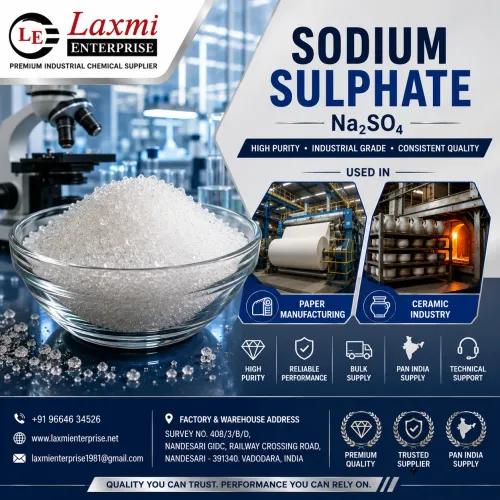
Laxmi Enterprise is a trusted manufacturer, supplier and distributor of industrial chemicals based in Nandesari GIDC, Vadodara, Gujarat. We supply Sodium Sulphate, Sodium Nitrate, Sodium Acetate, Tri Sodium Phosphate and a comprehensive range of industrial chemicals to detergent, glass, textile, paper, ceramic, construction, water treatment and chemical processing industries across India.
Since 1981, we have built our reputation by supplying consistent-quality industrial chemicals supported by dependable logistics, technical knowledge and long-term customer relationships. Our commitment is to help Indian manufacturers improve production efficiency, strengthen quality systems and achieve sustainable industrial growth through reliable chemical solutions.
Every manufacturing facility invests considerable effort in purchasing quality raw materials.
Purchase managers compare suppliers.
Quality engineers review specifications.
Production managers plan manufacturing schedules.
Warehouse teams prepare storage space.
After all these activities are completed, one important responsibility still remains.
Protecting the quality of the material after it reaches the factory.
This is where moisture control becomes important.
Many production problems do not begin because the material left the supplier in poor condition.
They begin because the material was not stored or handled correctly after delivery.
Proper moisture control protects raw material quality, improves warehouse efficiency and supports stable manufacturing throughout the year.
For manufacturers using Sodium Sulphate, good storage practices are not optional.
They are an essential part of quality management.
## Why Moisture Management Deserves More Attention
Moisture is often an overlooked factor in industrial manufacturing.
It cannot always be seen immediately.
Its effects usually develop gradually.
Changes in warehouse conditions.
Poor storage practices.
Damaged packaging.
Improper unloading.
Seasonal humidity.
Each of these factors can influence the condition of stored industrial chemicals.
Manufacturers who understand moisture management experience fewer handling issues and maintain better production consistency.
Preventing problems is always easier than correcting them later.
## The Journey Does Not End at Delivery
When a shipment reaches the customer's factory, many people believe the supplier's responsibility has ended.
From a manufacturing perspective, the journey is only halfway complete.
The material must still be unloaded safely.
Inspected.
Stored correctly.
Protected until production begins.
Every stage after delivery influences how the material performs inside the manufacturing process.
Good warehouse management preserves product quality until the moment it enters production.
## Warehouse Design Influences Material Condition
A well-designed warehouse contributes directly to quality preservation.
The storage area should remain clean throughout the year.
Ventilation should support proper air circulation.
Roof structures should be inspected regularly.
Water drainage around the building should remain unobstructed.
Natural light improves inspection activities while organised storage layouts improve material movement.
Good warehouse design supports both operational efficiency and quality management.
## Seasonal Challenges in India
Indian manufacturers operate under a wide range of climatic conditions.
Summer temperatures can become extremely high.
The monsoon introduces significant humidity.
Winter conditions vary across different regions.
Warehouse management practices should adapt to these seasonal changes.
Additional inspections during the rainy season.
Routine roof maintenance before monsoon begins.
Improved ventilation where appropriate.
Regular housekeeping.
These simple practices help maintain stable storage conditions throughout the year.
## Proper Pallet Management
Industrial chemicals should never be stored directly on warehouse floors.
Pallets provide separation between the material and the floor surface.
They improve air circulation.
Simplify forklift handling.
Reduce the possibility of packaging damage.
Support better warehouse organisation.
Pallet condition should also be inspected regularly.
Broken pallets create unnecessary handling risks and may damage packaging during storage.
## Safe Stacking Practices
Correct stacking improves both safety and product protection.
Bags should remain stable throughout the storage period.
Uneven stacks increase the possibility of movement and packaging damage.
Warehouse personnel should follow internal safety procedures regarding stacking height and storage layout.
Safe stacking improves operational efficiency while protecting employees and inventory.
## Packaging Inspection Should Continue During Storage
Receiving inspection is important.
Ongoing inspection is equally valuable.
Warehouse personnel should periodically review stored inventory.
Look for damaged bags.
Signs of moisture.
Stack stability.
Clear identification.
Routine inspections help identify small issues before they become larger operational problems.
Preventive inspections are far more effective than emergency corrective actions.
## Inventory Rotation Supports Quality
Good warehouse management includes disciplined inventory rotation.
Older inventory should generally be used before recently received material.
This reduces extended storage periods and simplifies inventory control.
Accurate inventory records also help procurement teams plan future purchases more effectively.
Inventory management and quality management should always work together.
## Housekeeping Improves Manufacturing Efficiency
Clean warehouses create efficient warehouses.
Clear aisles improve forklift movement.
Organised storage areas simplify inspections.
Proper waste management reduces contamination risks.
Clearly identified storage locations reduce material handling time.
Housekeeping is often viewed as a routine activity.
In reality, it supports productivity, safety and quality every day.
## Transportation Also Influences Moisture Protection
Material protection begins before the truck reaches the customer's warehouse.
Professional packaging.
Careful loading.
Protected transportation.
Organised unloading.
Each stage contributes to preserving product condition.
Suppliers who invest in proper transportation practices help customers maintain product quality throughout the supply chain.
Quality protection is a shared responsibility.
## Warehouse Audits Should Become Routine
Leading manufacturers conduct periodic warehouse audits.
These reviews help identify opportunities for improvement.
Storage conditions.
Pallet condition.
Packaging quality.
Inventory accuracy.
Housekeeping standards.
Material identification.
Routine audits strengthen warehouse discipline and support continuous improvement.
Small improvements made regularly create significant long-term operational benefits.
## Procurement and Warehouse Teams Should Work Together
Procurement selects suppliers.
Warehouse teams receive materials.
Quality departments inspect shipments.
Production departments consume inventory.
Each department influences manufacturing success.
Regular communication between these teams improves purchasing decisions and warehouse planning.
Strong internal collaboration creates stronger supply chains.
## How Laxmi Enterprise Helps Customers Protect Product Quality
At Laxmi Enterprise, we understand that maintaining product quality extends far beyond manufacturing.
Operating from Nandesari GIDC, Vadodara, we supply Sodium Sulphate and other industrial chemicals to manufacturers across India.
Every shipment is prepared with attention to packaging quality, handling practices and organised dispatch planning.
We also work closely with customers by sharing practical recommendations for storage and handling because protecting product quality is a shared responsibility.
Our objective is not only to supply industrial chemicals.
It is to help customers maintain consistent manufacturing performance from the day material is dispatched until the day it enters production.
## Final Thoughts
Moisture control is one of the simplest ways to improve manufacturing reliability.
Clean warehouses.
Proper pallets.
Disciplined inspections.
Professional packaging.
Organised inventory.
Routine audits.
These practices require planning more than investment.
Manufacturers who manage storage conditions effectively experience smoother warehouse operations, better material handling and greater production confidence.
Quality does not end at the supplier's warehouse.
It continues until the material becomes part of the finished product.
## Frequently Asked Questions
Why is moisture control important for Sodium Sulphate?
Moisture management helps preserve product condition, supports efficient handling, protects packaging and contributes to stable manufacturing operations.
Should Sodium Sulphate be stored directly on warehouse floors?
No. Industrial chemicals should be stored on suitable pallets to improve protection, air circulation and warehouse handling efficiency.
How often should warehouse inspections be performed?
Regular inspections should be conducted throughout the year, with additional attention during the monsoon season and periods of high humidity.
Why is inventory rotation important?
Inventory rotation supports organised warehouse management, reduces extended storage periods and helps maintain efficient production planning.
Why do manufacturers across India choose Laxmi Enterprise?
Manufacturers choose Laxmi Enterprise because we combine consistent-quality Sodium Sulphate with professional packaging, dependable logistics and responsive customer support. Operating from Nandesari GIDC, Vadodara, we help industries maintain reliable manufacturing through quality products and practical technical guidance.
## About Laxmi Enterprise
Laxmi Enterprise is a trusted manufacturer, supplier and distributor of industrial chemicals based in Nandesari GIDC, Vadodara, Gujarat. We supply Sodium Sulphate, Sodium Nitrate, Sodium Acetate, Tri Sodium Phosphate and a comprehensive range of industrial chemicals to detergent, glass, textile, paper, ceramic, construction, water treatment and chemical processing industries across India.
Since 1981, we have built our reputation by supplying consistent-quality industrial chemicals supported by dependable logistics, technical knowledge and long-term customer relationships. Our commitment is to help Indian manufacturers improve production efficiency, strengthen quality systems and achieve sustainable industrial growth through reliable chemical solutions.
Keywords