Sodium Nitrate Free Flow – Technical Reference Guide
Chemical Identity at a Glance
Property Details
Product Name Sodium Nitrate Free Flow
Chemical Name Sodium Nitrate
Molecular Formula NaNO₃
Molecular Weight 84.99 g/mol
CAS Number 7631-99-4
EC Number 231-554-3
Chemical Classification Inorganic Nitrate Salt
Physical Form White Free-Flowing Crystalline Granules
Solubility Highly Soluble in Water
Odor Odorless
Oxidizing Property Yes
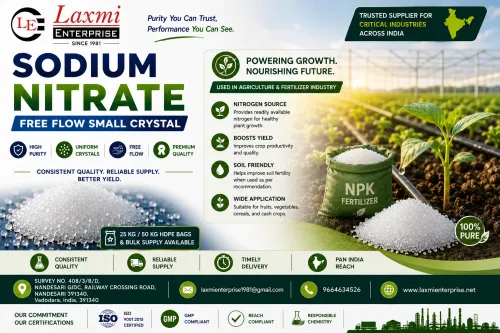
Standard Commercial Packing 25 kg Bag, 50 kg Bag, 500 kg Jumbo Bag
Where is Sodium Nitrate Free Flow Used?
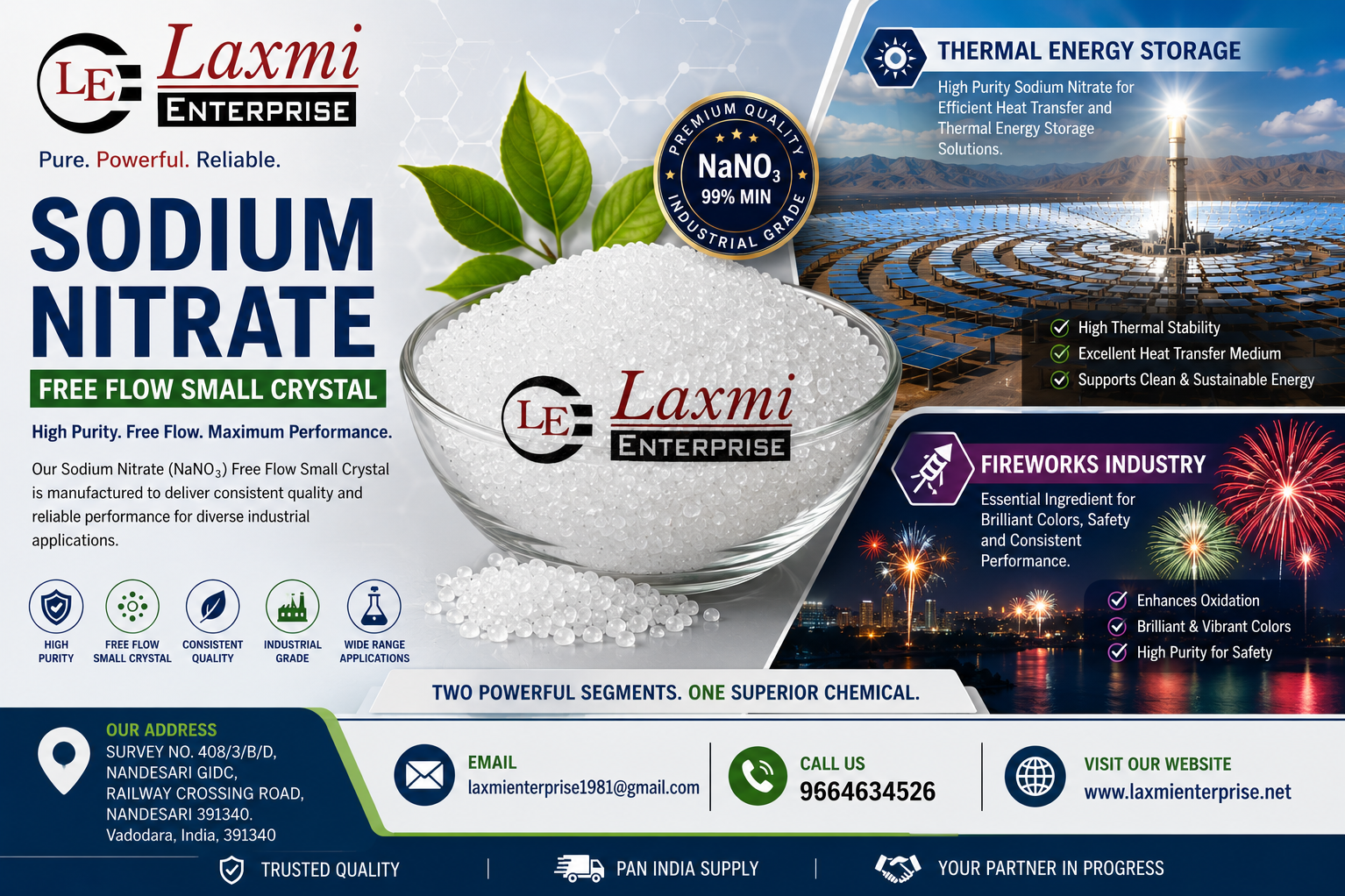
Because of its excellent chemical stability, high purity, and superior handling properties, Sodium Nitrate Free Flow is widely used in:
Chemical Processing Industry
Specialty Chemical Manufacturing
Glass Manufacturing
Automotive Glass Industry
Solar Glass Manufacturing
Ceramic Industry
Pigment Industry
Metal Refining
Heat Treatment
Thermal Energy Storage
Molten Salt Systems
Laboratory Chemical Manufacturing
Water Treatment Chemical Production
Fertilizer Manufacturing
Industrial Salt Blending
Each application has unique technical requirements, making it important to select the appropriate specification for the intended process.
Why Engineers Specify Free Flow Sodium Nitrate
Engineers focus on production efficiency rather than just chemical composition.
A Free Flow grade provides several operational advantages:
Reliable hopper discharge
Uniform screw feeder performance
Better pneumatic conveying
Faster material charging
Consistent batch preparation
Improved dissolution
Reduced production interruptions
Easier warehouse handling
Lower maintenance requirements
These practical advantages help improve manufacturing reliability.
Key Performance Characteristics
A quality Free Flow Sodium Nitrate should demonstrate:
High chemical purity
Uniform crystal size
Excellent flowability
Low moisture content
Stable bulk density
Rapid dissolution
Minimal dust generation
Good storage stability
Reliable batch consistency
Suitable industrial packaging
Together, these characteristics contribute to dependable production performance.
What Procurement Teams Look For
Professional procurement teams generally evaluate:
Product Quality
Chemical purity
Physical properties
Batch consistency
Documentation
Certificate of Analysis (COA)
Safety Data Sheet (SDS)
Product Specification
Batch Identification
Commercial Factors
Packaging options
Delivery reliability
Supply continuity
Technical support
Operational Factors
Warehouse handling
Storage stability
Inventory management
Production compatibility
Considering all these aspects helps support informed purchasing decisions.
Common Challenges in Industrial Plants
Manufacturers may encounter operational issues when raw materials do not meet expected quality standards.
Typical challenges include:
Poor material flow
Hopper blockages
Uneven dosing
Excessive moisture
Inconsistent particle size
Packaging damage
Product contamination
Batch-to-batch variation
Selecting a well-manufactured Free Flow product can help reduce these operational concerns.
How to Improve Production Efficiency
Industrial users can improve efficiency by:
Choosing the correct product specification.
Using appropriate packaging for consumption levels.
Following recommended storage practices.
Maintaining FIFO inventory.
Reviewing each shipment's COA.
Recording batch numbers during production.
Conducting regular warehouse inspections.
Working closely with reliable suppliers.
These practices support smoother operations and more consistent manufacturing outcomes.
Packaging Selection Matrix
Daily Consumption Recommended Packing
Up to 500 kg 25 kg Bags
500 kg – 2 MT 50 kg Bags
Above 2 MT 500 kg Jumbo Bags
The most suitable packaging depends on material handling methods, warehouse capacity, and production requirements.
Warehouse Checklist
Before placing Sodium Nitrate into storage, confirm:
✓ Warehouse is clean and dry.
✓ Pallets are available.
✓ Ventilation is adequate.
✓ Product labels are visible.
✓ Bags are free from damage.
✓ Batch numbers are recorded.
✓ FIFO system is implemented.
✓ Moisture exposure is minimized.
Regular warehouse inspections help preserve product quality.
Procurement Checklist
Before approving a supplier, verify:
Product specifications meet process requirements.
Product is a genuine Free Flow grade.
Standard packing is available in 25 kg, 50 kg, and 500 kg Jumbo Bags.
COA is supplied with each batch.
SDS is available.
Supplier maintains consistent quality.
Delivery schedules are reliable.
Technical support is accessible.
Product traceability is maintained.
Packaging is suitable for transportation and storage.
Expert Tips for First-Time Buyers
If you are purchasing Sodium Nitrate Free Flow for the first time:
Clearly define your application.
Confirm the required product grade.
Review technical specifications.
Request a sample COA.
Discuss storage recommendations with the supplier.
Select the appropriate packing size based on your daily consumption.
Evaluate the supplier's ability to provide long-term support.
Taking these steps helps reduce procurement risks and supports successful implementation.
Final Advanced FAQs
What makes Sodium Nitrate Free Flow different from standard Sodium Nitrate?
The Free Flow grade is manufactured to improve material handling by reducing caking, maintaining consistent flowability, and supporting automated feeding systems while retaining the same chemical identity as Sodium Nitrate.
Why do production managers prefer Free Flow materials?
Free Flow materials reduce handling issues such as bridging, uneven discharge, and manual intervention, helping maintain continuous production.
How can buyers evaluate a supplier before placing a bulk order?
Buyers should review product specifications, verify technical documentation, assess packaging quality, evaluate delivery performance, and consider the supplier's history of providing consistent product quality.
Which packing size is suitable for continuous production?
For many continuous production facilities, 50 kg Bags are widely used. Plants with high-volume automated material handling often choose 500 kg Jumbo Bags.
Does proper storage affect Free Flow performance?
Yes. Keeping the product in a cool, dry, and well-ventilated environment helps preserve its free-flowing characteristics and reduces the risk of moisture-related caking.
Why is technical documentation important for industrial customers?
Technical documents provide assurance that the supplied product meets specified quality requirements and support quality control, traceability, and regulatory compliance.
How can manufacturers improve consistency when using Sodium Nitrate Free Flow?
Using consistent batches, following recommended storage practices, maintaining accurate inventory records, and selecting a reliable supplier all contribute to stable production and repeatable manufacturing performance.
Chemical Identity at a Glance
Property Details
Product Name Sodium Nitrate Free Flow
Chemical Name Sodium Nitrate
Molecular Formula NaNO₃
Molecular Weight 84.99 g/mol
CAS Number 7631-99-4
EC Number 231-554-3
Chemical Classification Inorganic Nitrate Salt
Physical Form White Free-Flowing Crystalline Granules
Solubility Highly Soluble in Water
Odor Odorless
Oxidizing Property Yes
Standard Commercial Packing 25 kg Bag, 50 kg Bag, 500 kg Jumbo Bag
Where is Sodium Nitrate Free Flow Used?
Because of its excellent chemical stability, high purity, and superior handling properties, Sodium Nitrate Free Flow is widely used in:
Chemical Processing Industry
Specialty Chemical Manufacturing
Glass Manufacturing
Automotive Glass Industry
Solar Glass Manufacturing
Ceramic Industry
Pigment Industry
Metal Refining
Heat Treatment
Thermal Energy Storage
Molten Salt Systems
Laboratory Chemical Manufacturing
Water Treatment Chemical Production
Fertilizer Manufacturing
Industrial Salt Blending
Each application has unique technical requirements, making it important to select the appropriate specification for the intended process.
Why Engineers Specify Free Flow Sodium Nitrate
Engineers focus on production efficiency rather than just chemical composition.
A Free Flow grade provides several operational advantages:
Reliable hopper discharge
Uniform screw feeder performance
Better pneumatic conveying
Faster material charging
Consistent batch preparation
Improved dissolution
Reduced production interruptions
Easier warehouse handling
Lower maintenance requirements
These practical advantages help improve manufacturing reliability.
Key Performance Characteristics
A quality Free Flow Sodium Nitrate should demonstrate:
High chemical purity
Uniform crystal size
Excellent flowability
Low moisture content
Stable bulk density
Rapid dissolution
Minimal dust generation
Good storage stability
Reliable batch consistency
Suitable industrial packaging
Together, these characteristics contribute to dependable production performance.
What Procurement Teams Look For
Professional procurement teams generally evaluate:
Product Quality
Chemical purity
Physical properties
Batch consistency
Documentation
Certificate of Analysis (COA)
Safety Data Sheet (SDS)
Product Specification
Batch Identification
Commercial Factors
Packaging options
Delivery reliability
Supply continuity
Technical support
Operational Factors
Warehouse handling
Storage stability
Inventory management
Production compatibility
Considering all these aspects helps support informed purchasing decisions.
Common Challenges in Industrial Plants
Manufacturers may encounter operational issues when raw materials do not meet expected quality standards.
Typical challenges include:
Poor material flow
Hopper blockages
Uneven dosing
Excessive moisture
Inconsistent particle size
Packaging damage
Product contamination
Batch-to-batch variation
Selecting a well-manufactured Free Flow product can help reduce these operational concerns.
How to Improve Production Efficiency
Industrial users can improve efficiency by:
Choosing the correct product specification.
Using appropriate packaging for consumption levels.
Following recommended storage practices.
Maintaining FIFO inventory.
Reviewing each shipment's COA.
Recording batch numbers during production.
Conducting regular warehouse inspections.
Working closely with reliable suppliers.
These practices support smoother operations and more consistent manufacturing outcomes.
Packaging Selection Matrix
Daily Consumption Recommended Packing
Up to 500 kg 25 kg Bags
500 kg – 2 MT 50 kg Bags
Above 2 MT 500 kg Jumbo Bags
The most suitable packaging depends on material handling methods, warehouse capacity, and production requirements.
Warehouse Checklist
Before placing Sodium Nitrate into storage, confirm:
✓ Warehouse is clean and dry.
✓ Pallets are available.
✓ Ventilation is adequate.
✓ Product labels are visible.
✓ Bags are free from damage.
✓ Batch numbers are recorded.
✓ FIFO system is implemented.
✓ Moisture exposure is minimized.
Regular warehouse inspections help preserve product quality.
Procurement Checklist
Before approving a supplier, verify:
Product specifications meet process requirements.
Product is a genuine Free Flow grade.
Standard packing is available in 25 kg, 50 kg, and 500 kg Jumbo Bags.
COA is supplied with each batch.
SDS is available.
Supplier maintains consistent quality.
Delivery schedules are reliable.
Technical support is accessible.
Product traceability is maintained.
Packaging is suitable for transportation and storage.
Expert Tips for First-Time Buyers
If you are purchasing Sodium Nitrate Free Flow for the first time:
Clearly define your application.
Confirm the required product grade.
Review technical specifications.
Request a sample COA.
Discuss storage recommendations with the supplier.
Select the appropriate packing size based on your daily consumption.
Evaluate the supplier's ability to provide long-term support.
Taking these steps helps reduce procurement risks and supports successful implementation.
Final Advanced FAQs
What makes Sodium Nitrate Free Flow different from standard Sodium Nitrate?
The Free Flow grade is manufactured to improve material handling by reducing caking, maintaining consistent flowability, and supporting automated feeding systems while retaining the same chemical identity as Sodium Nitrate.
Why do production managers prefer Free Flow materials?
Free Flow materials reduce handling issues such as bridging, uneven discharge, and manual intervention, helping maintain continuous production.
How can buyers evaluate a supplier before placing a bulk order?
Buyers should review product specifications, verify technical documentation, assess packaging quality, evaluate delivery performance, and consider the supplier's history of providing consistent product quality.
Which packing size is suitable for continuous production?
For many continuous production facilities, 50 kg Bags are widely used. Plants with high-volume automated material handling often choose 500 kg Jumbo Bags.
Does proper storage affect Free Flow performance?
Yes. Keeping the product in a cool, dry, and well-ventilated environment helps preserve its free-flowing characteristics and reduces the risk of moisture-related caking.
Why is technical documentation important for industrial customers?
Technical documents provide assurance that the supplied product meets specified quality requirements and support quality control, traceability, and regulatory compliance.
How can manufacturers improve consistency when using Sodium Nitrate Free Flow?
Using consistent batches, following recommended storage practices, maintaining accurate inventory records, and selecting a reliable supplier all contribute to stable production and repeatable manufacturing performance.
Keywords