Sodium Nitrate in Chemical Manufacturing and Industrial Synthesis: Oxidation Chemistry, Process Engineering, Reactor Design, Process Optimization, Quality Control, and Sustainable Chemical Production
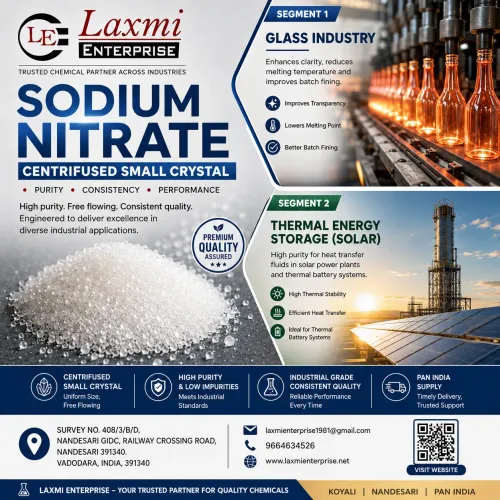
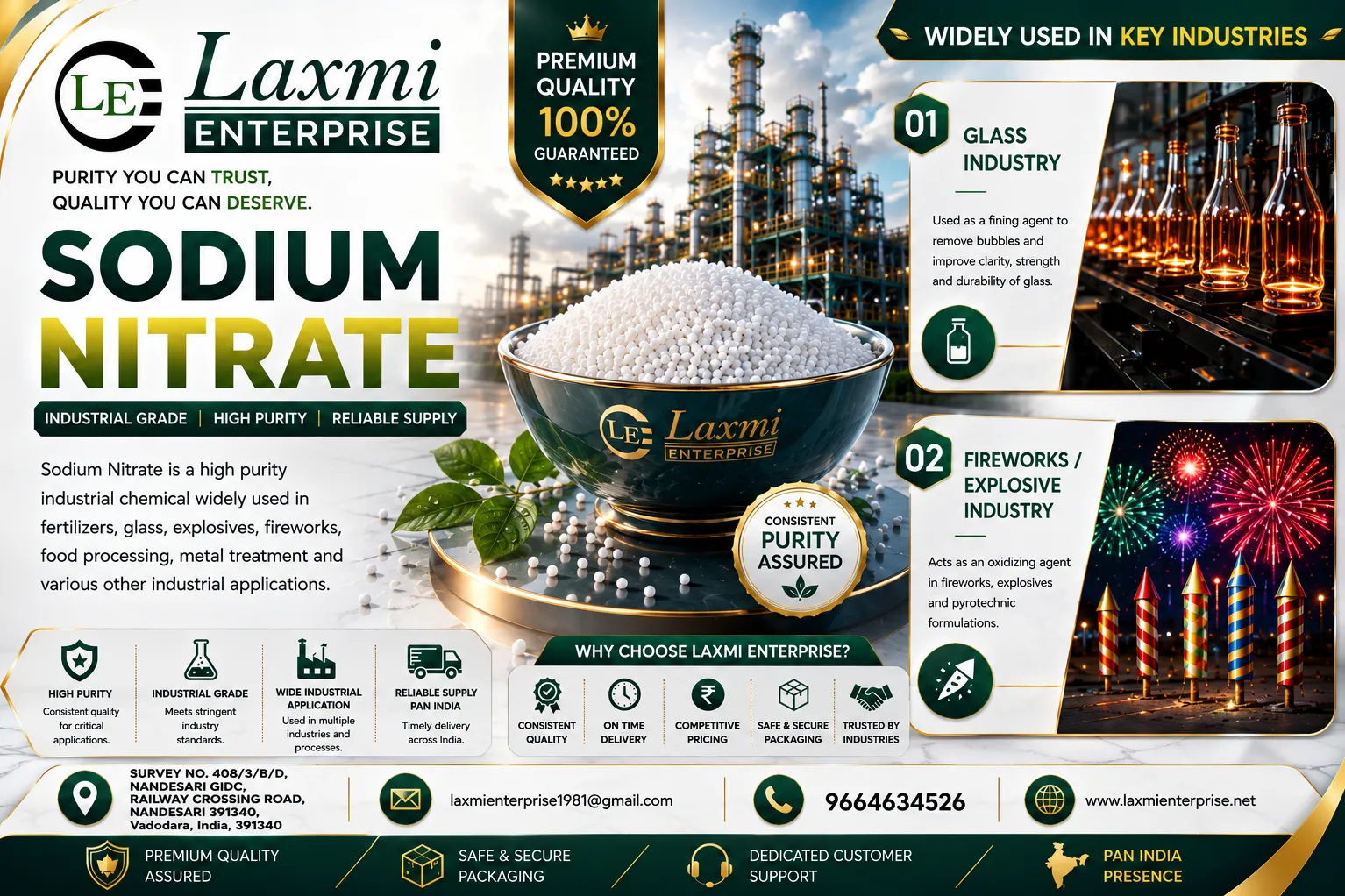
Chemical manufacturing is built upon the precise control of reactions, raw material quality, process conditions, and product consistency. Among the numerous inorganic chemicals used in industrial synthesis, sodium nitrate (NaNO₃) serves as an important oxidizing reagent and source of nitrate ions in a variety of legitimate industrial processes. Its predictable chemical behavior, good water solubility, high purity, and compatibility with many industrial systems make it valuable across multiple sectors of the chemical industry.
Unlike commodity raw materials used only as fillers or bulk additives, sodium nitrate often influences reaction pathways, product quality, and process efficiency. Manufacturers therefore evaluate not only its chemical composition but also particle size, moisture content, impurity profile, storage stability, and batch-to-batch consistency.
For process engineers, production managers, research scientists, procurement professionals, and quality specialists, understanding how sodium nitrate behaves within industrial manufacturing systems helps improve process reliability, reduce operating costs, and maintain consistent product quality.
This guide explores the role of sodium nitrate in industrial chemical manufacturing, process engineering, reactor operations, quality assurance, sustainability, and future technological developments.
The Role of Sodium Nitrate in Chemical Manufacturing
Sodium nitrate is used in industrial chemistry because it provides:
A reliable nitrate source
Predictable chemical behavior
High water solubility
Good storage stability
Consistent industrial quality
Its selection depends on the chemistry of the process, product specifications, regulatory requirements, and engineering design.
Chemical Properties Relevant to Manufacturing
Process engineers typically evaluate:
Chemical purity
Moisture content
Solubility
Bulk density
Particle size distribution
Flowability
Storage stability
Consistent material properties support repeatable manufacturing performance.
Industrial Process Development
Before commercial production begins, manufacturers normally progress through several stages:
Laboratory Research
Scientists evaluate reaction feasibility, raw material compatibility, and product characteristics.
Bench-Scale Studies
Small-scale experiments refine process variables and identify operational challenges.
Pilot Plant Trials
Pilot facilities assess process scalability, equipment performance, and product consistency.
Commercial Production
Validated processes are transferred to full-scale manufacturing with documented operating procedures and quality controls.
Process Engineering
Process engineering converts laboratory chemistry into reliable industrial manufacturing.
Key objectives include:
Stable production
Efficient resource utilization
Product consistency
Process safety
Cost optimization
Engineering decisions influence every stage of production.
Reactor Selection
The choice of reactor depends on:
Physical state of reactants
Reaction characteristics
Heat generation
Mixing requirements
Production capacity
Common industrial reactor types include:
Batch reactors
Continuous stirred systems
Plug flow systems
Multi-stage process reactors
The selection is based on process-specific engineering requirements.
Mixing and Agitation
Efficient mixing promotes:
Uniform reactant distribution
Consistent concentration
Improved heat transfer
Reduced localized variations
Mixing performance depends on impeller design, reactor geometry, fluid properties, and operating conditions.
Heat Transfer
Temperature control is critical in industrial chemical production.
Heat-transfer systems may include:
Steam heating
Cooling water
Thermal oil systems
Plate heat exchangers
Shell-and-tube heat exchangers
Proper thermal management supports product quality and process stability.
Mass Transfer
Many industrial reactions involve the movement of chemical species between phases.
Mass-transfer performance affects:
Reaction efficiency
Product uniformity
Production rate
Process economics
Equipment design seeks to maximize transfer efficiency while maintaining stable operation.
Process Monitoring
Modern chemical plants continuously monitor process variables such as:
Temperature
Pressure
Flow rate
Density
Conductivity
pH (where applicable)
Tank levels
Continuous monitoring enables rapid detection of deviations.
Process Automation
Automation enhances manufacturing through:
Programmable Logic Controllers (PLC)
Distributed Control Systems (DCS)
Supervisory Control and Data Acquisition (SCADA)
Recipe management
Alarm systems
Historical data recording
Automation improves repeatability and operational efficiency.
Process Optimization
Optimization seeks to improve:
Production yield
Resource utilization
Energy efficiency
Equipment productivity
Product consistency
Continuous improvement relies on process data, engineering expertise, and statistical analysis.
Quality Control During Production
Quality control begins with incoming raw materials and continues throughout manufacturing.
Typical evaluations include:
Identity verification
Purity testing
Moisture analysis
Process sampling
Final product testing
Documentation review
Consistent quality control supports reliable customer performance.
Laboratory Support
Manufacturing laboratories provide:
Raw material testing
In-process analysis
Finished product evaluation
Instrument calibration
Method verification
Batch release support
Close collaboration between production and laboratory teams improves overall process control.
Process Documentation
Accurate documentation supports:
Product traceability
Quality assurance
Regulatory compliance
Continuous improvement
Knowledge transfer
Typical records include:
Batch production records
Process parameters
Laboratory reports
Equipment maintenance logs
Change control documentation
Raw Material Storage
Proper storage preserves product quality.
Recommended practices include:
Dry storage conditions
Moisture-resistant packaging
Batch identification
Inventory rotation
Regular inspections
Storage conditions should align with the manufacturer's recommendations and applicable safety requirements.
Material Handling
Efficient handling systems improve:
Worker safety
Material flow
Inventory accuracy
Production efficiency
Handling methods should minimize contamination and product loss.
Waste Reduction
Chemical manufacturers increasingly focus on minimizing waste through:
Process optimization
Improved raw material utilization
Recycling where technically appropriate
Energy-efficient operations
Waste reduction supports both sustainability and operating cost improvements.
Energy Management
Energy-efficient manufacturing may include:
Heat recovery
Process integration
Variable-speed drives
High-efficiency motors
Optimized process scheduling
Reducing energy consumption enhances both profitability and environmental performance.
Risk Management
Chemical manufacturing requires structured risk assessment.
Risk management typically addresses:
Process deviations
Equipment failures
Supply chain interruptions
Utility outages
Product quality issues
Preventive planning improves operational resilience.
Research and Development
R& D teams support manufacturing by:
Improving existing processes
Developing new products
Evaluating alternative raw materials
Enhancing product performance
Increasing process efficiency
Innovation helps manufacturers remain competitive.
Digital Manufacturing
Industry 4.0 technologies increasingly support:
Real-time production monitoring
Predictive maintenance
Data analytics
AI-assisted optimization
Digital twins
Cloud-connected manufacturing
Digital systems improve operational visibility and decision-making.
Sustainability
Sustainable chemical manufacturing emphasizes:
Lower energy consumption
Efficient resource use
Reduced waste generation
Responsible water management
Continuous environmental improvement
Sustainability has become an important competitive advantage.
Supply Chain Integration
Close coordination between procurement, production, warehousing, and logistics helps:
Reduce lead times
Improve inventory accuracy
Support reliable customer deliveries
Increase production flexibility
Integrated planning improves overall business performance.
Selecting a Sodium Nitrate Supplier
Chemical manufacturers should evaluate suppliers based on:
Consistent purity
Batch-to-batch reliability
Moisture control
Technical documentation
Laboratory support
Supply continuity
Packaging quality
Technical expertise
Long-term supplier partnerships contribute to stable manufacturing operations.
Future Developments
Future innovation is expected to focus on:
AI-assisted process optimization
Autonomous manufacturing systems
Advanced process analytics
Digital quality prediction
Sustainable process engineering
Smart chemical factories
These developments will continue improving manufacturing efficiency and product consistency.
Conclusion
Sodium nitrate remains an important industrial raw material for a variety of legitimate chemical manufacturing processes because of its predictable chemical behavior, high purity, and reliable performance. Successful integration into manufacturing depends on sound process engineering, robust quality management, appropriate equipment selection, effective automation, and continuous optimization. As digital technologies, sustainability initiatives, and advanced process analytics become increasingly important, manufacturers that combine technical expertise with operational excellence will be better positioned to deliver consistent quality and long-term value to industrial customers.
Frequently Asked Questions (FAQ)
1. Why is sodium nitrate used in chemical manufacturing?
It provides a reliable nitrate source and predictable chemical behavior, making it suitable for various industrial synthesis and process applications where these properties are required.
2. What factors influence the selection of sodium nitrate for manufacturing?
Key considerations include chemical purity, moisture content, particle size distribution, storage stability, documentation, and batch-to-batch consistency.
3. Why is process automation important?
Automation improves process consistency, production efficiency, data collection, alarm management, and operational reliability.
4. How does laboratory support contribute to manufacturing?
Laboratories verify raw material quality, monitor in-process conditions, test finished products, calibrate instruments, and support batch release decisions.
5. Why is supplier consistency important?
Consistent raw material quality helps maintain stable production, predictable process performance, and reliable finished product quality.
6. How can manufacturers improve sustainability?
Through energy optimization, waste reduction, efficient resource utilization, water conservation, and continuous process improvement.
7. What role does digital manufacturing play?
Digital manufacturing provides real-time monitoring, predictive analytics, equipment diagnostics, and improved process control through connected systems.
8. What documentation should accompany industrial sodium nitrate?
Industrial buyers typically expect a Certificate of Analysis (COA), Technical Data Sheet (TDS), Safety Data Sheet (SDS), and batch traceability records.
Chemical manufacturing is built upon the precise control of reactions, raw material quality, process conditions, and product consistency. Among the numerous inorganic chemicals used in industrial synthesis, sodium nitrate (NaNO₃) serves as an important oxidizing reagent and source of nitrate ions in a variety of legitimate industrial processes. Its predictable chemical behavior, good water solubility, high purity, and compatibility with many industrial systems make it valuable across multiple sectors of the chemical industry.
Unlike commodity raw materials used only as fillers or bulk additives, sodium nitrate often influences reaction pathways, product quality, and process efficiency. Manufacturers therefore evaluate not only its chemical composition but also particle size, moisture content, impurity profile, storage stability, and batch-to-batch consistency.
For process engineers, production managers, research scientists, procurement professionals, and quality specialists, understanding how sodium nitrate behaves within industrial manufacturing systems helps improve process reliability, reduce operating costs, and maintain consistent product quality.
This guide explores the role of sodium nitrate in industrial chemical manufacturing, process engineering, reactor operations, quality assurance, sustainability, and future technological developments.
The Role of Sodium Nitrate in Chemical Manufacturing
Sodium nitrate is used in industrial chemistry because it provides:
A reliable nitrate source
Predictable chemical behavior
High water solubility
Good storage stability
Consistent industrial quality
Its selection depends on the chemistry of the process, product specifications, regulatory requirements, and engineering design.
Chemical Properties Relevant to Manufacturing
Process engineers typically evaluate:
Chemical purity
Moisture content
Solubility
Bulk density
Particle size distribution
Flowability
Storage stability
Consistent material properties support repeatable manufacturing performance.
Industrial Process Development
Before commercial production begins, manufacturers normally progress through several stages:
Laboratory Research
Scientists evaluate reaction feasibility, raw material compatibility, and product characteristics.
Bench-Scale Studies
Small-scale experiments refine process variables and identify operational challenges.
Pilot Plant Trials
Pilot facilities assess process scalability, equipment performance, and product consistency.
Commercial Production
Validated processes are transferred to full-scale manufacturing with documented operating procedures and quality controls.
Process Engineering
Process engineering converts laboratory chemistry into reliable industrial manufacturing.
Key objectives include:
Stable production
Efficient resource utilization
Product consistency
Process safety
Cost optimization
Engineering decisions influence every stage of production.
Reactor Selection
The choice of reactor depends on:
Physical state of reactants
Reaction characteristics
Heat generation
Mixing requirements
Production capacity
Common industrial reactor types include:
Batch reactors
Continuous stirred systems
Plug flow systems
Multi-stage process reactors
The selection is based on process-specific engineering requirements.
Mixing and Agitation
Efficient mixing promotes:
Uniform reactant distribution
Consistent concentration
Improved heat transfer
Reduced localized variations
Mixing performance depends on impeller design, reactor geometry, fluid properties, and operating conditions.
Heat Transfer
Temperature control is critical in industrial chemical production.
Heat-transfer systems may include:
Steam heating
Cooling water
Thermal oil systems
Plate heat exchangers
Shell-and-tube heat exchangers
Proper thermal management supports product quality and process stability.
Mass Transfer
Many industrial reactions involve the movement of chemical species between phases.
Mass-transfer performance affects:
Reaction efficiency
Product uniformity
Production rate
Process economics
Equipment design seeks to maximize transfer efficiency while maintaining stable operation.
Process Monitoring
Modern chemical plants continuously monitor process variables such as:
Temperature
Pressure
Flow rate
Density
Conductivity
pH (where applicable)
Tank levels
Continuous monitoring enables rapid detection of deviations.
Process Automation
Automation enhances manufacturing through:
Programmable Logic Controllers (PLC)
Distributed Control Systems (DCS)
Supervisory Control and Data Acquisition (SCADA)
Recipe management
Alarm systems
Historical data recording
Automation improves repeatability and operational efficiency.
Process Optimization
Optimization seeks to improve:
Production yield
Resource utilization
Energy efficiency
Equipment productivity
Product consistency
Continuous improvement relies on process data, engineering expertise, and statistical analysis.
Quality Control During Production
Quality control begins with incoming raw materials and continues throughout manufacturing.
Typical evaluations include:
Identity verification
Purity testing
Moisture analysis
Process sampling
Final product testing
Documentation review
Consistent quality control supports reliable customer performance.
Laboratory Support
Manufacturing laboratories provide:
Raw material testing
In-process analysis
Finished product evaluation
Instrument calibration
Method verification
Batch release support
Close collaboration between production and laboratory teams improves overall process control.
Process Documentation
Accurate documentation supports:
Product traceability
Quality assurance
Regulatory compliance
Continuous improvement
Knowledge transfer
Typical records include:
Batch production records
Process parameters
Laboratory reports
Equipment maintenance logs
Change control documentation
Raw Material Storage
Proper storage preserves product quality.
Recommended practices include:
Dry storage conditions
Moisture-resistant packaging
Batch identification
Inventory rotation
Regular inspections
Storage conditions should align with the manufacturer's recommendations and applicable safety requirements.
Material Handling
Efficient handling systems improve:
Worker safety
Material flow
Inventory accuracy
Production efficiency
Handling methods should minimize contamination and product loss.
Waste Reduction
Chemical manufacturers increasingly focus on minimizing waste through:
Process optimization
Improved raw material utilization
Recycling where technically appropriate
Energy-efficient operations
Waste reduction supports both sustainability and operating cost improvements.
Energy Management
Energy-efficient manufacturing may include:
Heat recovery
Process integration
Variable-speed drives
High-efficiency motors
Optimized process scheduling
Reducing energy consumption enhances both profitability and environmental performance.
Risk Management
Chemical manufacturing requires structured risk assessment.
Risk management typically addresses:
Process deviations
Equipment failures
Supply chain interruptions
Utility outages
Product quality issues
Preventive planning improves operational resilience.
Research and Development
R& D teams support manufacturing by:
Improving existing processes
Developing new products
Evaluating alternative raw materials
Enhancing product performance
Increasing process efficiency
Innovation helps manufacturers remain competitive.
Digital Manufacturing
Industry 4.0 technologies increasingly support:
Real-time production monitoring
Predictive maintenance
Data analytics
AI-assisted optimization
Digital twins
Cloud-connected manufacturing
Digital systems improve operational visibility and decision-making.
Sustainability
Sustainable chemical manufacturing emphasizes:
Lower energy consumption
Efficient resource use
Reduced waste generation
Responsible water management
Continuous environmental improvement
Sustainability has become an important competitive advantage.
Supply Chain Integration
Close coordination between procurement, production, warehousing, and logistics helps:
Reduce lead times
Improve inventory accuracy
Support reliable customer deliveries
Increase production flexibility
Integrated planning improves overall business performance.
Selecting a Sodium Nitrate Supplier
Chemical manufacturers should evaluate suppliers based on:
Consistent purity
Batch-to-batch reliability
Moisture control
Technical documentation
Laboratory support
Supply continuity
Packaging quality
Technical expertise
Long-term supplier partnerships contribute to stable manufacturing operations.
Future Developments
Future innovation is expected to focus on:
AI-assisted process optimization
Autonomous manufacturing systems
Advanced process analytics
Digital quality prediction
Sustainable process engineering
Smart chemical factories
These developments will continue improving manufacturing efficiency and product consistency.
Conclusion
Sodium nitrate remains an important industrial raw material for a variety of legitimate chemical manufacturing processes because of its predictable chemical behavior, high purity, and reliable performance. Successful integration into manufacturing depends on sound process engineering, robust quality management, appropriate equipment selection, effective automation, and continuous optimization. As digital technologies, sustainability initiatives, and advanced process analytics become increasingly important, manufacturers that combine technical expertise with operational excellence will be better positioned to deliver consistent quality and long-term value to industrial customers.
Frequently Asked Questions (FAQ)
1. Why is sodium nitrate used in chemical manufacturing?
It provides a reliable nitrate source and predictable chemical behavior, making it suitable for various industrial synthesis and process applications where these properties are required.
2. What factors influence the selection of sodium nitrate for manufacturing?
Key considerations include chemical purity, moisture content, particle size distribution, storage stability, documentation, and batch-to-batch consistency.
3. Why is process automation important?
Automation improves process consistency, production efficiency, data collection, alarm management, and operational reliability.
4. How does laboratory support contribute to manufacturing?
Laboratories verify raw material quality, monitor in-process conditions, test finished products, calibrate instruments, and support batch release decisions.
5. Why is supplier consistency important?
Consistent raw material quality helps maintain stable production, predictable process performance, and reliable finished product quality.
6. How can manufacturers improve sustainability?
Through energy optimization, waste reduction, efficient resource utilization, water conservation, and continuous process improvement.
7. What role does digital manufacturing play?
Digital manufacturing provides real-time monitoring, predictive analytics, equipment diagnostics, and improved process control through connected systems.
8. What documentation should accompany industrial sodium nitrate?
Industrial buyers typically expect a Certificate of Analysis (COA), Technical Data Sheet (TDS), Safety Data Sheet (SDS), and batch traceability records.
Keywords