Sodium Nitrate in Low-E Glass Manufacturing: Refining Chemistry, Coating Compatibility, Surface Energy, Defect Control, and Process Optimization for High-Performance Architectural Glass
Technical Audience: Glass Plant Managers • Furnace Engineers • Batch House Engineers • Process Engineers • Quality Managers • Procurement Teams • Architectural Glass Manufacturers • Coating Line Specialists • Façade Consultants
Introduction
Low-Emissivity (Low-E) glass has transformed the architectural glass industry by enabling buildings to become more energy-efficient, environmentally sustainable, and thermally comfortable. Today, Low-E glass is widely specified in commercial skyscrapers, airports, hospitals, luxury residences, green buildings, data centers, educational institutions, and industrial facilities. It plays a vital role in achieving certifications such as LEED, BREEAM, IGBC, and other green building standards by reducing heat transfer while maintaining high visible light transmission.
However, manufacturing premium Low-E glass requires much more than applying a metallic coating. The performance of the coating depends fundamentally on the quality of the underlying float glass substrate. Any defect introduced during glass melting—such as bubbles, seeds, cords, stones, inclusions, surface waviness, or chemical inhomogeneity—can reduce coating uniformity, optical appearance, temperability, and final product yield.
For this reason, leading float glass manufacturers focus heavily on batch chemistry, furnace stability, refining efficiency, and raw material consistency before the glass ever reaches the coating line.
In glass manufacturing processes where Sodium Nitrate (NaNO₃) is incorporated into the batch, it functions primarily as an oxidizing and refining agent. During melting, it helps maintain suitable oxidation conditions, supports the removal of dissolved gases, and contributes to the production of a cleaner and more homogeneous molten glass. These process improvements help provide a higher-quality substrate for downstream coating operations.
This article provides a detailed technical overview of Sodium Nitrate's role in Low-E glass manufacturing, including furnace chemistry, quality control, procurement strategy, and production optimization.
Technical Note: The exact batch formulation, refining system, and oxidizing agents vary among glass manufacturers. Sodium Nitrate is used where it is appropriate for the selected formulation and process design. The discussion below addresses its general engineering role rather than prescribing a universal recipe.
Understanding Low-E Glass
Low-E (Low Emissivity) glass is a high-performance glazing product designed to reduce infrared heat transfer while allowing a high percentage of visible light to pass through.
Unlike ordinary float glass, Low-E glass incorporates microscopically thin metallic or metal oxide coatings that modify the way the glass interacts with thermal radiation.
Typical performance objectives include:
High visible light transmission (VLT)
Low emissivity (ε)
Controlled Solar Heat Gain Coefficient (SHGC)
Improved U-value
Neutral appearance
Low reflectance (depending on coating design)
Long-term durability within insulated glazing units (IGUs)
The quality of these coatings depends significantly on the condition of the glass substrate.
How Low-E Glass Is Manufactured
A simplified manufacturing sequence is:
Raw Material Selection
↓
Batch Mixing
↓
Glass Melting
↓
Refining
↓
Float Bath Forming
↓
Annealing (Lehr)
↓
Inspection
↓
Online or Offline Low-E Coating
↓
Heat Treatment (when required)
↓
Insulated Glass Unit (IGU) Assembly
↓
Final Quality Inspection
Every stage influences the performance of the finished architectural glass.
Why the Float Glass Substrate Is Critical
Low-E coatings are typically only a few nanometers thick. Such thin functional layers magnify even small imperfections in the glass beneath them.
A poor substrate may contribute to:
Pinholes in coatings
Non-uniform optical appearance
Reduced coating adhesion
Localized haze
Increased visible defects
Higher rejection during inspection
Lower process yield
Producing a stable substrate begins with controlled melting and refining.
Engineering Role of Sodium Nitrate in Glass Refining
In formulations where Sodium Nitrate is used, it contributes during the melting stage through oxidation and refining mechanisms.
Its principal engineering functions include:
1. Supporting Oxidizing Furnace Conditions
An oxidizing atmosphere helps maintain appropriate redox conditions within the melt. Balanced oxidation chemistry is important for achieving consistent glass quality and controlling the behavior of certain multivalent elements present in the batch.
2. Assisting Gas Removal
During melting, decomposition of batch materials generates gases.
Examples include:
Carbon dioxide (CO₂)
Water vapor
Sulfur-containing gases (depending on formulation)
Oxygen released during refining reactions
Efficient refining encourages gas bubbles to coalesce, rise, and escape before the molten glass enters the forming stage.
3. Improving Melt Homogeneity
Uniform distribution of chemical constituents contributes to:
Stable refractive index
Reduced striae
Lower optical distortion
Better coating uniformity
Predictable tempering behavior
4. Supporting Continuous Furnace Operation
Large float glass furnaces operate continuously for years. Stable refining chemistry helps maintain consistent production conditions over extended campaigns, reducing variability between production lots.
Glass Defects That Can Affect Low-E Coating Quality
Seeds and Bubbles
Microscopic gas inclusions may become more noticeable after coating and can affect optical inspection or aesthetic acceptance.
Potential contributing factors
Incomplete refining
Temperature fluctuations
Excessive pull rate
Batch inconsistency
Insufficient residence time
Stones
Stones are unmelted or foreign particles embedded in the glass.
Possible sources include:
Refractory wear
Raw material contamination
Incomplete melting
These defects often require rejection because they interfere with coating uniformity and may compromise downstream processing.
Striae and Cords
Localized variations in composition or density can alter the path of transmitted light, reducing optical quality.
Potential causes include:
Inadequate homogenization
Furnace flow irregularities
Temperature gradients
Surface Distortion
Although many surface defects originate during forming or handling, refining quality influences the overall uniformity of the glass entering subsequent processes.
Low-E Coating Technologies
The architectural industry primarily uses two coating technologies:
Pyrolytic (Hard Coat)
Applied during float glass production
Durable and mechanically robust
Suitable for monolithic glazing in some applications
Magnetron Sputter Vacuum Deposition (Soft Coat)
Applied offline in a vacuum chamber
Multiple ultra-thin metallic layers
Superior thermal performance
Widely used in high-performance insulated glazing units
Both technologies benefit from a clean and consistent glass substrate.
Key Performance Indicators (KPIs) for Low-E Glass Manufacturers
Process engineers commonly monitor:
Manufacturing KPI Importance
Visible Light Transmission (VLT) Optical performance
Solar Heat Gain Coefficient (SHGC) Solar control
U-value Thermal insulation
Haze Optical clarity
Bubble density Refining efficiency
Surface waviness Coating quality
Thickness variation Product consistency
Coating adhesion Long-term durability
Furnace pull rate Production efficiency
Defect rate (ppm) Quality performance
These KPIs help optimize production and reduce waste.
Quality Control in Modern Float Glass Plants
Advanced manufacturing facilities employ multiple inspection stages, including:
Automated optical scanners
Laser thickness gauges
Bubble detection systems
Polarized light stress analysis
Surface defect cameras
Flatness measurement
Online coating inspection
Laboratory spectroscopy
Colorimetric analysis
Mechanical strength testing
These systems enable early detection of process deviations.
Procurement Strategy for Sodium Nitrate
For glass manufacturers, procurement decisions extend beyond purchase price. A reliable supplier contributes to process stability and long-term operational efficiency.
Evaluation criteria commonly include:
Product Quality
High chemical purity
Controlled moisture content
Uniform particle size
Low insoluble matter
Documentation
Certificate of Analysis (COA)
Batch traceability
Product specifications
Quality records
Supply Chain Reliability
Consistent availability
Nationwide logistics
Packaging integrity
Technical support
A dependable supply chain reduces the risk of production interruptions.
Storage and Handling Best Practices
To preserve quality:
Store in dry, covered warehouses.
Protect bags from moisture ingress.
Keep packaging sealed until use.
Follow FIFO (First In, First Out) inventory practices.
Segregate from incompatible materials in accordance with applicable safety guidance.
Inspect packaging before batch charging.
Proper storage helps maintain material consistency.
Why Glass Manufacturers Choose Laxmi Enterprise
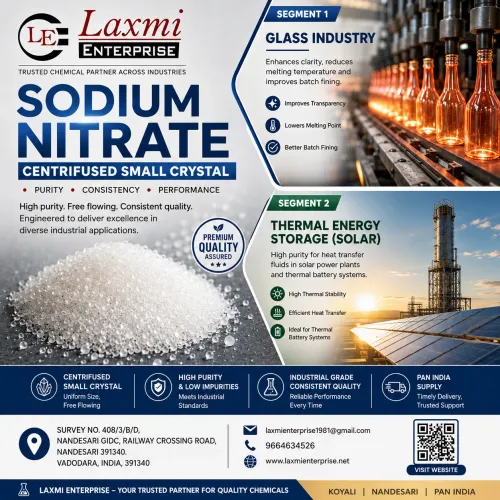
Laxmi Enterprise supplies industrial-grade Sodium Nitrate to manufacturers across India with a focus on quality consistency and dependable service.
Key strengths include:
Industrial-grade product quality
Batch-to-batch consistency
Reliable nationwide supply
Secure packaging
Certificate of Analysis (COA)
Responsive customer support
Timely dispatch
Long-term supply partnerships for continuous-process industries
Frequently Asked Questions (FAQ)
1. Why is substrate quality so important for Low-E coatings?
Low-E coatings are extremely thin and replicate the condition of the underlying glass. Surface defects, inclusions, or optical distortions in the substrate may become more apparent after coating and can affect appearance, coating uniformity, or downstream processing.
2. Does Sodium Nitrate improve the thermal performance of Low-E glass directly?
No. Thermal performance is primarily determined by the Low-E coating design, glazing configuration, and insulating glass unit construction. Sodium Nitrate contributes earlier in the process by supporting refining and producing a higher-quality glass substrate where it is part of the batch formulation.
3. Can refining quality influence coating yield?
Yes. Cleaner, more homogeneous glass generally reduces the likelihood of substrate-related coating defects, which can improve process efficiency and reduce rejection rates.
4. What are the most common substrate defects that affect coating operations?
Manufacturers monitor bubbles, seeds, stones, striae, cords, inclusions, scratches, surface waviness, and thickness variations because these defects may affect optical appearance or coating quality.
5. Why do continuous float furnaces require consistent raw materials?
Continuous furnaces operate for years without shutdown. Variations in raw material quality can influence melting behavior, refining efficiency, and furnace stability, making consistency a critical procurement requirement.
6. Is Sodium Nitrate used in every Low-E glass formulation?
No. Glass formulations differ between manufacturers and product types. The use of Sodium Nitrate depends on the specific batch design, refining strategy, and process requirements.
7. Which quality documents should accompany industrial Sodium Nitrate shipments?
Manufacturers typically expect a Certificate of Analysis (COA), batch number, product specifications, packing details, and other agreed quality documentation to support traceability and incoming inspection.
8. What role does process data play in defect reduction?
Modern plants use statistical process control (SPC), online sensors, automated inspection systems, and historical production data to identify trends, investigate root causes, and implement preventive actions before defects become widespread.
9. How does procurement influence glass quality?
Selecting a supplier based solely on price may increase process variability if product consistency is not maintained. Procurement teams increasingly evaluate suppliers on quality systems, technical support, logistics reliability, and long-term performance.
10. How should Sodium Nitrate be stored in a glass manufacturing facility?
It should be stored in a clean, dry environment in sealed packaging, protected from moisture and contamination, and handled according to applicable industrial safety procedures and the manufacturer's recommendations.
Conclusion
The manufacture of premium Low-E glass is a multidisciplinary process combining materials science, furnace engineering, coating technology, quality assurance, and supply chain management. Success depends on producing a defect-free float glass substrate capable of supporting advanced functional coatings without compromising optical or thermal performance.
Where incorporated into appropriate glass formulations, Sodium Nitrate contributes to oxidation control and melt refining, helping manufacturers achieve cleaner molten glass, improved homogeneity, and greater process consistency. Combined with disciplined process control, advanced inspection systems, and reliable raw material sourcing, it supports the production of high-performance architectural glass for modern energy-efficient buildings.
For manufacturers seeking industrial-grade Sodium Nitrate with consistent quality, dependable logistics, and technical documentation, Laxmi Enterprise serves industries across India with products designed to meet the demands of continuous-process glass manufacturing.
Keywords