

Sodium Nitrate in Solar Glass Manufacturing: Advanced Engineering of Ultra-Clear Glass, Optical Transmission, Furnace Stability, Process Control, and High-Performance Photovoltaic Glass
Solar photovoltaic (PV) glass is among the highest-value flat glass products manufactured today. Unlike conventional architectural float glass, solar glass is engineered to maximize light transmission, optical uniformity, mechanical durability, and long-term environmental stability. Every stage—from raw material selection and batch preparation to melting, forming, coating, tempering, and inspection—must be tightly controlled to achieve consistent performance.
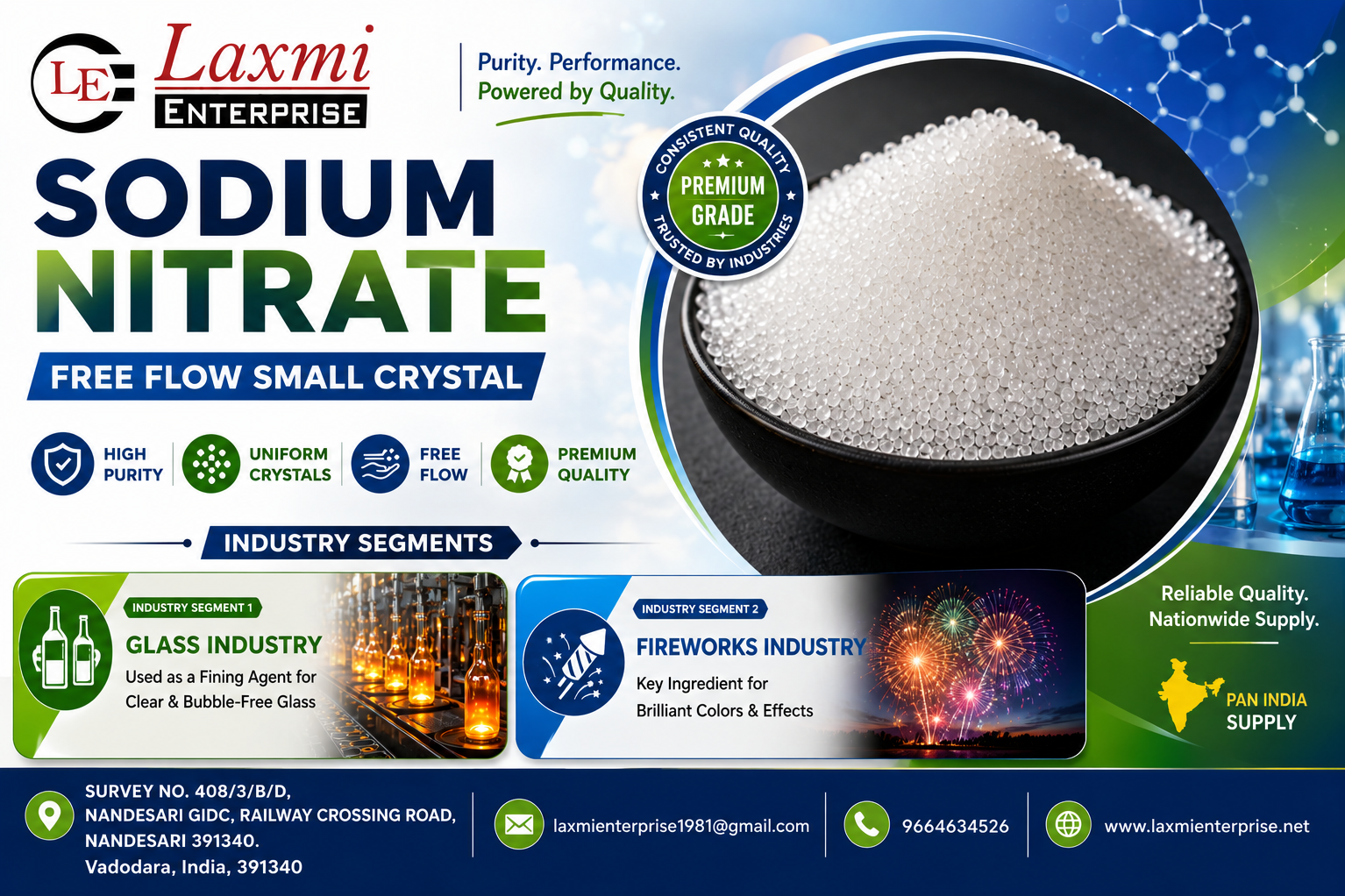
Within suitable glass formulations, sodium nitrate (NaNO₃) serves as a refining and oxidizing additive that contributes to melt quality and process stability. Its effectiveness depends on the complete glass composition, furnace operating conditions, and overall quality management system.
For solar glass manufacturers, procurement engineers, quality professionals, and production managers, consistent raw material quality is essential because even small variations can affect production efficiency, coating performance, and final product quality.
Evolution of Solar Glass Manufacturing
The first generations of photovoltaic modules primarily focused on electrical efficiency.
Modern PV manufacturers must now optimize multiple characteristics simultaneously:
High optical transmission
Low optical distortion
Surface uniformity
Mechanical strength
Long-term weather resistance
Coating compatibility
Dimensional precision
High-volume automated manufacturing
As global solar installations continue to grow, manufacturers increasingly emphasize production consistency alongside module performance.
What Makes Solar Glass Different?
Although solar glass is produced using float glass technology, its engineering objectives differ significantly.
Conventional architectural glass emphasizes:
Visual appearance
Flatness
Building performance
Solar glass additionally prioritizes:
Maximum sunlight transmission
Stable optical properties
Surface cleanliness
Compatibility with photovoltaic manufacturing
Long-term outdoor durability
This places greater demands on raw materials, furnace operation, and quality control.
The Science of Light Transmission
The primary function of PV glass is to allow as much sunlight as possible to reach the photovoltaic cells beneath it.
Optical performance depends on factors such as:
Glass composition
Surface quality
Internal homogeneity
Inclusion control
Bubble minimization
Coating compatibility
Manufacturers monitor these characteristics throughout production to maintain consistent product quality.
Engineering the Glass Batch
Every solar glass batch is designed to achieve repeatable melting behavior and consistent optical characteristics.
Typical objectives include:
Uniform chemical composition
Controlled moisture
Stable particle size distribution
Efficient melting
High melt homogeneity
Reliable refining
The quality of each raw material contributes to the overall performance of the batch.
Role of Sodium Nitrate in Suitable Solar Glass Formulations
Within appropriate formulations, sodium nitrate contributes to:
Supporting oxidizing furnace conditions
Assisting melt refinement
Improving melt uniformity
Helping reduce gaseous inclusions
Promoting stable furnace chemistry
Its role should be evaluated as part of the complete batch design rather than in isolation.
Raw Material Engineering
Solar glass manufacturers place strong emphasis on incoming raw material quality.
Important evaluation criteria include:
Batch-to-batch consistency
Chemical purity
Controlled moisture
Uniform particle size
Reliable documentation
Traceability
Consistency across all raw materials helps reduce process variation.
Particle Engineering and Batch Uniformity
Particle size distribution influences:
Batch mixing efficiency
Packing characteristics
Heat absorption
Melting consistency
Dust generation
Although particle size is only one factor, maintaining consistent distributions contributes to stable furnace performance.
Melt Homogeneity
Solar glass requires highly uniform molten glass.
Manufacturers seek to minimize:
Localized composition differences
Entrapped gas
Thermal gradients
Melt instability
Improved homogeneity supports better optical performance and downstream processing.
Bubble Control and Optical Quality
Gas inclusions can influence optical quality and production yield.
Manufacturers therefore optimize:
Batch consistency
Furnace operating conditions
Residence time
Refining efficiency
The goal is to produce glass with minimal visible imperfections.
Furnace Engineering
A solar glass furnace is designed to maintain:
Stable temperature profiles
Efficient combustion
Uniform heat distribution
Consistent glass levels
Reliable batch charging
Continuous monitoring helps maintain these conditions over long production campaigns.
Heat Transfer Mechanisms
Three forms of heat transfer influence glass production:
Radiation
Provides the majority of thermal energy within high-temperature furnaces.
Convection
Promotes mixing and thermal uniformity within the molten glass.
Conduction
Transfers heat through refractories and adjacent materials.
Understanding these mechanisms helps engineers optimize furnace efficiency.
Process Stability
Stable manufacturing depends on controlling variation.
Key objectives include:
Consistent furnace operation
Repeatable batch composition
Predictable melt behavior
Reliable forming conditions
Uniform optical properties
Reducing unnecessary variation improves production efficiency and product quality.
Online Quality Monitoring
Modern solar glass plants increasingly use automated inspection systems to evaluate:
Surface defects
Optical distortion
Thickness
Dimensional accuracy
Coating readiness
Real-time monitoring allows rapid identification of process deviations.
Coating Compatibility
Many photovoltaic modules use coated glass to enhance performance.
To support consistent coating application, manufacturers aim for:
Uniform surfaces
Controlled cleanliness
Stable optical characteristics
Consistent glass composition
Quality assurance before coating is therefore a critical production step.
Laboratory Quality Systems
Laboratories support manufacturing by verifying:
Incoming raw material quality
Batch verification
Finished glass characteristics
Documentation
Long-term quality trends
Analytical data enables informed production decisions.
Digital Manufacturing and Industry 4.0
Modern facilities increasingly integrate:
Manufacturing Execution Systems (MES)
Laboratory Information Management Systems (LIMS)
Enterprise Resource Planning (ERP)
AI-assisted process monitoring
Predictive maintenance
Digital production dashboards
These technologies improve traceability and operational visibility.
Procurement Engineering
Solar glass manufacturers typically evaluate suppliers based on:
Product consistency
Laboratory capability
Technical documentation
Traceability
Supply reliability
Technical support
Continuous improvement programs
A reliable supplier contributes to long-term manufacturing stability.
Sustainability in Solar Glass Production
Manufacturers continue to invest in:
Energy-efficient furnace operation
Waste heat recovery
Optimized raw material utilization
Reduced production waste
Digital energy management
Responsible supply chain practices
Sustainability initiatives improve both environmental performance and operational efficiency.
Future Technologies
The next generation of solar glass manufacturing is expected to include:
AI-assisted furnace optimization
Digital twins for process simulation
Machine-learning quality prediction
Automated defect classification
Smart supply chain analytics
Advanced optical inspection systems
These technologies will support greater consistency, efficiency, and scalability.
Technical Insight: Why Procurement Matters More in Solar Glass Than Standard Float Glass
Solar glass manufacturers often operate with tighter quality tolerances than conventional float glass producers because downstream photovoltaic performance depends on highly consistent glass properties.
This means procurement teams must evaluate suppliers not only on price but also on:
Long-term quality consistency
Laboratory competence
Traceability
Documentation quality
Process capability
Logistics reliability
A technically capable supplier helps reduce production variability and supports stable manufacturing.
Conclusion
Solar glass manufacturing combines materials science, furnace engineering, optical quality control, and advanced automation into one of the most sophisticated continuous manufacturing processes in the glass industry. Within suitable formulations, sodium nitrate supports melt refining and stable furnace chemistry, while overall product quality depends on the combined performance of all raw materials, process controls, and quality systems. Manufacturers that integrate disciplined procurement, digital manufacturing, laboratory excellence, and continuous improvement are best positioned to meet the growing demand for high-performance photovoltaic glass.
Frequently Asked Questions (FAQ)
1. How is solar glass different from conventional float glass?
Solar glass is engineered to maximize optical transmission, maintain high surface quality, and support photovoltaic module performance, whereas conventional float glass primarily serves architectural and general glazing applications.
2. Why is raw material consistency important in solar glass manufacturing?
Consistent raw materials help maintain stable melting behavior, uniform optical properties, reliable coating performance, and predictable manufacturing results.
3. What role can sodium nitrate play in suitable solar glass formulations?
It may function as a refining and oxidizing additive that supports melt quality and process stability, depending on the overall formulation and manufacturing process.
4. What production parameters influence optical quality?
Batch consistency, melt homogeneity, furnace stability, refining efficiency, surface quality, and inspection systems all contribute to optical performance.
5. Why are laboratory systems essential?
Laboratories verify raw material quality, support process monitoring, analyze finished glass, and provide documentation that supports consistent production.
6. How do digital manufacturing systems improve production?
MES, LIMS, ERP, AI-assisted monitoring, and predictive maintenance improve traceability, efficiency, and process control.
7. What should procurement teams evaluate when sourcing sodium nitrate?
Quality consistency, technical documentation, traceability, laboratory capability, logistics performance, and long-term supply reliability are key considerations.
8. What future technologies are shaping solar glass manufacturing?
AI-driven optimization, digital twins, advanced optical inspection, machine learning, and integrated smart manufacturing systems are expected to play increasingly important roles.