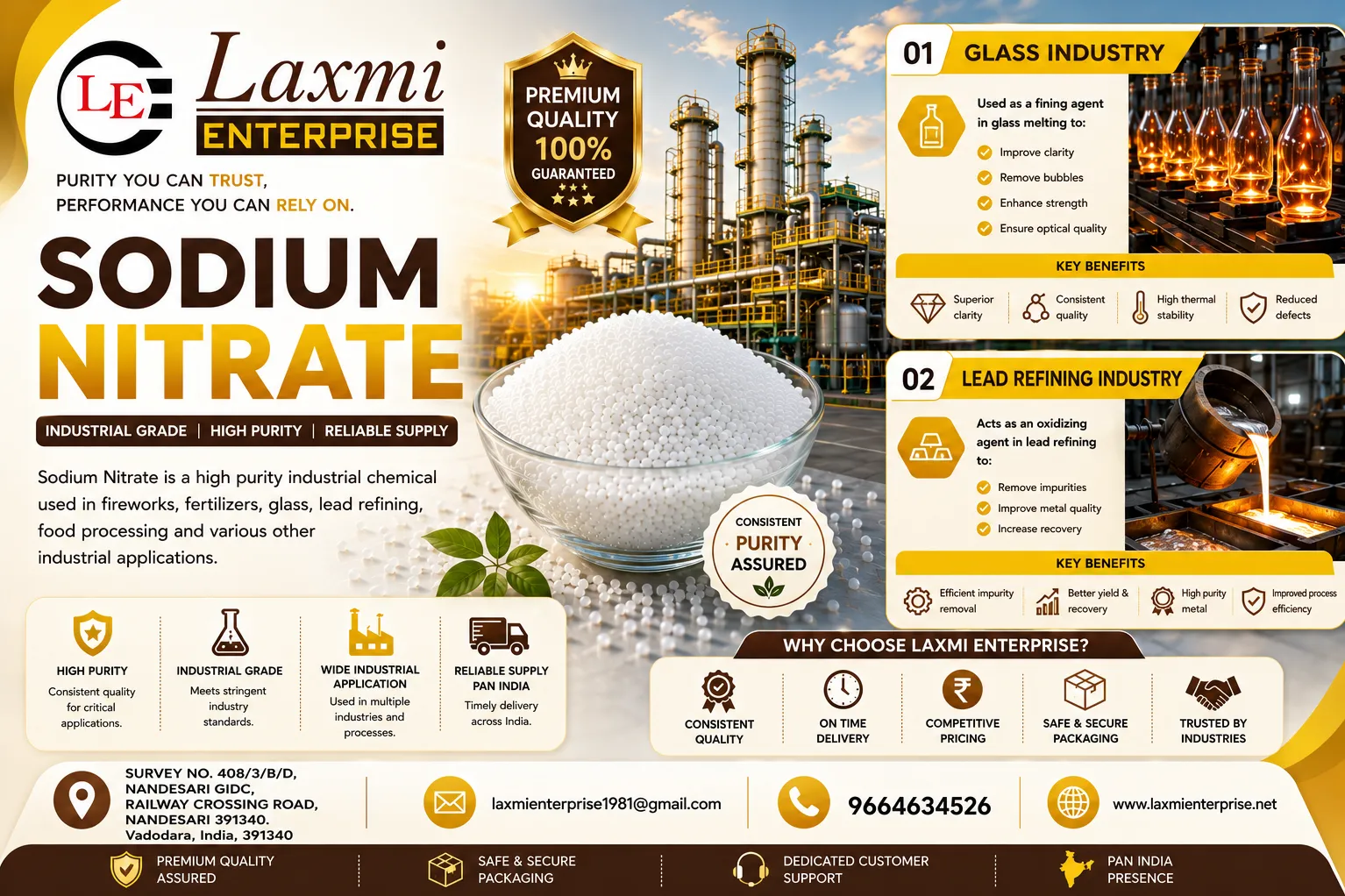
Sodium Nitrate Production Economics: Manufacturing Cost Analysis, Raw Material Optimization, Utility Cost Reduction, Capacity Planning, Lean Manufacturing, Six Sigma, Operational Excellence, and Industry 4.0
Manufacturing sodium nitrate at an industrial scale is not simply about producing a chemically pure product. The long-term success of a production facility depends on its ability to consistently manufacture high-quality sodium nitrate at the lowest sustainable cost while maintaining safety, environmental compliance, and customer satisfaction.
In today's competitive chemical industry, buyers evaluate suppliers on far more than price. They consider production reliability, quality consistency, supply continuity, logistics capability, technical support, inventory availability, sustainability initiatives, and operational excellence. Manufacturers that optimize production economics can invest more effectively in quality assurance, modern equipment, research and development, and customer service, creating a stronger competitive position.
Production economics combines chemical engineering, industrial engineering, financial management, operations research, and data analytics. It examines how raw materials, utilities, equipment, labor, maintenance, logistics, and process efficiency interact to determine the total manufacturing cost of sodium nitrate.
This comprehensive guide explains the engineering and economic principles that influence sodium nitrate production costs and how modern manufacturers improve profitability through continuous operational optimization.
Understanding Production Economics
Production economics evaluates the relationship between:
Manufacturing cost
Production efficiency
Resource utilization
Product quality
Plant capacity
Market competitiveness
The objective is not simply to reduce costs but to optimize the entire manufacturing system while maintaining product specifications and customer requirements.
Components of Manufacturing Cost
The total production cost of sodium nitrate consists of several major categories.
Raw Material Cost
Raw materials generally represent the largest portion of manufacturing cost.
This category includes:
Sodium-containing feedstocks
Nitric acid or nitrate sources
Process additives
Water used in production
Efficient procurement, supplier qualification, and inventory planning help reduce raw material costs without compromising quality.
Utility Cost
Utilities support every stage of production.
Major utility expenses include:
Steam
Electricity
Cooling water
Compressed air
Fuel
Process water
Utility optimization directly improves manufacturing profitability.
Labor Cost
Labor includes:
Production operators
Maintenance technicians
Laboratory personnel
Quality assurance staff
Process engineers
Supervisors
Modern automation allows skilled personnel to focus on process optimization rather than repetitive manual operations.
Maintenance Cost
Maintenance activities include:
Preventive maintenance
Predictive maintenance
Corrective maintenance
Spare parts management
Equipment calibration
Reliable maintenance programs reduce unexpected downtime and extend equipment life.
Packaging Cost
Packaging contributes significantly to the delivered product cost.
Typical components include:
Industrial bags
Bulk containers
Pallets
Stretch wrapping
Labels
Handling materials
Optimized packaging balances product protection, logistics efficiency, and customer requirements.
Logistics Cost
Transportation costs depend on:
Shipping distance
Freight mode
Fuel prices
Load optimization
Warehouse location
Delivery frequency
Strategically located inventory and optimized shipment planning reduce logistics expenses.
Fixed Costs and Variable Costs
Manufacturing costs are generally divided into two categories.
Fixed Costs
These remain relatively constant regardless of production volume.
Examples include:
Building depreciation
Equipment depreciation
Insurance
Administrative salaries
Property expenses
Variable Costs
Variable costs change with production volume.
Examples include:
Raw materials
Utilities
Packaging
Transportation
Production consumables
Improving variable cost efficiency has a direct impact on cost per tonne of sodium nitrate.
Cost per Tonne Analysis
One of the most widely used manufacturing indicators is cost per tonne.
This metric reflects the total manufacturing cost divided by the quantity of finished product produced.
Reducing cost per tonne requires improvements across multiple operational areas rather than focusing on a single expense category.
Capacity Utilization
Production facilities rarely operate continuously at maximum design capacity.
Capacity utilization measures how effectively available production capability is used.
Higher utilization generally results in:
Lower fixed cost allocation per tonne
Improved equipment productivity
Better labor efficiency
Enhanced return on investment
However, operating consistently above optimal capacity may increase maintenance requirements and reduce equipment reliability.
Bottleneck Analysis
Every manufacturing process contains at least one limiting operation known as the bottleneck.
Common bottlenecks include:
Evaporation capacity
Crystallization rate
Drying throughput
Packaging speed
Material handling systems
Identifying and improving bottlenecks increases overall plant productivity without necessarily expanding the entire facility.
Overall Equipment Effectiveness (OEE)
OEE is one of the most important performance indicators in modern manufacturing.
It evaluates:
Availability
The percentage of scheduled production time during which equipment is operating.
Performance
Comparison of actual production speed with the designed production rate.
Quality
The proportion of production meeting specification without rework.
Improving OEE increases production efficiency while reducing manufacturing costs.
Lean Manufacturing Principles
Lean manufacturing focuses on maximizing customer value while eliminating activities that do not add value.
The primary objective is to reduce waste throughout the production process.
Common forms of waste include:
Excess inventory
Waiting time
Unnecessary transportation
Overproduction
Rework
Excess motion
Unused employee knowledge
Lean principles improve efficiency without sacrificing quality.
Value Stream Mapping (VSM)
Value Stream Mapping is used to visualize the flow of materials and information throughout the manufacturing process.
A value stream map identifies:
Value-adding activities
Non-value-adding activities
Process delays
Inventory accumulation
Material movement
By analyzing the entire production flow, manufacturers can identify opportunities for improvement and eliminate inefficiencies.
Kaizen and Continuous Improvement
Kaizen is a philosophy of continuous, incremental improvement.
Rather than relying solely on large capital projects, Kaizen encourages regular small improvements in:
Equipment setup
Workplace organization
Process standardization
Material handling
Quality control
Over time, these incremental changes produce significant improvements in productivity and cost efficiency.
Six Sigma Methodology
Six Sigma is a structured approach to reducing process variation and improving quality.
The DMAIC framework includes:
Define
Measure
Analyze
Improve
Control
In sodium nitrate manufacturing, Six Sigma techniques can be applied to:
Crystal size consistency
Moisture control
Batch uniformity
Utility consumption
Packaging accuracy
Reducing variability improves both customer satisfaction and production economics.
Statistical Process Control (SPC)
SPC uses statistical methods to monitor manufacturing performance.
Control charts help identify:
Process drift
Abnormal variation
Equipment instability
Measurement errors
Early detection enables corrective action before off-specification product is produced.
Inventory Optimization
Maintaining excessive inventory increases:
Storage costs
Working capital requirements
Risk of product aging
Insufficient inventory increases the risk of stockouts and delayed deliveries.
Inventory optimization balances customer service with efficient capital utilization.
Procurement Strategy
Effective procurement extends beyond negotiating the lowest purchase price.
Key considerations include:
Supplier reliability
Material consistency
Lead time
Quality performance
Long-term partnerships
Supply chain resilience
Reliable suppliers contribute to stable production and reduced operational risk.
Energy Cost Reduction
Energy is one of the largest operating expenses in sodium nitrate production.
Common energy optimization strategies include:
Heat recovery systems
Multiple-effect evaporation
Variable frequency drives
High-efficiency motors
Steam trap maintenance
Improved insulation
Energy efficiency reduces operating costs and supports sustainability goals.
Water Management
Efficient water utilization lowers both operating costs and environmental impact.
Best practices include:
Condensate recovery
Process water recycling
Leak detection
Cooling water optimization
Water balance monitoring
Responsible water management is increasingly important for industrial operations.
Maintenance Economics
Maintenance should be viewed as an investment rather than a cost.
Predictive maintenance programs reduce:
Emergency repairs
Equipment downtime
Spare parts consumption
Production interruptions
Condition monitoring technologies improve maintenance planning and equipment reliability.
Digital Manufacturing
Industry 4.0 technologies enable manufacturers to make data-driven decisions.
Examples include:
Real-time production dashboards
Industrial Internet of Things (IIoT)
Artificial intelligence
Machine learning
Digital twins
Cloud-based analytics
Digital manufacturing improves process visibility and supports continuous optimization.
Sustainability and Cost Competitiveness
Sustainability initiatives often generate economic benefits through:
Lower energy consumption
Reduced waste
Improved material recovery
Efficient water use
Lower emissions
Better regulatory compliance
Sustainable manufacturing strengthens long-term competitiveness.
Capital Investment Decisions
Manufacturers regularly evaluate investments in:
New equipment
Process automation
Capacity expansion
Energy-efficient technologies
Quality control laboratories
Investment decisions are typically based on:
Return on Investment (ROI)
Payback period
Net Present Value (NPV)
Internal Rate of Return (IRR)
These financial tools help prioritize projects that deliver the greatest long-term value.
Benchmarking
Benchmarking compares plant performance against:
Internal historical data
Industry standards
Similar production facilities
Best-in-class manufacturers
Benchmarking identifies opportunities for operational improvement and supports strategic planning.
Risk Management
Economic performance is influenced by several external factors, including:
Raw material price volatility
Energy market fluctuations
Supply chain disruptions
Regulatory changes
Market demand
Currency exchange rates
Comprehensive risk management strategies improve business resilience.
Future Trends
The future of sodium nitrate production economics will be shaped by:
AI-assisted production scheduling
Autonomous process optimization
Predictive supply chain management
Smart energy grids
Carbon footprint optimization
Circular economy initiatives
Advanced manufacturing analytics
Manufacturers adopting these technologies are likely to achieve greater operational efficiency and long-term competitiveness.
Conclusion
Production economics in sodium nitrate manufacturing extends far beyond accounting. It integrates engineering, operations, quality management, maintenance, supply chain strategy, and digital technologies to optimize every aspect of production. By improving raw material utilization, reducing utility consumption, maximizing equipment effectiveness, and embracing continuous improvement methodologies such as Lean Manufacturing and Six Sigma, manufacturers can lower production costs while maintaining high product quality. In an increasingly competitive global market, operational excellence has become a defining factor in sustainable growth and customer confidence.
Frequently Asked Questions
Why is production economics important in sodium nitrate manufacturing?
Production economics helps manufacturers optimize costs, improve efficiency, maintain quality, and strengthen long-term competitiveness by integrating engineering, operational, and financial decision-making.
What typically contributes the most to manufacturing cost?
Raw materials and utilities often represent the largest share of production costs, followed by labor, maintenance, packaging, and logistics.
What is Overall Equipment Effectiveness (OEE)?
OEE is a key manufacturing performance indicator that measures equipment availability, production performance, and product quality to evaluate how effectively equipment is utilized.
How does Lean Manufacturing benefit chemical plants?
Lean Manufacturing reduces non-value-adding activities, minimizes waste, shortens production cycles, improves workflow, and enhances overall operational efficiency.
What is the purpose of Six Sigma in sodium nitrate production?
Six Sigma reduces process variation and improves consistency by using structured data analysis and continuous improvement techniques.
Why is capacity utilization important?
Higher capacity utilization spreads fixed costs across greater production output, improving cost efficiency while making better use of installed equipment.
How does Industry 4.0 improve production economics?
Industry 4.0 technologies provide real-time monitoring, predictive analytics, process automation, and data-driven optimization, enabling better operational decisions and lower manufacturing costs.
How do sustainability initiatives affect production costs?
Energy efficiency, water conservation, waste reduction, and material recovery often lower operating expenses while improving environmental performance and regulatory compliance.
Manufacturing sodium nitrate at an industrial scale is not simply about producing a chemically pure product. The long-term success of a production facility depends on its ability to consistently manufacture high-quality sodium nitrate at the lowest sustainable cost while maintaining safety, environmental compliance, and customer satisfaction.
In today's competitive chemical industry, buyers evaluate suppliers on far more than price. They consider production reliability, quality consistency, supply continuity, logistics capability, technical support, inventory availability, sustainability initiatives, and operational excellence. Manufacturers that optimize production economics can invest more effectively in quality assurance, modern equipment, research and development, and customer service, creating a stronger competitive position.
Production economics combines chemical engineering, industrial engineering, financial management, operations research, and data analytics. It examines how raw materials, utilities, equipment, labor, maintenance, logistics, and process efficiency interact to determine the total manufacturing cost of sodium nitrate.
This comprehensive guide explains the engineering and economic principles that influence sodium nitrate production costs and how modern manufacturers improve profitability through continuous operational optimization.
Understanding Production Economics
Production economics evaluates the relationship between:
Manufacturing cost
Production efficiency
Resource utilization
Product quality
Plant capacity
Market competitiveness
The objective is not simply to reduce costs but to optimize the entire manufacturing system while maintaining product specifications and customer requirements.
Components of Manufacturing Cost
The total production cost of sodium nitrate consists of several major categories.
Raw Material Cost
Raw materials generally represent the largest portion of manufacturing cost.
This category includes:
Sodium-containing feedstocks
Nitric acid or nitrate sources
Process additives
Water used in production
Efficient procurement, supplier qualification, and inventory planning help reduce raw material costs without compromising quality.
Utility Cost
Utilities support every stage of production.
Major utility expenses include:
Steam
Electricity
Cooling water
Compressed air
Fuel
Process water
Utility optimization directly improves manufacturing profitability.
Labor Cost
Labor includes:
Production operators
Maintenance technicians
Laboratory personnel
Quality assurance staff
Process engineers
Supervisors
Modern automation allows skilled personnel to focus on process optimization rather than repetitive manual operations.
Maintenance Cost
Maintenance activities include:
Preventive maintenance
Predictive maintenance
Corrective maintenance
Spare parts management
Equipment calibration
Reliable maintenance programs reduce unexpected downtime and extend equipment life.
Packaging Cost
Packaging contributes significantly to the delivered product cost.
Typical components include:
Industrial bags
Bulk containers
Pallets
Stretch wrapping
Labels
Handling materials
Optimized packaging balances product protection, logistics efficiency, and customer requirements.
Logistics Cost
Transportation costs depend on:
Shipping distance
Freight mode
Fuel prices
Load optimization
Warehouse location
Delivery frequency
Strategically located inventory and optimized shipment planning reduce logistics expenses.
Fixed Costs and Variable Costs
Manufacturing costs are generally divided into two categories.
Fixed Costs
These remain relatively constant regardless of production volume.
Examples include:
Building depreciation
Equipment depreciation
Insurance
Administrative salaries
Property expenses
Variable Costs
Variable costs change with production volume.
Examples include:
Raw materials
Utilities
Packaging
Transportation
Production consumables
Improving variable cost efficiency has a direct impact on cost per tonne of sodium nitrate.
Cost per Tonne Analysis
One of the most widely used manufacturing indicators is cost per tonne.
This metric reflects the total manufacturing cost divided by the quantity of finished product produced.
Reducing cost per tonne requires improvements across multiple operational areas rather than focusing on a single expense category.
Capacity Utilization
Production facilities rarely operate continuously at maximum design capacity.
Capacity utilization measures how effectively available production capability is used.
Higher utilization generally results in:
Lower fixed cost allocation per tonne
Improved equipment productivity
Better labor efficiency
Enhanced return on investment
However, operating consistently above optimal capacity may increase maintenance requirements and reduce equipment reliability.
Bottleneck Analysis
Every manufacturing process contains at least one limiting operation known as the bottleneck.
Common bottlenecks include:
Evaporation capacity
Crystallization rate
Drying throughput
Packaging speed
Material handling systems
Identifying and improving bottlenecks increases overall plant productivity without necessarily expanding the entire facility.
Overall Equipment Effectiveness (OEE)
OEE is one of the most important performance indicators in modern manufacturing.
It evaluates:
Availability
The percentage of scheduled production time during which equipment is operating.
Performance
Comparison of actual production speed with the designed production rate.
Quality
The proportion of production meeting specification without rework.
Improving OEE increases production efficiency while reducing manufacturing costs.
Lean Manufacturing Principles
Lean manufacturing focuses on maximizing customer value while eliminating activities that do not add value.
The primary objective is to reduce waste throughout the production process.
Common forms of waste include:
Excess inventory
Waiting time
Unnecessary transportation
Overproduction
Rework
Excess motion
Unused employee knowledge
Lean principles improve efficiency without sacrificing quality.
Value Stream Mapping (VSM)
Value Stream Mapping is used to visualize the flow of materials and information throughout the manufacturing process.
A value stream map identifies:
Value-adding activities
Non-value-adding activities
Process delays
Inventory accumulation
Material movement
By analyzing the entire production flow, manufacturers can identify opportunities for improvement and eliminate inefficiencies.
Kaizen and Continuous Improvement
Kaizen is a philosophy of continuous, incremental improvement.
Rather than relying solely on large capital projects, Kaizen encourages regular small improvements in:
Equipment setup
Workplace organization
Process standardization
Material handling
Quality control
Over time, these incremental changes produce significant improvements in productivity and cost efficiency.
Six Sigma Methodology
Six Sigma is a structured approach to reducing process variation and improving quality.
The DMAIC framework includes:
Define
Measure
Analyze
Improve
Control
In sodium nitrate manufacturing, Six Sigma techniques can be applied to:
Crystal size consistency
Moisture control
Batch uniformity
Utility consumption
Packaging accuracy
Reducing variability improves both customer satisfaction and production economics.
Statistical Process Control (SPC)
SPC uses statistical methods to monitor manufacturing performance.
Control charts help identify:
Process drift
Abnormal variation
Equipment instability
Measurement errors
Early detection enables corrective action before off-specification product is produced.
Inventory Optimization
Maintaining excessive inventory increases:
Storage costs
Working capital requirements
Risk of product aging
Insufficient inventory increases the risk of stockouts and delayed deliveries.
Inventory optimization balances customer service with efficient capital utilization.
Procurement Strategy
Effective procurement extends beyond negotiating the lowest purchase price.
Key considerations include:
Supplier reliability
Material consistency
Lead time
Quality performance
Long-term partnerships
Supply chain resilience
Reliable suppliers contribute to stable production and reduced operational risk.
Energy Cost Reduction
Energy is one of the largest operating expenses in sodium nitrate production.
Common energy optimization strategies include:
Heat recovery systems
Multiple-effect evaporation
Variable frequency drives
High-efficiency motors
Steam trap maintenance
Improved insulation
Energy efficiency reduces operating costs and supports sustainability goals.
Water Management
Efficient water utilization lowers both operating costs and environmental impact.
Best practices include:
Condensate recovery
Process water recycling
Leak detection
Cooling water optimization
Water balance monitoring
Responsible water management is increasingly important for industrial operations.
Maintenance Economics
Maintenance should be viewed as an investment rather than a cost.
Predictive maintenance programs reduce:
Emergency repairs
Equipment downtime
Spare parts consumption
Production interruptions
Condition monitoring technologies improve maintenance planning and equipment reliability.
Digital Manufacturing
Industry 4.0 technologies enable manufacturers to make data-driven decisions.
Examples include:
Real-time production dashboards
Industrial Internet of Things (IIoT)
Artificial intelligence
Machine learning
Digital twins
Cloud-based analytics
Digital manufacturing improves process visibility and supports continuous optimization.
Sustainability and Cost Competitiveness
Sustainability initiatives often generate economic benefits through:
Lower energy consumption
Reduced waste
Improved material recovery
Efficient water use
Lower emissions
Better regulatory compliance
Sustainable manufacturing strengthens long-term competitiveness.
Capital Investment Decisions
Manufacturers regularly evaluate investments in:
New equipment
Process automation
Capacity expansion
Energy-efficient technologies
Quality control laboratories
Investment decisions are typically based on:
Return on Investment (ROI)
Payback period
Net Present Value (NPV)
Internal Rate of Return (IRR)
These financial tools help prioritize projects that deliver the greatest long-term value.
Benchmarking
Benchmarking compares plant performance against:
Internal historical data
Industry standards
Similar production facilities
Best-in-class manufacturers
Benchmarking identifies opportunities for operational improvement and supports strategic planning.
Risk Management
Economic performance is influenced by several external factors, including:
Raw material price volatility
Energy market fluctuations
Supply chain disruptions
Regulatory changes
Market demand
Currency exchange rates
Comprehensive risk management strategies improve business resilience.
Future Trends
The future of sodium nitrate production economics will be shaped by:
AI-assisted production scheduling
Autonomous process optimization
Predictive supply chain management
Smart energy grids
Carbon footprint optimization
Circular economy initiatives
Advanced manufacturing analytics
Manufacturers adopting these technologies are likely to achieve greater operational efficiency and long-term competitiveness.
Conclusion
Production economics in sodium nitrate manufacturing extends far beyond accounting. It integrates engineering, operations, quality management, maintenance, supply chain strategy, and digital technologies to optimize every aspect of production. By improving raw material utilization, reducing utility consumption, maximizing equipment effectiveness, and embracing continuous improvement methodologies such as Lean Manufacturing and Six Sigma, manufacturers can lower production costs while maintaining high product quality. In an increasingly competitive global market, operational excellence has become a defining factor in sustainable growth and customer confidence.
Frequently Asked Questions
Why is production economics important in sodium nitrate manufacturing?
Production economics helps manufacturers optimize costs, improve efficiency, maintain quality, and strengthen long-term competitiveness by integrating engineering, operational, and financial decision-making.
What typically contributes the most to manufacturing cost?
Raw materials and utilities often represent the largest share of production costs, followed by labor, maintenance, packaging, and logistics.
What is Overall Equipment Effectiveness (OEE)?
OEE is a key manufacturing performance indicator that measures equipment availability, production performance, and product quality to evaluate how effectively equipment is utilized.
How does Lean Manufacturing benefit chemical plants?
Lean Manufacturing reduces non-value-adding activities, minimizes waste, shortens production cycles, improves workflow, and enhances overall operational efficiency.
What is the purpose of Six Sigma in sodium nitrate production?
Six Sigma reduces process variation and improves consistency by using structured data analysis and continuous improvement techniques.
Why is capacity utilization important?
Higher capacity utilization spreads fixed costs across greater production output, improving cost efficiency while making better use of installed equipment.
How does Industry 4.0 improve production economics?
Industry 4.0 technologies provide real-time monitoring, predictive analytics, process automation, and data-driven optimization, enabling better operational decisions and lower manufacturing costs.
How do sustainability initiatives affect production costs?
Energy efficiency, water conservation, waste reduction, and material recovery often lower operating expenses while improving environmental performance and regulatory compliance.
Keywords