

Sodium Nitrate (NaNO₃) for Bright Annealing
1. Overview
Sodium Nitrate, commonly known as Chile Saltpeter, is an oxidizing salt used in molten salt bath heat treatment — particularly in bright annealing and metal cleaning operations.
It helps achieve oxide-free, bright metallic surfaces by providing an oxygen-rich but controlled environment that prevents carbon contamination or surface dulling.
2. What Is Bright Annealing?
Bright Annealing is a heat treatment process conducted in a non-oxidizing or controlled atmosphere to:
Soften the metal
Relieve internal stresses
Improve ductility and formability
Preserve a bright, reflective metallic surface without scaling or oxidation
Bright annealing is used extensively for stainless steel, carbon steel, copper, brass, and alloy strips or wires.
3. Role of Sodium Nitrate in Bright Annealing
Sodium nitrate serves as a key component of salt bath mixtures used for:
Surface protection during annealing
Oxide removal from metal surfaces
Controlled oxidation to maintain surface brightness
Uniform heat transfer in the molten salt medium
4. Mechanism of Action
When heated (350–600°C), sodium nitrate partially decomposes to sodium nitrite (NaNO₂) and oxygen (O₂):
The liberated oxygen provides a mild oxidizing atmosphere that:
Removes residual carbon and oil films
Prevents surface discoloration
Produces a smooth, bright finish
This reaction helps maintain clean metallic surfaces during the heating and cooling cycles.
5. Common Salt Bath Compositions
Composition Typical Ratio (% by weight) Temperature Range (°C) Purpose
NaNO₃ – NaNO₂ 50 : 50 450–600 Bright annealing of steel/copper
NaNO₃ – KNO₃ 60 : 40 400–550 Uniform heating & oxide prevention
NaNO₃ – NaNO₂ – Na₂CO₃ 40 : 40 : 20 500–650 Annealing & cleaning combination
Exact composition depends on metal type and process conditions.
6. Advantages of Using Sodium Nitrate
* Prevents oxidation and scaling – maintains bright metallic finish
* Uniform heating – ensures consistent metallurgical structure
* Removes carbon and oil residues – produces clean surfaces
* Fast heat transfer – reduces cycle time and improves productivity
* Stable, reusable salt mixture – long bath life with easy maintenance
7. Typical Applications
Stainless steel strip and wire annealing
Copper and brass bright annealing
Carbon steel surface cleaning before plating or coating
Descaling and oxide removal prior to polishing or drawing
8. Operating Guidelines
Maintain bath temperature within 450–650°C depending on metal type.
Avoid overheating (>700°C) to prevent nitrate decomposition and gas evolution.
Regularly monitor nitrate/nitrite ratio for consistent oxidation potential.
Ensure adequate ventilation — thermal decomposition releases oxygen and minor nitrogen oxides.
9. Safety and Handling
Oxidizing material — avoid contact with organic matter, reducing agents, or combustibles.
Store in cool, dry, ventilated areas away from acids.
Use stainless steel or mild steel containers for molten baths.
10. Key Specifications (Industrial Grade Sodium Nitrate)
Property Typical Value
Appearance White crystalline solid
Purity (NaNO₃) 99% min
Moisture ≤0.5%
Insoluble matter ≤0.05%
pH (5% solution) 6.0–8.5
Melting point 308°C
Bulk density 1.4–1.5 g/cm³
* Summary: Why Sodium Nitrate for Bright Annealing
Parameter Benefit
Surface finish Produces clean, mirror-bright metal surfaces
Process efficiency Uniform heating and oxidation control
Cost-effectiveness Long-lasting, reusable salt bath
Compatibility Works for ferrous and non-ferrous metals
Safety Environmentally stable, low toxicity (with care)
Would you like me to prepare a technical data sheet (TDS) or marketing brochure content for
“Sodium Nitrate for Bright Annealing Applications” — including product specs, typical usage, and packaging (with Laxmi Enterprise branding)?
It would be perfect for your industrial chemicals catalog.
Industrial Sodium Nitrate – Heat Treatment Applications
1. Overview
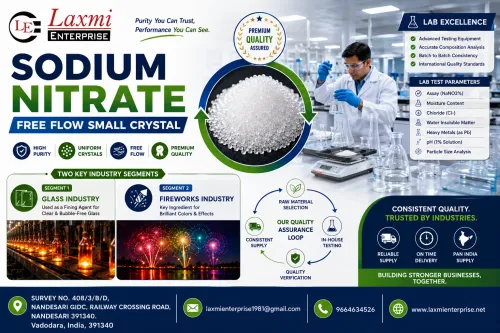
Sodium Nitrate (NaNO₃) is a strong oxidizing agent widely used in heat treatment salt baths for ferrous and non-ferrous metals.
It plays a crucial role in achieving clean, scale-free, and uniform metal surfaces during heating operations such as annealing, tempering, and quenching.
2. Role of Sodium Nitrate in Heat Treatment
Sodium nitrate is primarily used as a heat transfer medium and surface conditioner in molten salt baths.
When heated, it decomposes partially to sodium nitrite (NaNO₂), releasing oxygen that maintains a controlled oxidizing atmosphere:
This oxygen release helps:
Prevent carburization (carbon absorption)
Remove oil and scale from metal surfaces
Maintain bright, oxide-free finishes
Ensure uniform heating without hot spots
3. Major Heat Treatment Applications
a) Bright Annealing
Sodium nitrate–based salt baths are used for bright annealing of stainless steel, carbon steel, copper, and brass.
The bath provides a clean oxidizing environment, ensuring smooth, lustrous surfaces.
Typical composition:
NaNO₃ / NaNO₂ = 50:50
Temperature range: 450–650°C
b) Nitrate–Nitrite Salt Baths for Tempering
Used for tempering of tool steels and alloy steels after hardening.
The molten salt ensures fast and uniform heat transfer, minimizing distortion and cracking.
Composition examples:
NaNO₃ : NaNO₂ = 60 : 40
Operating range: 180–540°C
Produces bright, clean, oxide-free surfaces compared to air tempering.
c) Preheating and Equalizing Baths
Used as an intermediate bath between quenching and tempering operations.
Ensures uniform temperature equalization of workpieces before final heat treatment.
Provides smooth transition between process stages.
d) Martempering and Austempering (with Nitrite Blends)
Sodium nitrate–based salts are blended with sodium nitrite and potassium nitrate for precise temperature control in martempering and austempering operations.
These processes improve:
Toughness
Dimensional stability
Microstructure uniformity
Typical ranges:
Process Temperature (°C) Composition (NaNO₃ : NaNO₂ : KNO₃)
Martempering 300–400 30 : 50 : 20
Austempering 250–400 40 : 40 : 20
e) Cleaning and Descaling
Sodium nitrate baths effectively remove oxides, grease, and carbon residues from metal parts.
Common pre-treatment before plating, galvanizing, or polishing.
Operates between 400–500°C, ensuring a bright and uniform surface.
4. Key Advantages in Heat Treatment
Advantage Description
Uniform heating High thermal conductivity ensures even heat distribution
Oxide-free surfaces Prevents scaling and maintains brightness
Fast heat transfer Reduces process cycle time
Stable molten bath Long bath life and reusability
Controlled atmosphere Minimizes carburization and decarburization
Smooth operation Reduces distortion and surface roughness
5. Typical Physical & Chemical Properties
Property Value / Specification
Chemical Formula NaNO₃
Molecular Weight 85.00 g/mol
Appearance White crystalline solid
Purity 99% min
Melting Point 308°C
Density 1.4–1.5 g/cm³
Solubility in Water (20°C) 87 g/100 mL
pH (5% sol.) 6.0–8.5
Decomposition Temp. ~380°C
6. Safety & Handling
Sodium Sulphate for Glass Manufacturing
Sodium Sulphate for Kraft Process
Sodium Sulphate for Paper Industry
Industrial Chemicals for Glass Production
Request Sodium Sulphate Quote
Bulk Sodium Sulphate Pricing
Sodium Sulphate MSDS Download
REACH-Compliant Sodium Sulphate
Sodium Sulphate with COA and SGS
“Get a Free Quote Now”
“Download Product Specifications”
“Request SDS & COA”
“Talk to a Product Expert”
“Order a Sample Batch”
Oxidizing substance — avoid contact with organic matter or reducing agents.
Use stainless steel or mild steel crucibles for molten operations.
Ensure good ventilation to disperse nitrogen oxides.
Store in cool, dry areas away from moisture and combustible materials.
7. Packaging & Storage
Supplied in 25 / 50 kg HDPE bags with liners
Available in jumbo bags (1 MT) for bulk users
Store under dry, shaded conditions to prevent caking
8. Common Industrial Uses
Bright annealing of stainless steel, brass, copper
Tempering of tool steels and spring steels
Martempering & Austempering in automotive components
Cleaning and pre-treatment before electroplating and polishing
Heat transfer medium in molten salt furnaces
* Summary: Why Sodium Nitrate in Heat Treatment
Feature Industrial Benefit
Strong oxidizer Prevents carburization and scaling
Thermal stability Wide temperature range (200–650°C)
Reusable bath Cost-efficient and long-lasting
Clean surface finish Produces bright, oxide-free metal
Reliable performance Consistent results for ferrous & non-ferrous alloys