Sodium Nitrate Technical Specifications Complete Guide for Industrial Buyers
Technical specifications are one of the first documents reviewed by production managers, quality engineers and procurement teams before approving a new raw material. A well-prepared specification helps buyers understand whether a product is suitable for their manufacturing process and supports consistent communication between suppliers and customers.
For Sodium Nitrate, the technical specification is more than a product description. It provides a framework for quality expectations, purchasing decisions, incoming inspection and production planning.
Every industry has different technical requirements. A glass manufacturer may focus on consistency during melting, while a specialty chemical manufacturer may emphasize purity and process compatibility. Understanding which specification matters for your application helps avoid unnecessary costs and production challenges.
Why Technical Specifications Matter
A technical specification creates a common understanding between supplier and buyer.
It helps manufacturers
Select suitable raw materials.
Compare suppliers fairly.
Maintain production consistency.
Reduce quality disputes.
Support procurement decisions.
Improve incoming inspection procedures.
Strengthen quality management systems.
When specifications are clearly understood, communication becomes more efficient and production planning becomes more reliable.
Product Identification
Before reviewing detailed quality parameters, buyers should confirm the basic product information.
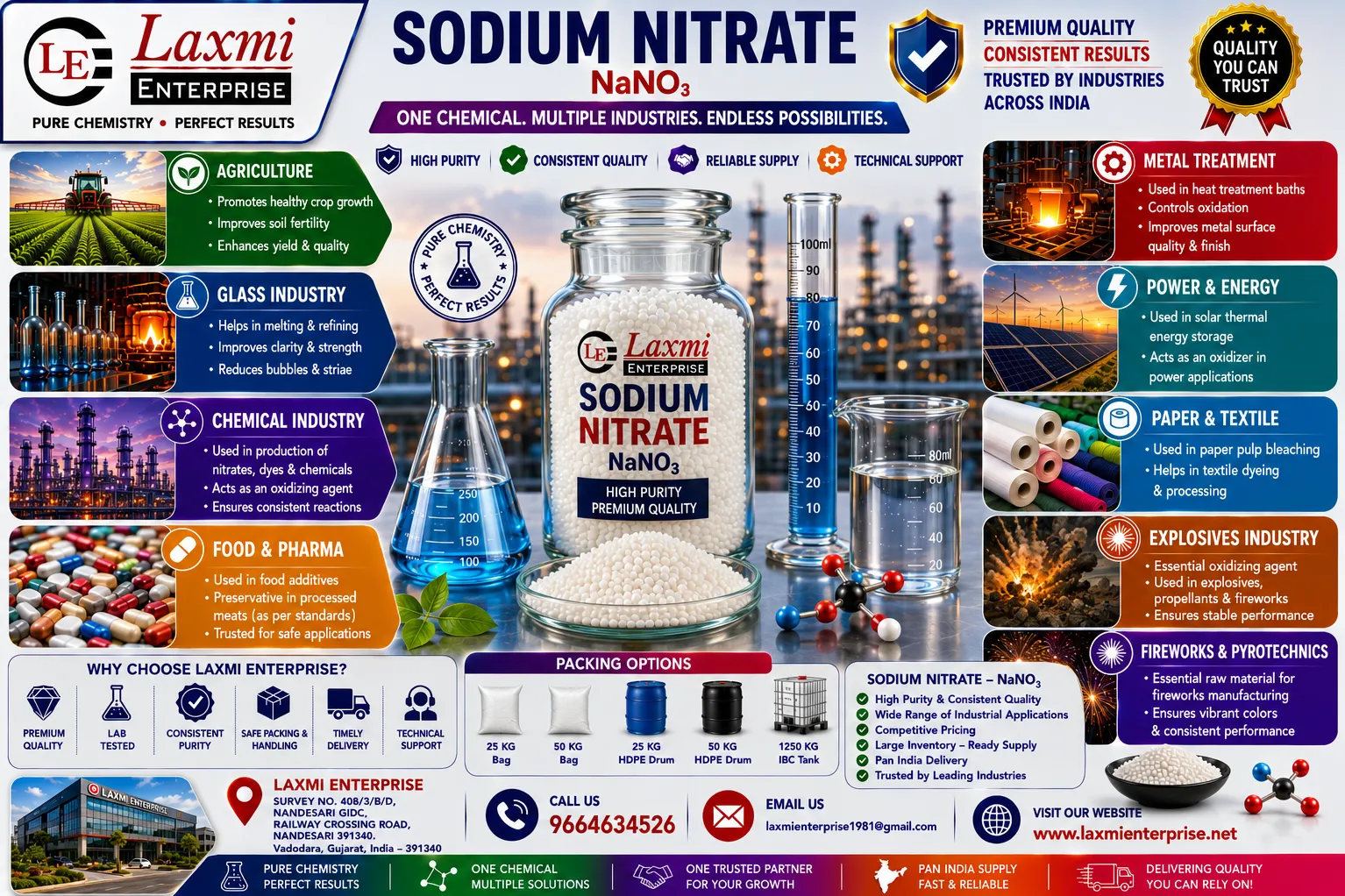
Product Name
Sodium Nitrate
Chemical Formula
NaNO3
Chemical Family
Inorganic Nitrate Salt
Appearance
White Crystalline Material
CAS Number
7631 99 4
Product Category
Industrial Chemical
Quality Parameters Commonly Reviewed
Different industries evaluate different characteristics. The following parameters are commonly reviewed as part of a technical specification.
Product Appearance
The material should have a uniform crystalline appearance appropriate for the agreed specification.
A consistent appearance supports easier visual inspection during receiving.
Purity
Purity is one of the most important quality characteristics.
The required purity depends on the customer's manufacturing process.
Rather than assuming one specification suits every application, buyers should confirm the appropriate grade for their production requirements.
Moisture Condition
Moisture influences storage behaviour and handling characteristics.
Proper storage and packaging help maintain free flowing material throughout the warehouse storage period.
Particle Size Distribution
Uniform particle size contributes to
Better material handling.
Improved blending.
Consistent feeding.
Reduced segregation during storage.
Predictable manufacturing performance.
Particle size requirements vary according to the application.
Water Solubility
High water solubility makes Sodium Nitrate suitable for numerous industrial applications.
Manufacturers requiring solution preparation often evaluate this characteristic as part of their procurement process.
Packaging Integrity
Technical quality includes packaging performance.
Industrial packaging should protect the product during transportation and storage.
Packaging should remain sealed until use.
Good packaging supports warehouse efficiency and inventory management.
Why Batch Consistency Is More Important Than a Single Analysis
Many buyers focus on one Certificate of Analysis.
Experienced manufacturers evaluate something more important.
Can the supplier maintain the same quality every month?
Batch consistency reduces production variation.
Production engineers can maintain established operating conditions.
Warehouse management becomes easier.
Incoming inspections become more predictable.
Long term consistency often provides greater manufacturing value than one excellent shipment.
Technical Specifications Should Match the Application
No single specification is ideal for every customer.
Glass manufacturers may prioritize one set of quality characteristics.
Heat treatment companies may evaluate different properties.
Chemical manufacturers may focus on consistency and documentation.
Research laboratories may have different purchasing criteria.
The correct specification always depends on the intended application.
Procurement Checklist Before Approval
Before approving a supplier, buyers should confirm
Product identification.
Specification suitability.
Packaging requirements.
Commercial quantity.
Delivery schedule.
Documentation requirements.
Inventory availability.
Supplier capability.
Long term supply support.
This checklist helps reduce procurement uncertainty.
Documentation That Supports Technical Evaluation
Professional suppliers generally provide documentation appropriate to commercial agreements and customer requirements.
This may include
Product specification.
Commercial invoice.
Delivery documentation.
Batch identification.
Certificate of Analysis where agreed.
Supporting quality documentation when applicable.
Organized documentation strengthens traceability and quality management.
Storage Recommendations
Proper storage helps preserve technical quality.
Store indoors.
Protect from moisture.
Maintain clean warehouse conditions.
Keep packaging sealed.
Use appropriate stock rotation.
Avoid physical damage to packaging.
Following good warehouse practices helps maintain product quality until production.
Technical Advice for Industrial Buyers
Many procurement teams compare only commercial quotations.
Experienced buyers compare specifications first.
Two products with similar prices may perform differently if their specifications do not match production requirements.
Understanding technical specifications before purchasing helps manufacturers avoid unnecessary operational issues.
Expert Observation
Companies with strong quality systems rarely approve a new Sodium Nitrate supplier based only on commercial discussions.
They review specifications.
Compare documentation.
Conduct incoming inspection.
Evaluate supplier consistency over time.
This disciplined approach supports stable manufacturing and strengthens supplier relationships.
How Laxmi Enterprise Supports Technical Procurement
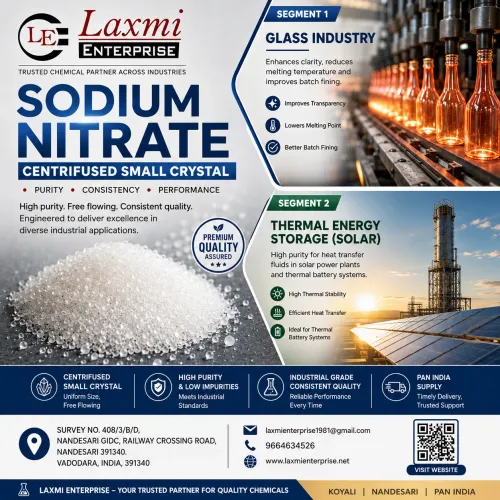
Laxmi Enterprise supplies industrial grade Sodium Nitrate from Nandesari GIDC, Vadodara to manufacturers across India.
We understand that technical purchasing requires more than commercial quotations.
Our approach focuses on
Consistent product quality.
Professional documentation.
Reliable deliveries.
Organized packaging.
Responsive customer support.
Long term business relationships.
We work closely with customers to understand their manufacturing requirements and support dependable procurement decisions.
Final Thoughts
Technical specifications provide the foundation for successful industrial purchasing.
Manufacturers who understand specification requirements are better positioned to select suitable products, reduce procurement risks and maintain consistent production.
Reliable specifications, dependable supply and strong communication create long term manufacturing confidence.
Frequently Asked Questions About Sodium Nitrate Specifications
What is a Sodium Nitrate technical specification
It is a document that describes the product identification, quality characteristics and other information required by buyers before approving the material for industrial use.
Why are technical specifications important
They help manufacturers evaluate product suitability, compare suppliers and support consistent production.
Does every industry require the same specification
No. The appropriate specification depends on the manufacturing process and intended application.
What quality characteristics are commonly reviewed
Appearance, purity, particle size, moisture condition, packaging quality and documentation are commonly reviewed.
Is product appearance enough to approve material
No. Visual inspection is useful, but manufacturers generally follow additional quality procedures according to their internal requirements.
Why is batch consistency important
Consistent batches help maintain repeatable production and reduce unnecessary process adjustments.
Should buyers compare specifications before comparing price
Yes. Product suitability should always be confirmed before commercial evaluation.
Can specifications vary between suppliers
Yes. Buyers should review supplier documentation carefully to confirm that the product meets their production requirements.
What documentation supports technical evaluation
Depending on commercial agreements, documentation may include product specifications, commercial documents, batch information and Certificate of Analysis where applicable.
How should Sodium Nitrate be stored after delivery
Store in a dry, clean warehouse with sealed packaging and proper inventory management.
Does packaging influence product quality
Yes. Proper packaging helps protect the material during transportation and storage.
Can Laxmi Enterprise provide technical support
Laxmi Enterprise works with industrial customers to understand application requirements and provide professional commercial support for Sodium Nitrate supply.
About Laxmi Enterprise
Laxmi Enterprise is a manufacturer, supplier and distributor of industrial chemicals located at Survey No. 408/3/B/D, Nandesari GIDC, Railway Crossing Road, Nandesari, Vadodara, Gujarat 391340.
We supply Sodium Nitrate, Sodium Sulphate, Sodium Acetate, Tri Sodium Phosphate and other industrial chemicals to manufacturers across India. Our focus is on consistent product quality, organized logistics, responsive customer support and long term industrial partnerships that help manufacturers maintain reliable production.
Keywords