Seawater Salt for Textile Applications
Overview
Seawater Salt, also known as Crude Solar Salt or Marine Salt, is a naturally evaporated form of sodium chloride (NaCl) obtained from seawater through solar evaporation.
It is widely used in textile dyeing and processing due to its excellent solubility, availability, and cost-effectiveness.
In the textile industry, seawater salt functions primarily as an electrolyte and leveling agent in the dyeing of cotton and blended fabrics using reactive and direct dyes.
Role in Textile Processing
1. Dye Fixation Agent
Promotes the exhaustion of dye from solution to fabric by neutralizing the repulsion between negatively charged dye molecules and fibers.
Ensures uniform dye penetration and improves shade consistency.
2. Leveling Agent
Minimizes patchy or uneven dyeing during the reactive dyeing process.
Helps achieve smooth, reproducible color shades on both cotton and viscose fabrics.
3. Electrolyte Substitute
Acts as a cost-effective alternative to refined vacuum salt.
Provides sufficient ionic strength for efficient dye uptake in bulk processing.
Applications in Textile Industry
Reactive dyeing of cotton, rayon, and viscose fabrics
Direct dyeing of blended textiles
Pre-treatment and scouring operations
Salt washing and finishing baths
Packaging Options
50 kg HDPE bags
1 MT jumbo bags (for bulk dyehouses)
Custom moisture-controlled packing on request
Major Textile Applications in Gujarat
Gujarat’s textile hubs heavily use seawater salt due to proximity to salt works and dyeing units:
Surat: Synthetic and polyester dyeing
Ahmedabad: Cotton and blended fabrics
Vadodara & Bharuch: Reactive dye and textile chemical manufacturing
SEO Keywords (for website/catalog use)
Seawater salt for textile dyeing
Marine salt for reactive dyeing
Textile grade salt supplier in Gujarat
Solar salt manufacturer Vadodara
Crude salt for textile industry India
Seawater salt supplier Surat
Sodium Sulfate for Reactive Dyeing
Overview
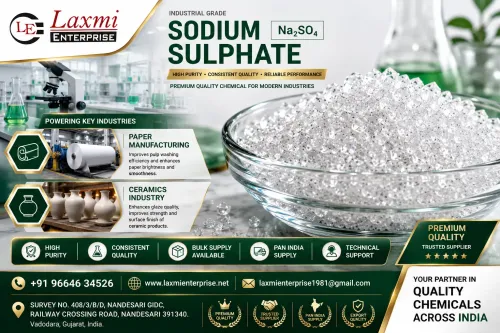
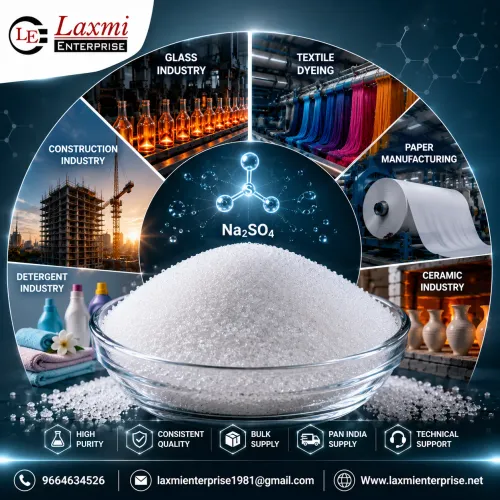
Sodium Sulfate (Na₂SO₄), also known as Glauber’s Salt, is an essential auxiliary chemical in the reactive dyeing of cotton and cellulosic fabrics.
It acts as an electrolyte that facilitates uniform dye absorption, enhances fixation efficiency, and ensures bright, consistent shades.
Compared to common salt (NaCl), Sodium Sulfate is less
corrosive to equipment, more consistent in purity, and
environmentally safer for textile effluent systems.
Role in Reactive Dyeing
1. Dye Exhaust Promoter
Reduces electrostatic repulsion between negatively charged dye molecules and fiber surfaces.
Ensures even dye migration and consistent shade buildup.
2. Leveling Agent
Improves color uniformity and prevents patchy or uneven dyeing.
Helps achieve reproducible shades across dye lots.
3. High Solubility & Compatibility
Dissolves completely in dye baths without residue.
Compatible with all major reactive dye brands (vinyl sulfone, MCT, bifunctional).
4. Eco-friendly Substitute
Produces lower chloride load compared to sodium chloride, reducing environmental impact in effluent treatment plants.
- sodium sulphate supplier
- sodium sulphate manufacturer
- sodium sulphate exporter
- bulk sodium sulphate
- industrial sodium sulphate
- sodium sulphate price
- sodium sulphate supplier in Vadodara
- sodium sulphate manufacturer in Gujarat
- buy sodium sulphate in India
- sodium sulphate exporter Asia Pacific
- Informational: what is sodium sulphate, uses of sodium sulphate
- Commercial: sodium sulphate price per kg, supplier comparison
- Transactional: buy sodium sulphate online, bulk sodium sulphate for sale
- Long-tail: sodium sulphate for detergents, sodium sulphate for glass industry
Sodium Sulfate for Paper Pulping Industries
Overview
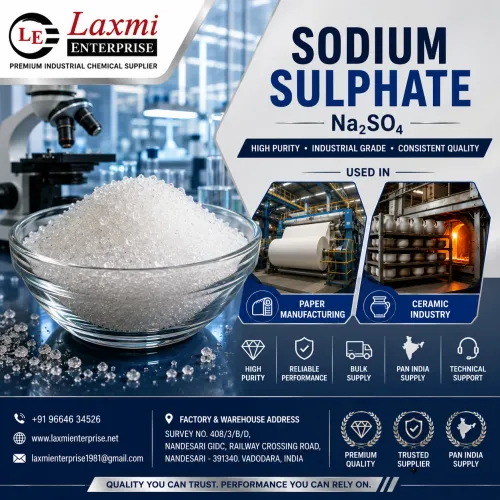
Sodium Sulfate (Na₂SO₄), also known as Glauber’s Salt, is a key chemical used in the Kraft (Sulfate) pulping process for paper manufacturing.
It serves as a make-up chemical in the recovery cycle, helping regenerate the pulping chemicals required for efficient fiber separation and high-strength paper production.
Its consistent purity, stability, and solubility make it a reliable component for kraft paper, duplex boards, corrugated sheets, and writing & printing paper industries.
Role in Paper Pulping
1. Make-up Chemical in Kraft Process
Sodium Sulfate is reduced to Sodium Sulfide (Na₂S) in the recovery furnace.
This regenerated Sodium Sulfide reacts with Sodium Hydroxide to produce the white liquor, which digests wood chips into pulp.
2. Fiber Strength & Quality
Promotes stronger cellulose fibers, resulting in superior strength, brightness, and tear resistance in finished paper.
3. Chemical Recovery Balance
Maintains the sodium-sulfur balance in the recovery system of pulp mills.
Enhances sustainability by enabling closed-loop chemical recovery with minimal waste discharge.
4. Environmental Advantage
Non-toxic, non-corrosive, and fully recyclable within the kraft pulping cycle.
Overview
Seawater Salt, also known as Crude Solar Salt or Marine Salt, is a naturally evaporated form of sodium chloride (NaCl) obtained from seawater through solar evaporation.
It is widely used in textile dyeing and processing due to its excellent solubility, availability, and cost-effectiveness.
In the textile industry, seawater salt functions primarily as an electrolyte and leveling agent in the dyeing of cotton and blended fabrics using reactive and direct dyes.
Role in Textile Processing
1. Dye Fixation Agent
Promotes the exhaustion of dye from solution to fabric by neutralizing the repulsion between negatively charged dye molecules and fibers.
Ensures uniform dye penetration and improves shade consistency.
2. Leveling Agent
Minimizes patchy or uneven dyeing during the reactive dyeing process.
Helps achieve smooth, reproducible color shades on both cotton and viscose fabrics.
3. Electrolyte Substitute
Acts as a cost-effective alternative to refined vacuum salt.
Provides sufficient ionic strength for efficient dye uptake in bulk processing.
Applications in Textile Industry
Reactive dyeing of cotton, rayon, and viscose fabrics
Direct dyeing of blended textiles
Pre-treatment and scouring operations
Salt washing and finishing baths
Packaging Options
50 kg HDPE bags
1 MT jumbo bags (for bulk dyehouses)
Custom moisture-controlled packing on request
Major Textile Applications in Gujarat
Gujarat’s textile hubs heavily use seawater salt due to proximity to salt works and dyeing units:
Surat: Synthetic and polyester dyeing
Ahmedabad: Cotton and blended fabrics
Vadodara & Bharuch: Reactive dye and textile chemical manufacturing
SEO Keywords (for website/catalog use)
Seawater salt for textile dyeing
Marine salt for reactive dyeing
Textile grade salt supplier in Gujarat
Solar salt manufacturer Vadodara
Crude salt for textile industry India
Seawater salt supplier Surat
Sodium Sulfate for Reactive Dyeing
Overview
Sodium Sulfate (Na₂SO₄), also known as Glauber’s Salt, is an essential auxiliary chemical in the reactive dyeing of cotton and cellulosic fabrics.
It acts as an electrolyte that facilitates uniform dye absorption, enhances fixation efficiency, and ensures bright, consistent shades.
Compared to common salt (NaCl), Sodium Sulfate is less
corrosive to equipment, more consistent in purity, and
environmentally safer for textile effluent systems.
Role in Reactive Dyeing
1. Dye Exhaust Promoter
Reduces electrostatic repulsion between negatively charged dye molecules and fiber surfaces.
Ensures even dye migration and consistent shade buildup.
2. Leveling Agent
Improves color uniformity and prevents patchy or uneven dyeing.
Helps achieve reproducible shades across dye lots.
3. High Solubility & Compatibility
Dissolves completely in dye baths without residue.
Compatible with all major reactive dye brands (vinyl sulfone, MCT, bifunctional).
4. Eco-friendly Substitute
Produces lower chloride load compared to sodium chloride, reducing environmental impact in effluent treatment plants.
- sodium sulphate supplier
- sodium sulphate manufacturer
- sodium sulphate exporter
- bulk sodium sulphate
- industrial sodium sulphate
- sodium sulphate price
- sodium sulphate supplier in Vadodara
- sodium sulphate manufacturer in Gujarat
- buy sodium sulphate in India
- sodium sulphate exporter Asia Pacific
- Informational: what is sodium sulphate, uses of sodium sulphate
- Commercial: sodium sulphate price per kg, supplier comparison
- Transactional: buy sodium sulphate online, bulk sodium sulphate for sale
- Long-tail: sodium sulphate for detergents, sodium sulphate for glass industry
Sodium Sulfate for Paper Pulping Industries
Overview
Sodium Sulfate (Na₂SO₄), also known as Glauber’s Salt, is a key chemical used in the Kraft (Sulfate) pulping process for paper manufacturing.
It serves as a make-up chemical in the recovery cycle, helping regenerate the pulping chemicals required for efficient fiber separation and high-strength paper production.
Its consistent purity, stability, and solubility make it a reliable component for kraft paper, duplex boards, corrugated sheets, and writing & printing paper industries.
Role in Paper Pulping
1. Make-up Chemical in Kraft Process
Sodium Sulfate is reduced to Sodium Sulfide (Na₂S) in the recovery furnace.
This regenerated Sodium Sulfide reacts with Sodium Hydroxide to produce the white liquor, which digests wood chips into pulp.
2. Fiber Strength & Quality
Promotes stronger cellulose fibers, resulting in superior strength, brightness, and tear resistance in finished paper.
3. Chemical Recovery Balance
Maintains the sodium-sulfur balance in the recovery system of pulp mills.
Enhances sustainability by enabling closed-loop chemical recovery with minimal waste discharge.
4. Environmental Advantage
Non-toxic, non-corrosive, and fully recyclable within the kraft pulping cycle.
Keywords