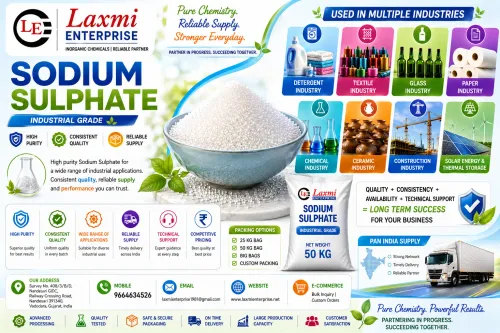

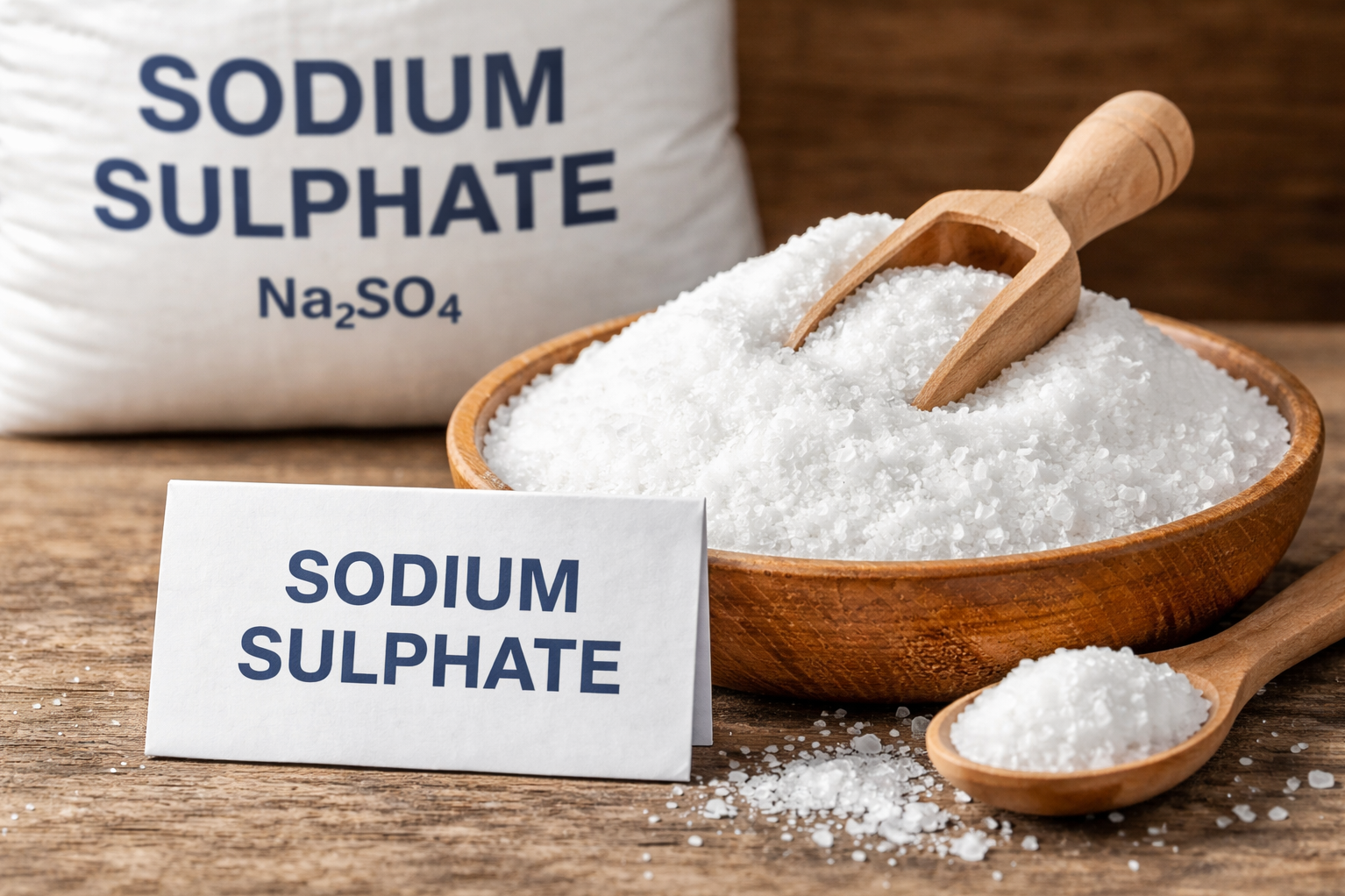
SODIUM SULFATE SUPPLY AND INDUSTRIAL GRADE SUPPLIERS
Chemical Name: Sodium Sulfate
Formula: Na₂SO₄
HSN (India): 283311 / 283319
Grades:
- Industrial Grade (Anhydrous / Glauber’s Salt)
- Detergent Grade
- Technical Grade
Major Industrial Applications
- Detergent & soap manufacturing
- Glass industry (flux & fining agent)
- Textile dyeing & kraft pulping
- Chemical intermediates
- Power plant & industrial wastewater treatment
- Paper & pulp industry
Nirma Limited – Gujarat
- Detergent & industrial grade
- Bulk tanker & jumbo bag supply
Gujarat Alkalies and Chemicals Ltd (GACL) – Gujarat
- High-purity industrial grade
- Consistent bulk supply
Aditya Birla Chemicals – Gujarat
- Industrial & specialty chemical applications
Tata Chemicals Ltd
- Stable quality for glass and detergent industries
Meghmani Organics Ltd – Gujarat
- Industrial grade with export capability
Vishnu Chemicals
Deepak Nitrite (linked sourcing)
Saurashtra Chemicals
Local Gujarat-based sulfate recovery units
- Sichuan Hongya Qingyi Chemical
- Hunan Yuanxing Chemical
- Guangxi Liuzhou Chemical
- Henan Jinshan Chemical
- Nordenham (Germany)
- Cooper Natural Resources (USA)
- Lenzing AG (Austria) – high purity applications
Anhydrous powder
Granular detergent grade
Decahydrate (Glauber’s salt)
25 kg / 50 kg bags
Jumbo bags (1 MT)
Bulk tanker (for large detergent plants)
- Domestic: ₹6–14/kg (bulk industrial grade)
- Imported (China CIF): USD 90–160/MT
- (Prices vary with purity, logistics, and volume)
Na₂SO₄: ≥ 98–99%
Moisture: ≤ 0.5%
Insoluble matter: ≤ 0.2%
Chloride: ≤ 0.5%
Gujarat suppliers offer lowest logistics cost for Vadodara & western India
Glass & detergent customers prefer low chloride content
Wastewater treatment buyers accept slightly lower purity at better price
Keep MSDS, COA, and HSN clarity ready for bulk buyers
Typical Sulfate Range:
- 1,000 – 50,000 mg/L (chemical, dye, pharma, power, mining)
Main Sources in Chemical Plants
- Sulfuric acid neutralization
- Sodium sulfate / ammonium sulfate processes
- Nitration, sulfonation reactions
- Brine regeneration & scrubber blowdown
- RO reject / ZLD streams
Chemical: BaCl₂ / Ba(OH)₂
Reaction:
Ba²⁺ + SO₄²⁻ → BaSO₄↓
- Very low solubility → high removal efficiency
- Used for high sulfate brines & RO reject
Sulfate <100 mg/L achievable
High chemical cost, toxic Ba handling
Industrial Use: Final polishing stage
Chemicals: Lime + Aluminum salts
pH: 10.5–11.5
- Converts sulfate into ettringite crystals
- Effective for 5,000–30,000 mg/L
- Common in ZLD chemical plants
Process:
SO₄²⁻ → H₂S (via sulfate-reducing bacteria)
- Requires carbon source (ethanol, acetate)
- Anaerobic reactors (UASB, AnMBR)
Nanofiltration (NF)
- Selective sulfate rejection
- Used as pretreatment to RO
Reverse Osmosis (RO)
- High sulfate rejection (>98%)
- Standard in ZLD plants
- Neutralization & equalization
- Primary chemical precipitation
- Clarifier / thickener
- UF → RO → MEE / ATFD
- Crystallizer (Na₂SO₄ / mixed salts recovery)
Gypsum sludge: Cement / brick blending
Barium sulfate: Hazardous waste disposal
Recovered sodium sulfate: Can be reused in detergents (if purity allows)
Scaling in RO & evaporators
Chemical dosing optimization
Sludge volume management
Sulfate interference in COD/BOD
Chloride & TDS balance
Avoid RO alone for very high sulfate
Use chemical removal before membranes
Evaluate salt recovery economics (Na₂SO₄ reuse)
Design for scaling control in evaporators
- Anhydrous powder
- Granular detergent grade
- Glauber’s salt (Na₂SO₄·10H₂O)
Typical Industrial Specs
- Purity: 98–99% min
- Moisture: ≤ 0.5%
- Chloride: ≤ 0.5%
- Insolubles: ≤ 0.2%
Saurashtra Chemicals
Vishnu Chemicals
Local sulfate recovery units (RO/ZLD by-product sodium sulfate)
Authorized bulk traders in Ankleshwar, Vapi, Vadodara
Sichuan Hongya Qingyi Chemical
Hunan Yuanxing Chemical
Guangxi Liuzhou Chemical
Henan Jinshan Chemical
Lenzing AG (Austria)
Nordenham (Germany)
Cooper Natural Resources (USA)
25 kg / 50 kg HDPE bags
1 MT jumbo bags
Bulk tanker (detergent plants)
Detergent & FMCG manufacturers
Glass plants
Textile & dyeing units
Chemical manufacturing units
ZLD / ETP salt recovery buyers
- Low-chloride sodium sulfate preferred for glass industry
- Detergent buyers accept granular, slightly higher moisture
- ZLD recovered salt suitable for ETP & textile customers
- Always keep COA, MSDS, HSN & GST clarity
- FGD (Flue Gas Desulfurization) blowdown
- Cooling tower blowdown
- DM plant & RO reject
- Ash pond / coal pile runoff
Typical Sulfate Levels
- 1,500 – 15,000 mg/L (FGD & RO reject)
- High Ca²⁺ + SO₄²⁻ → severe scaling
Reaction:
Ca²⁺ + SO₄²⁻ → CaSO₄↓
- Used in FGD blowdown
- Reduces sulfate to ~1,500–2,000 mg/L
Chemicals: Lime + Al salts
pH: 10.5–11.5
- Converts sulfate into ettringite crystals
- Handles 5,000–20,000 mg/L
- Widely used before RO/MEE
Nanofiltration (NF)
- Selectively removes sulfate
- Used before RO to reduce scaling
Chemical: BaCl₂
Reaction: Ba²⁺ + SO₄²⁻ → BaSO₄↓
- Used for RO reject polishing
- Achieves sulfate <100 mg/L
Gypsum sludge: Cement plants / landfill
Ettringite sludge: Dewatering + secured disposal
Recovered salts: Limited reuse potential
Gypsum & ettringite scaling
High sludge volume
RO membrane fouling
Chloride–sulfate balance
Evaporator scaling control
Design a power-plant-specific sulfate removal scheme
Prepare technical tender documentation
Recommend chemicals (lime, Al salts, antiscalants)
Estimate CAPEX/OPEX for your plant
HSN Code (India): 283311 / 283319
Physical Form: White crystalline powder / granules
Common Grades:
- Industrial / Technical Grade
- Detergent Grade
- Glauber’s Salt (Decahydrate)
- Purity (Na₂SO₄): ≥ 98.0–99.0%
- Moisture: ≤ 0.5%
- Chloride (as NaCl): ≤ 0.5%
- Insoluble matter: ≤ 0.2%
Detergent & soap manufacturing
Glass & fiberglass plants
Textile dyeing & printing
Chemical manufacturing
Pulp & paper
ZLD / ETP salt recovery use
Large Manufacturers
- Nirma Limited – Gujarat
- Gujarat Alkalies & Chemicals Ltd (GACL) – Gujarat
- Aditya Birla Chemicals – Gujarat
- Tata Chemicals Ltd
- Meghmani Organics Ltd – Gujarat
Saurashtra Chemicals
Vishnu Chemicals
Local sulfate recovery units (ZLD by-product Na₂SO₄)
Authorized traders in Ankleshwar, Vapi, Vadodara
Sichuan Hongya Qingyi Chemical
Hunan Yuanxing Chemical
Guangxi Liuzhou Chemical
Henan Jinshan Chemical
Lenzing AG – Austria
Nordenham – Germany
Cooper Natural Resources – USA
25 kg / 50 kg HDPE bags
1 MT jumbo bags
Bulk supply for detergent plants
Glass industry: requires low chloride
Detergent industry: prefers granular grade
ETP/ZLD users: accept recovered salt at lower cost
Always maintain COA, MSDS, HSN & GST compliance]
Sulfate scale forms when sulfate ions (SO₄²⁻) react with calcium, barium, or strontium at high temperature and concentration, creating hard, insoluble deposits.
Common Sulfate Scales
- Calcium sulfate (CaSO₄) – most common
- Barium sulfate (BaSO₄) – extremely hard, insoluble
- Strontium sulfate (SrSO₄)
Thermal systems cause:
- Water concentration (high cycles)
- Solubility reduction of CaSO₄ with temperature
- Increased evaporation → supersaturation
- Local hot spots → rapid nucleation
High-risk units
- Multi-Effect Evaporators (MEE)
- Mechanical Vapor Recompression (MVR)
- Boilers
- Heat exchangers
- Crystallizers
- RO reject heaters (ZLD plants)
Remove sulfate before thermal units.
Methods
- Lime / calcium precipitation
- Ettringite process
- Barium precipitation (polishing)
- Nanofiltration (NF
Specialized sulfate antiscalants
- Phosphonate-based
- Polymer blends (carboxylate + sulfonate)
Key points
- Must be sulfate-specific (not generic RO antiscalant)
- Continuous dosing before heater
- Compatible with high temperature
Operate at slightly acidic pH (6.0–6.5) where possible
Avoid pH shocks that cause sudden precipitation
Control alkalinity
Lower top brine temperature
Reduce single-pass recovery
Use multi-effect instead of single-effect evaporation
High-velocity turbulent flow
Plate-type heat exchangers (less fouling)
Online cleaning balls / pigging
Periodic CIP with chelants
Calcium Sulfate
- Weak acid + chelating agents
- EDTA-based cleaners
- Hot water circulation
Extremely difficult
Requires specialty dissolvers
Often mechanical removal
Lime / ettringite sulfate reduction
Clarification & filtration
NF / RO (optional)
Sulfate-specific antiscalant dosing
MEE / MVR
Crystallizer
- 20–40% heat transfer loss
- Frequent shutdowns & CIP
- Tube replacement
- Increased energy consumption
Sulfate (mg/L)
Calcium (mg/L)
TDS & conductivity
Temperature profile
Scaling indices (LSI, CSI, SSI)
· Certification Sodium Sulphate for Detergents
· Detergent Grade Sodium Sulphate
· Sodium Sulphate in Powdered Detergents
· Laundry Chemicals Supplier
· Sodium Sulphate for Textile Processing
· Textile Chemicals Supplier
· Dye Fixing Agent Chemicals
· Sodium Sulphate in Dyeing
· Sodium Sulphate for Glass Manufacturing
· Sodium Sulphate for Kraft Process
· Sodium Sulphate for Paper Industry
· Industrial Chemicals for Glass Production
· Request Sodium Sulphate Quote
· Bulk Sodium Sulphate Pricing
· Sodium Sulphate MSDS Download
· REACH-Compliant Sodium Sulphate
· Sodium Sulphate with COA and SGS
· · “Get a Free Quote Now”
· · “Download Product Specifications”
· · “Request SDS & COA”
· · “Talk to a Product Expert”
· · “Order a Sample Batch”