Sodium Sulphate Explained A Complete Industrial Guide for Manufacturers and Procurement Professionals
When manufacturers search for Sodium Sulphate, they are usually not looking for only a chemical formula. They want to understand how it improves production, which industries use it, what quality parameters matter, and how to choose a supplier that can support uninterrupted manufacturing. This guide answers those practical questions in a clear and factual manner.
Sodium Sulphate, with the chemical formula Na₂SO₄, is one of the most widely used inorganic salts in industrial manufacturing. It is a white crystalline, odorless, and highly water soluble compound that supports a wide range of manufacturing processes. Because of its chemical stability, compatibility with different formulations, and cost effectiveness, Sodium Sulphate has become an essential raw material for industries including detergents, textiles, glass, pulp and paper, chemicals, construction materials, water treatment, and selected feed applications.
Many people ask what Sodium Sulphate is used for in industry. The answer depends on the manufacturing process. In most applications, Sodium Sulphate is not the main ingredient of the finished product. Instead, it acts as a process support chemical that improves manufacturing efficiency, product consistency, and production economics. This is one of the reasons why it continues to be in high demand across Indian industries.
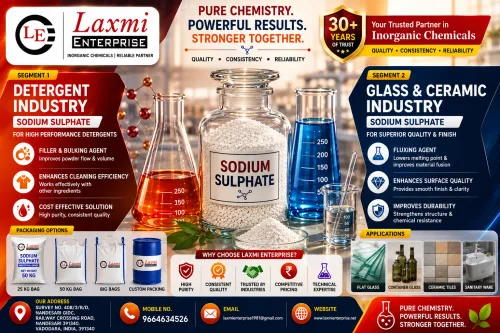
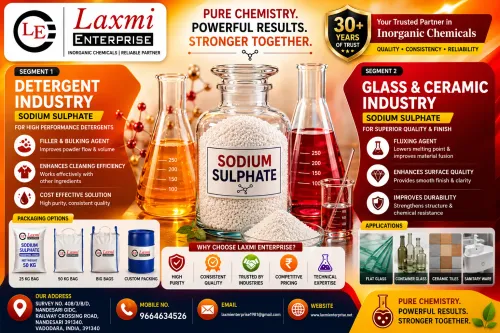
One of the largest consumers of Sodium Sulphate is the detergent manufacturing industry. Manufacturers use it to control bulk density, improve the flow characteristics of detergent powder, and maintain uniform product quality. A consistent grade of Sodium Sulphate helps blending operations run smoothly and supports efficient packaging, reducing production interruptions and improving overall plant productivity.
Another important application is in textile dyeing and processing. Textile manufacturers frequently ask why Sodium Sulphate is required during reactive dyeing. Reactive dyes and cotton fibres naturally repel each other because they carry similar electrical charges. Sodium Sulphate reduces this repulsion, allowing dye molecules to move more effectively towards the fibre. This improves dye exhaustion, enhances shade consistency, and helps achieve reproducible colour results from one batch to another. High quality Sodium Sulphate also reduces the possibility of uneven dyeing and costly reprocessing.
The glass industry also depends on Sodium Sulphate. During glass melting, the chemical functions as a fining agent that assists in removing trapped gas bubbles from molten glass. The result is improved transparency, better optical quality, and fewer manufacturing defects. This application is especially important in the production of container glass, float glass, and solar glass.
Paper and pulp manufacturers use Sodium Sulphate as part of the kraft pulping process. It contributes to efficient chemical recovery operations and supports stable production conditions. Chemical manufacturers also use Sodium Sulphate in various formulations where consistent quality and predictable chemical behaviour are important for process control.
Industrial buyers often ask what quality specifications should be considered before purchasing Sodium Sulphate. The most important parameters include Sodium Sulphate purity, moisture content, insoluble matter, chloride level, particle size distribution, and batch to batch consistency. A product with consistent specifications helps manufacturers maintain stable production, improve finished product quality, and reduce process variability.
Another common question is whether Technical Grade Sodium Sulphate or Commercial Grade Sodium Sulphate should be selected. Technical Grade Sodium Sulphate is generally preferred for applications where quality consistency is critical, such as textile dyeing and specialty chemical manufacturing. Commercial Grade Sodium Sulphate is widely used in detergent manufacturing, paper production, and other applications where standard industrial specifications meet production requirements. The correct grade should always be selected according to the process requirements rather than price alone.
Choosing the right Sodium Sulphate supplier is equally important. Reliable suppliers maintain consistent product quality, provide technical documentation, ensure regular stock availability, and offer dependable logistics support. A stable supply chain reduces production downtime and helps manufacturers maintain delivery commitments to their customers. Procurement teams increasingly evaluate suppliers based on long term reliability, quality assurance systems, and technical support rather than focusing only on the lowest quotation.
Demand for Sodium Sulphate is expected to grow steadily as detergent manufacturing expands, textile exports increase, glass production rises, and infrastructure projects stimulate demand for construction chemicals. Environmental regulations are also encouraging new applications in water treatment and resource recovery systems. These developments make Sodium Sulphate an important industrial chemical not only for current manufacturing needs but also for future industrial growth.
Laxmi Enterprise supplies Industrial Grade and Technical Grade Sodium Sulphate to manufacturers across India. From its operations in Koyali and Nandesari, Vadodara, the company serves detergent manufacturers, textile processing units, glass plants, paper mills, chemical manufacturers, construction chemical producers, and other industrial customers. The focus is on delivering consistent quality, reliable availability, technical support, and dependable logistics so that customers can operate with confidence and maintain uninterrupted production.
Manufacturing success is rarely determined by one raw material alone. It is achieved through the consistent performance of every component used in the production process. Sodium Sulphate may appear to be a simple inorganic salt, but its influence on manufacturing efficiency, product quality, process stability, and production economics makes it one of the most valuable industrial chemicals used across modern manufacturing. Choosing the right grade and partnering with a dependable supplier allows manufacturers to improve operational efficiency while building long term production reliability.

Vadodara
08048096415
+919664634526
 Chat with us
 Chat with us