Sodium Sulphate in Glass Fiber Manufacturing: A Complete Technical Guide for Industrial Manufacturers
The Science Behind Glass Refining
The production of glass fiber requires more than simply melting raw materials. During the melting stage, several chemical reactions occur simultaneously. Carbonates release carbon dioxide, moisture evaporates, and gases are generated as minerals decompose under extreme furnace temperatures. If these gases remain trapped within the molten glass, they can create bubbles, known as seeds, which may reduce the quality of the finished glass and disrupt continuous fiber production.
Glass refining is the stage where these unwanted gas inclusions are reduced, allowing the molten glass to become more homogeneous before it reaches the fiber-forming equipment.
High-purity sodium sulphate contributes to this refining stage by supporting the removal of entrapped gases under high-temperature conditions. Its role is not to change the final composition of the glass significantly but to assist the refining process, promoting a cleaner and more stable molten glass. Better refining helps improve furnace efficiency and supports consistent glass quality.
Understanding the Glass Melting Process
Glass fiber manufacturing follows a carefully controlled sequence of operations.
1. Raw Material Selection
Production begins with the selection of high-quality mineral raw materials. Each ingredient must meet strict specifications for purity, particle size, and chemical composition. Even minor variations can influence melting behavior and finished glass properties.
2. Batch Preparation
All raw materials are accurately weighed and blended to create a homogeneous batch. Modern plants use automated systems to ensure precise proportions and minimize variation between batches.
3. Furnace Charging
The prepared batch is continuously fed into large regenerative or oxy-fuel furnaces operating at temperatures typically between 1, 400°C and 1, 600°C. Consistent feeding is essential to maintain stable furnace conditions.
4. Melting and Refining
As the batch melts, chemical reactions occur and gases are released. During this stage, sodium sulphate supports the refining process by helping reduce gaseous inclusions and promoting a more uniform melt.
5. Conditioning
Before fiber formation, the molten glass is conditioned to achieve the required viscosity. Uniform temperature and composition are critical for producing fibers with consistent diameters.
6. Fiber Formation
The molten glass flows through platinum-rhodium bushings containing hundreds or thousands of precision orifices. Continuous filaments are drawn, cooled, coated with sizing agents, and collected for further processing.
Maintaining consistency throughout each stage depends heavily on the quality of the raw materials entering the furnace.
Types of Glass Fiber
Different industries require different glass compositions to achieve specific mechanical, thermal, and chemical properties.
E-Glass
E-Glass is the most widely produced glass fiber worldwide. It is commonly used in electrical insulation, construction materials, automotive composites, printed circuit boards, and general-purpose reinforced plastics because of its excellent balance of strength, electrical insulation, and cost.
C-Glass
C-Glass offers enhanced chemical resistance and is used in environments exposed to corrosive substances, including chemical storage tanks, piping systems, and industrial process equipment.
S-Glass
S-Glass is designed for high-strength applications where superior tensile properties are required. It is commonly used in aerospace, defense, sporting goods, and advanced engineering composites.
AR-Glass
Alkali-resistant glass is formulated for cement reinforcement applications. It improves durability in concrete products exposed to alkaline environments.
Specialty Glass Fibers
Special formulations are developed for optical fibers, filtration systems, thermal insulation, battery separators, and high-performance industrial applications.
Although glass compositions differ, all require stable melting and refining conditions supported by consistent raw materials.
Why Raw Material Consistency Matters
Continuous glass furnaces often operate without interruption for several years. Once production begins, maintaining a stable process becomes essential.
Variations in sodium sulphate quality can affect:
Batch consistency
Material flow during feeding
Refining efficiency
Furnace stability
Glass homogeneity
Production planning
Overall manufacturing efficiency
Industrial manufacturers therefore emphasize long-term consistency rather than occasional high-quality shipments.
Technical Specifications Buyers Commonly Evaluate
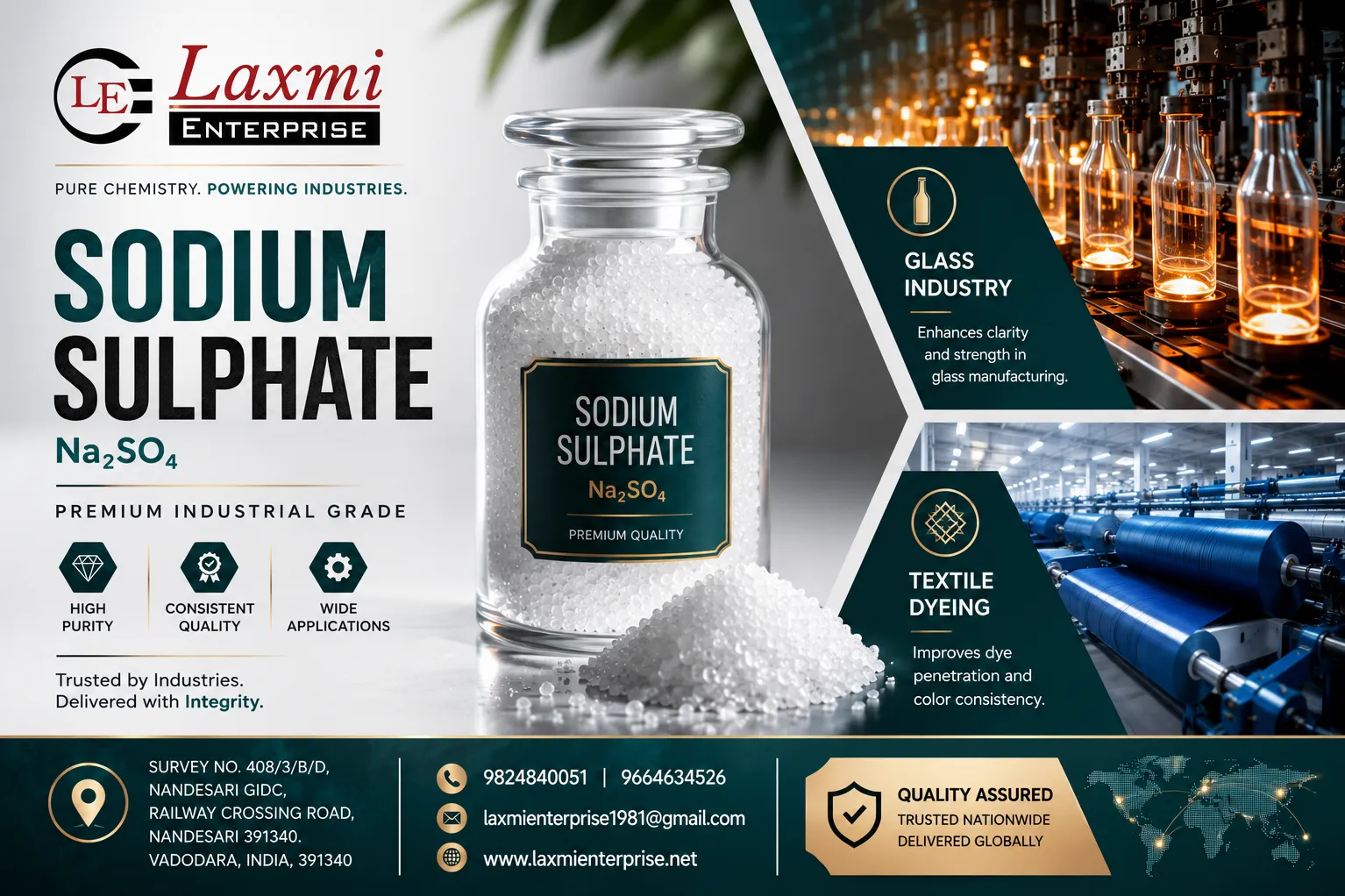
When purchasing sodium sulphate for glass manufacturing, buyers typically review a Certificate of Analysis (COA) to confirm that each shipment meets their quality requirements.
Common parameters include:
Parameter Typical Requirement
Sodium Sulphate (Na₂SO₄) High Purity
Moisture Low
Water Insoluble Matter Low
Chloride Content Controlled
Iron (Fe) Very Low
Particle Size Uniform
Bulk Density Consistent
Whiteness High
Appearance White Free-Flowing Crystals
Actual specifications vary depending on furnace design, glass composition, and internal quality standards.
Importance of Particle Size Distribution
Particle size influences several aspects of batch preparation and handling.
Uniform particle size supports:
Accurate weighing
Better blending
Reduced segregation
Improved material flow
Consistent feeding into the furnace
Oversized particles may dissolve more slowly, while excessive fines can create dust and handling challenges. Controlled particle size helps improve overall production efficiency.
Moisture Control
Moisture content is another important quality parameter.
Excess moisture may influence:
Storage stability
Material flow
Batch consistency
Bulk handling
Automated feeding systems
Manufacturers generally prefer low-moisture sodium sulphate because it simplifies storage and supports reliable production.
Storage Stability
Glass manufacturers often maintain significant inventories of raw materials to ensure uninterrupted production.
A stable sodium sulphate product should maintain its quality throughout storage without excessive caking or degradation when kept in appropriate conditions.
Proper storage contributes to:
Consistent feeding performance
Reduced waste
Improved inventory management
Better production planning
Packaging Options
Industrial suppliers provide sodium sulphate in several packaging formats depending on customer requirements.
Common options include:
25 kg HDPE bags with inner liners
50 kg industrial bags
Jumbo bags (500 kg to 1, 500 kg)
Bulk tanker deliveries
Customized packaging for export
Packaging should protect the material from moisture and contamination during transportation and storage.
Quality Control During Production
Reliable sodium sulphate manufacturers implement quality assurance procedures throughout production.
Quality control may include:
Raw material inspection
Process monitoring
Laboratory analysis
Batch sampling
Particle size verification
Moisture testing
Chemical purity analysis
Packaging inspection
Final product certification
Consistent quality control reduces batch-to-batch variation and provides confidence for industrial buyers.
Common Challenges in Glass Manufacturing
Glass manufacturers continuously work to optimize furnace performance while minimizing defects.
Some operational challenges include:
Energy consumption
Furnace wear
Raw material variability
Bubble formation
Glass inclusions
Production downtime
Fiber breakage
Quality consistency
Using high-quality raw materials, including sodium sulphate, helps reduce variability and supports smoother production.
Selecting the Right Sodium Sulphate Supplier
Choosing a supplier should involve a comprehensive evaluation rather than focusing solely on price.
Industrial buyers should assess:
Manufacturing capability
Consistency of product quality
Quality management systems
Production capacity
Supply reliability
Technical support
Packaging standards
Logistics capability
Documentation
Industry experience
A dependable supplier becomes a long-term manufacturing partner by providing consistent materials that support stable production.
International Quality Expectations
Glass manufacturers supplying global markets often align their operations with internationally recognized quality management systems.
Common expectations include:
Batch traceability
Documented quality procedures
Consistent product specifications
Reliable Certificates of Analysis
Controlled manufacturing processes
Continuous quality improvement
Suppliers capable of meeting these expectations help manufacturers maintain customer confidence and support export-oriented production.
The Science Behind Glass Refining
The production of glass fiber requires more than simply melting raw materials. During the melting stage, several chemical reactions occur simultaneously. Carbonates release carbon dioxide, moisture evaporates, and gases are generated as minerals decompose under extreme furnace temperatures. If these gases remain trapped within the molten glass, they can create bubbles, known as seeds, which may reduce the quality of the finished glass and disrupt continuous fiber production.
Glass refining is the stage where these unwanted gas inclusions are reduced, allowing the molten glass to become more homogeneous before it reaches the fiber-forming equipment.
High-purity sodium sulphate contributes to this refining stage by supporting the removal of entrapped gases under high-temperature conditions. Its role is not to change the final composition of the glass significantly but to assist the refining process, promoting a cleaner and more stable molten glass. Better refining helps improve furnace efficiency and supports consistent glass quality.
Understanding the Glass Melting Process
Glass fiber manufacturing follows a carefully controlled sequence of operations.
1. Raw Material Selection
Production begins with the selection of high-quality mineral raw materials. Each ingredient must meet strict specifications for purity, particle size, and chemical composition. Even minor variations can influence melting behavior and finished glass properties.
2. Batch Preparation
All raw materials are accurately weighed and blended to create a homogeneous batch. Modern plants use automated systems to ensure precise proportions and minimize variation between batches.
3. Furnace Charging
The prepared batch is continuously fed into large regenerative or oxy-fuel furnaces operating at temperatures typically between 1, 400°C and 1, 600°C. Consistent feeding is essential to maintain stable furnace conditions.
4. Melting and Refining
As the batch melts, chemical reactions occur and gases are released. During this stage, sodium sulphate supports the refining process by helping reduce gaseous inclusions and promoting a more uniform melt.
5. Conditioning
Before fiber formation, the molten glass is conditioned to achieve the required viscosity. Uniform temperature and composition are critical for producing fibers with consistent diameters.
6. Fiber Formation
The molten glass flows through platinum-rhodium bushings containing hundreds or thousands of precision orifices. Continuous filaments are drawn, cooled, coated with sizing agents, and collected for further processing.
Maintaining consistency throughout each stage depends heavily on the quality of the raw materials entering the furnace.
Types of Glass Fiber
Different industries require different glass compositions to achieve specific mechanical, thermal, and chemical properties.
E-Glass
E-Glass is the most widely produced glass fiber worldwide. It is commonly used in electrical insulation, construction materials, automotive composites, printed circuit boards, and general-purpose reinforced plastics because of its excellent balance of strength, electrical insulation, and cost.
C-Glass
C-Glass offers enhanced chemical resistance and is used in environments exposed to corrosive substances, including chemical storage tanks, piping systems, and industrial process equipment.
S-Glass
S-Glass is designed for high-strength applications where superior tensile properties are required. It is commonly used in aerospace, defense, sporting goods, and advanced engineering composites.
AR-Glass
Alkali-resistant glass is formulated for cement reinforcement applications. It improves durability in concrete products exposed to alkaline environments.
Specialty Glass Fibers
Special formulations are developed for optical fibers, filtration systems, thermal insulation, battery separators, and high-performance industrial applications.
Although glass compositions differ, all require stable melting and refining conditions supported by consistent raw materials.
Why Raw Material Consistency Matters
Continuous glass furnaces often operate without interruption for several years. Once production begins, maintaining a stable process becomes essential.
Variations in sodium sulphate quality can affect:
Batch consistency
Material flow during feeding
Refining efficiency
Furnace stability
Glass homogeneity
Production planning
Overall manufacturing efficiency
Industrial manufacturers therefore emphasize long-term consistency rather than occasional high-quality shipments.
Technical Specifications Buyers Commonly Evaluate
When purchasing sodium sulphate for glass manufacturing, buyers typically review a Certificate of Analysis (COA) to confirm that each shipment meets their quality requirements.
Common parameters include:
Parameter Typical Requirement
Sodium Sulphate (Na₂SO₄) High Purity
Moisture Low
Water Insoluble Matter Low
Chloride Content Controlled
Iron (Fe) Very Low
Particle Size Uniform
Bulk Density Consistent
Whiteness High
Appearance White Free-Flowing Crystals
Actual specifications vary depending on furnace design, glass composition, and internal quality standards.
Importance of Particle Size Distribution
Particle size influences several aspects of batch preparation and handling.
Uniform particle size supports:
Accurate weighing
Better blending
Reduced segregation
Improved material flow
Consistent feeding into the furnace
Oversized particles may dissolve more slowly, while excessive fines can create dust and handling challenges. Controlled particle size helps improve overall production efficiency.
Moisture Control
Moisture content is another important quality parameter.
Excess moisture may influence:
Storage stability
Material flow
Batch consistency
Bulk handling
Automated feeding systems
Manufacturers generally prefer low-moisture sodium sulphate because it simplifies storage and supports reliable production.
Storage Stability
Glass manufacturers often maintain significant inventories of raw materials to ensure uninterrupted production.
A stable sodium sulphate product should maintain its quality throughout storage without excessive caking or degradation when kept in appropriate conditions.
Proper storage contributes to:
Consistent feeding performance
Reduced waste
Improved inventory management
Better production planning
Packaging Options
Industrial suppliers provide sodium sulphate in several packaging formats depending on customer requirements.
Common options include:
25 kg HDPE bags with inner liners
50 kg industrial bags
Jumbo bags (500 kg to 1, 500 kg)
Bulk tanker deliveries
Customized packaging for export
Packaging should protect the material from moisture and contamination during transportation and storage.
Quality Control During Production
Reliable sodium sulphate manufacturers implement quality assurance procedures throughout production.
Quality control may include:
Raw material inspection
Process monitoring
Laboratory analysis
Batch sampling
Particle size verification
Moisture testing
Chemical purity analysis
Packaging inspection
Final product certification
Consistent quality control reduces batch-to-batch variation and provides confidence for industrial buyers.
Common Challenges in Glass Manufacturing
Glass manufacturers continuously work to optimize furnace performance while minimizing defects.
Some operational challenges include:
Energy consumption
Furnace wear
Raw material variability
Bubble formation
Glass inclusions
Production downtime
Fiber breakage
Quality consistency
Using high-quality raw materials, including sodium sulphate, helps reduce variability and supports smoother production.
Selecting the Right Sodium Sulphate Supplier
Choosing a supplier should involve a comprehensive evaluation rather than focusing solely on price.
Industrial buyers should assess:
Manufacturing capability
Consistency of product quality
Quality management systems
Production capacity
Supply reliability
Technical support
Packaging standards
Logistics capability
Documentation
Industry experience
A dependable supplier becomes a long-term manufacturing partner by providing consistent materials that support stable production.
International Quality Expectations
Glass manufacturers supplying global markets often align their operations with internationally recognized quality management systems.
Common expectations include:
Batch traceability
Documented quality procedures
Consistent product specifications
Reliable Certificates of Analysis
Controlled manufacturing processes
Continuous quality improvement
Suppliers capable of meeting these expectations help manufacturers maintain customer confidence and support export-oriented production.
Keywords