

Sodium Sulphate in Mining and Mineral Processing: Applications, Process Chemistry, Quality Requirements, and Industrial Benefits
This targets a strong industrial segment that is highly relevant for sodium sulphate while expanding your website's authority.
Introduction
Mining and mineral processing are among the most resource-intensive industries in the world, supplying essential raw materials for construction, metallurgy, chemicals, electronics, batteries, agriculture, and manufacturing. Every year, billions of tonnes of ores and industrial minerals are extracted, processed, refined, and converted into valuable products. Achieving efficient mineral recovery requires a combination of advanced equipment, optimized processing techniques, and carefully selected industrial chemicals.
Although sodium sulphate is not a universal reagent used in every mineral processing operation, it is employed in selected chemical processing, laboratory analysis, and industrial applications where its physical and chemical properties are beneficial. It also serves as an important raw material in the manufacture of other chemicals that support mining operations.
For mining companies, metallurgical plants, and mineral processing facilities, consistency in chemical quality is essential. Raw materials must exhibit predictable composition, reliable physical characteristics, and dependable supply to ensure stable plant operations and consistent product quality. High-purity sodium sulphate supports these objectives by providing controlled chemical properties suitable for industrial applications where it is specified.
This article explores the role of sodium sulphate in mining and mineral processing, its technical characteristics, procurement considerations, quality requirements, storage practices, and the factors industrial buyers should evaluate when selecting a supplier.
Overview of the Mining and Mineral Processing Industry
The mining industry consists of several interconnected stages that convert naturally occurring mineral deposits into marketable products.
Typical stages include:
Geological exploration
Mine planning
Ore extraction
Crushing and grinding
Mineral beneficiation
Dewatering
Smelting or refining
Product handling
Transportation
Each stage requires specialized equipment, process control, and, in many cases, carefully selected industrial chemicals.
Modern mineral processing plants operate continuously and rely on consistent raw material quality to maintain production efficiency and reduce operational variability.
Understanding Sodium Sulphate
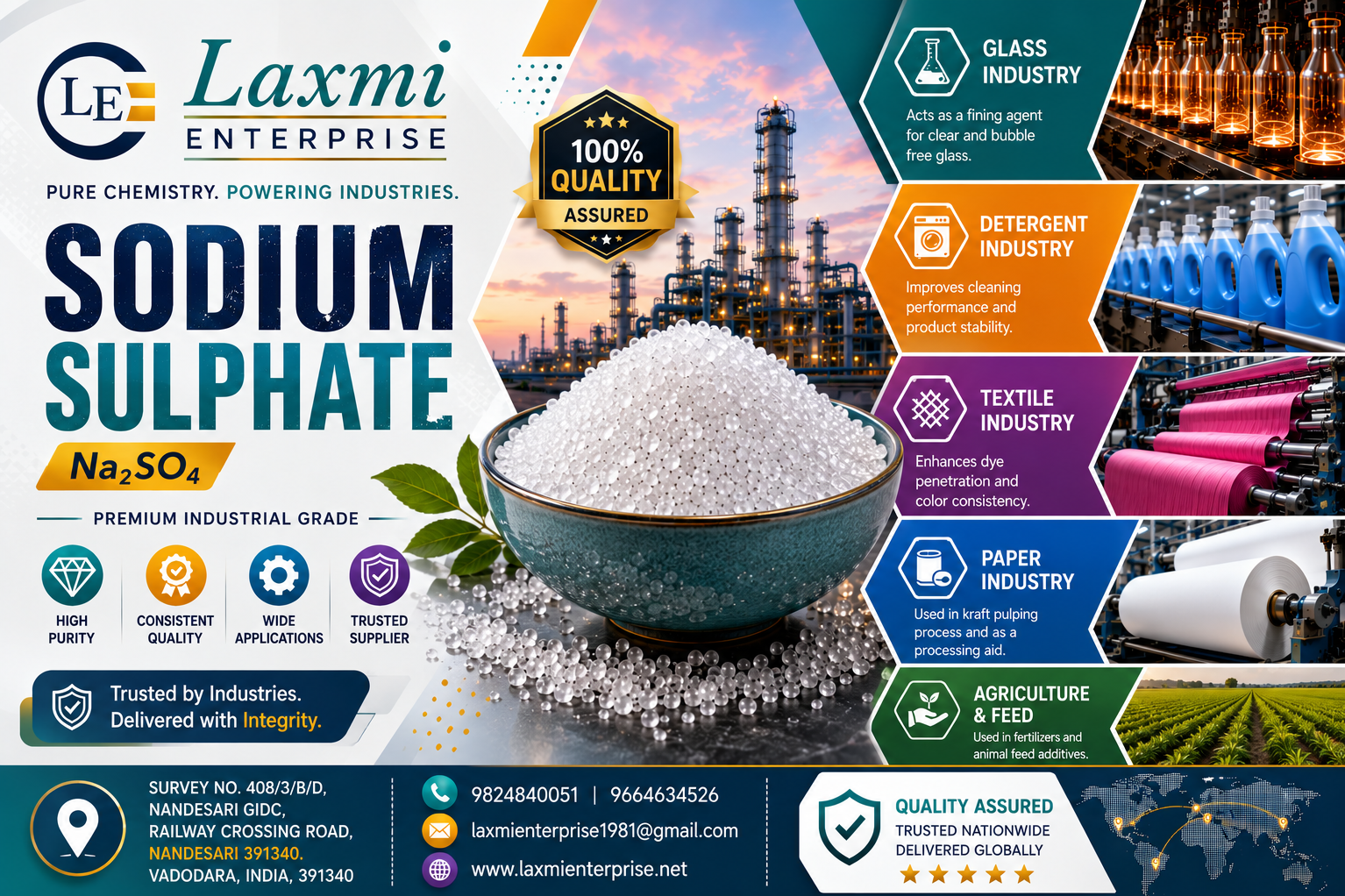
Sodium sulphate is an inorganic salt with the chemical formula Na₂SO₄. It is commercially available in both anhydrous and hydrated forms and is widely used across industries including glass manufacturing, detergents, textiles, pulp and paper, chemicals, laboratories, and selected mining-related applications.
For industrial processing, manufacturers typically supply anhydrous sodium sulphate because of its low moisture content, stable crystalline structure, and ease of handling.
Technical Profile
Property Typical Information
Chemical Name Sodium Sulphate
Chemical Formula Na₂SO₄
Molecular Weight 142.04 g/mol
CAS Number 7757-82-6
Appearance White crystalline powder or granules
Odor Odorless
Water Solubility Highly soluble
Chemical Nature Neutral inorganic salt
Stability Excellent under recommended storage conditions
Flammability Non-flammable
Actual specifications depend on product grade and customer requirements.
Why Chemical Quality Matters in Mining
Large mining operations consume substantial quantities of industrial chemicals every year. Even chemicals that play supporting roles must meet consistent quality standards because production interruptions can significantly affect plant performance.
Industrial buyers generally evaluate:
Chemical purity
Batch consistency
Particle size
Moisture content
Packaging quality
Supply reliability
Technical documentation
Storage stability
A dependable supplier helps reduce procurement risks while supporting uninterrupted production.
Industrial Applications of Sodium Sulphate in Mining
Although sodium sulphate is not considered a primary flotation reagent or leaching chemical, it has several industrial applications associated with mining and mineral processing.
Chemical Manufacturing
Sodium sulphate serves as a raw material in manufacturing certain industrial chemicals that are supplied to mining operations.
Laboratory Analysis
Analytical laboratories supporting mining operations may use sodium sulphate in specific analytical procedures, sample preparation methods, or laboratory formulations, depending on the testing protocol.
Mineral Processing Research
Universities, research institutions, and pilot plants frequently investigate sodium sulphate within controlled studies related to mineral processing, crystallization, and process chemistry.
Industrial Water Systems
In some specialized industrial processes, sodium sulphate may be present as part of process water chemistry or recycled industrial streams, requiring monitoring and control.
Process Development
Engineering companies and research organizations use sodium sulphate in laboratory-scale experiments to evaluate chemical behavior under controlled conditions.
Importance of Product Consistency
Mining projects often operate continuously for months or years. Consistent chemical quality helps maintain stable operating conditions and simplifies inventory management.
Reliable sodium sulphate offers several operational advantages:
Predictable handling characteristics
Uniform particle size
Stable storage performance
Consistent chemical composition
Reliable packaging integrity
Repeatable laboratory performance
Simplified quality control
These characteristics contribute to efficient industrial operations, even where sodium sulphate plays a supporting role.
Physical Characteristics Important to Industrial Buyers
Mining companies commonly assess the following product characteristics before supplier approval:
High chemical purity
Low moisture content
Controlled insoluble matter
Uniform particle size
Free-flowing crystals
High product whiteness
Reliable packaging
Batch-to-batch consistency
Maintaining these properties helps improve handling, storage, and process reliability.