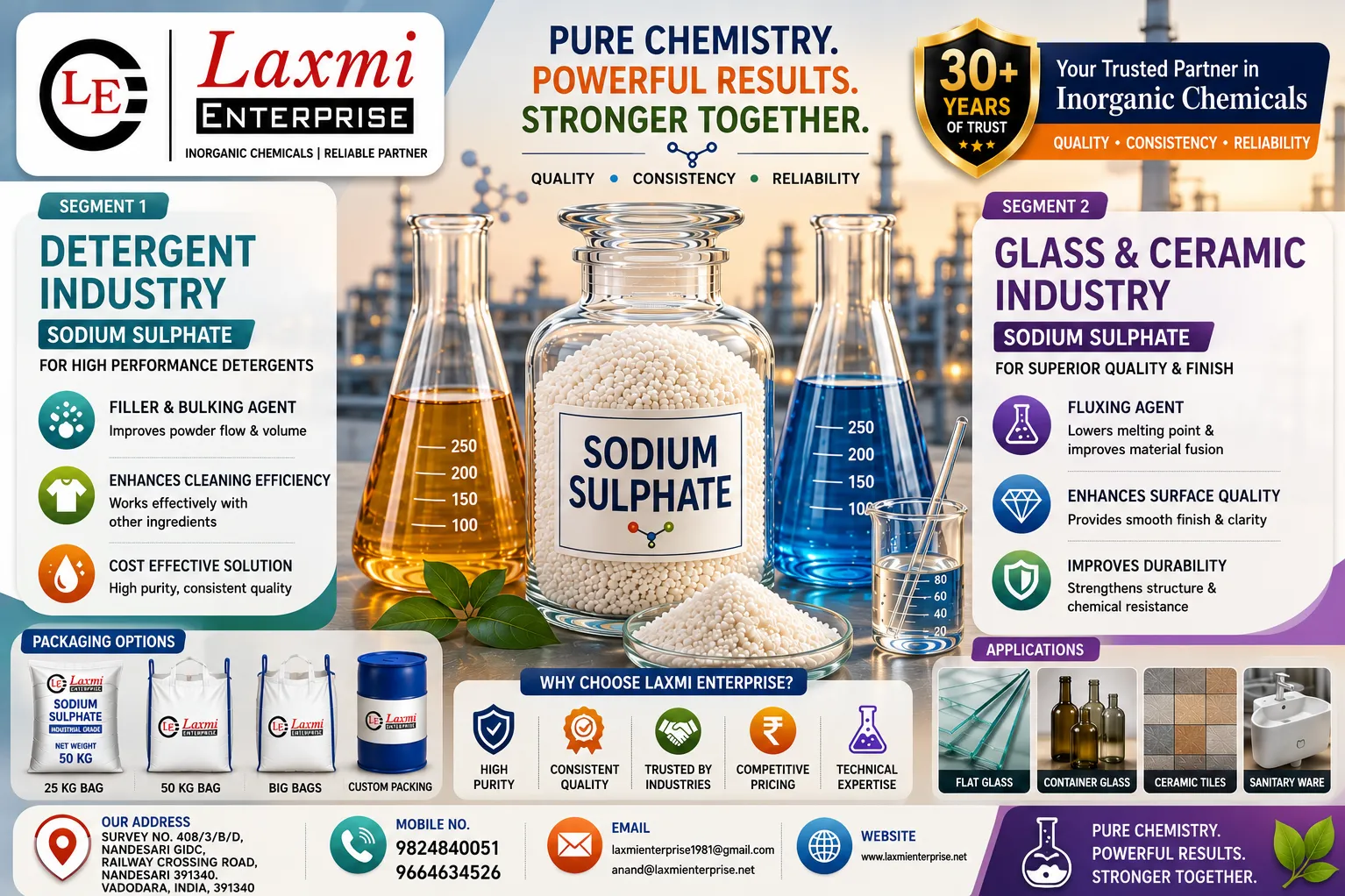
Sodium Sulphate in Textile Dyeing and Processing: A Technical Guide for Textile Mills and Processing Houses
The textile industry is one of India's largest manufacturing sectors.
From cotton fabrics and blended textiles to home furnishings and industrial fabrics, every product passes through multiple processing stages before reaching the customer.
Modern textile processing is expected to achieve three objectives at the same time.
Consistent colour.
High production efficiency.
Minimum process variation.
Achieving these objectives requires experienced operators, modern machinery, disciplined process control and reliable raw materials.
Among the chemicals used in textile dyeing, Sodium Sulphate is widely used in many reactive dyeing processes because it supports controlled dye uptake and process consistency.
For textile manufacturers, the quality and consistency of Sodium Sulphate directly influence production planning, repeatability and overall process stability.
Selecting the right supplier is therefore a technical decision rather than only a commercial one.
Understanding the Textile Dyeing Process
A fabric does not move directly from weaving to the finished product.
It passes through several carefully controlled operations.
Preparation.
Scouring.
Bleaching.
Dyeing.
Washing.
Finishing.
Quality inspection.
Every stage depends on maintaining controlled process conditions.
If variation occurs during one stage, the effect may become visible in the next.
Process engineers therefore focus on reducing unnecessary variation throughout the production cycle.
Reliable chemicals contribute significantly to maintaining that stability.
Why Consistency Matters in Reactive Dyeing
Reactive dyeing requires careful control of process parameters.
Temperature.
Time.
Chemical addition.
Liquor ratio.
Process sequence.
When these parameters remain stable, dyeing becomes more predictable.
Consistent Sodium Sulphate supports repeatable processing conditions by allowing manufacturers to follow established operating procedures with confidence.
Production engineers value repeatability because it improves productivity while reducing unnecessary process corrections.
The Importance of Batch-to-Batch Consistency
Textile buyers expect uniform colour from one production lot to another.
Meeting this expectation requires disciplined manufacturing.
Machine settings are standardised.
Recipes are documented.
Quality checks are performed.
Raw materials must also remain consistent.
If incoming chemicals vary unexpectedly, production teams may need additional monitoring and process adjustments.
Stable raw materials reduce these risks and help maintain repeatable manufacturing performance.
Consistency is one of the foundations of quality textile production.
Reliable Supply Supports Continuous Production
Most textile processing units operate according to planned production schedules.
Machine utilisation is carefully monitored.
Customer delivery dates are fixed.
Production delays affect the entire manufacturing programme.
Reliable Sodium Sulphate supply allows procurement teams to plan confidently.
Warehouse inventory remains balanced.
Production schedules continue without unnecessary interruptions.
Reliable logistics contribute directly to operational efficiency.
Warehouse Management in Textile Processing Units
Industrial chemicals should be stored with the same discipline applied to production.
Receiving inspections should verify packaging and documentation.
Storage areas should remain dry and organised.
Inventory should be clearly identified.
Older stock should normally be used before recently received material.
Good warehouse management supports consistent production while reducing handling difficulties.
Organised storage reflects organised manufacturing.
Communication Between Technical and Procurement Teams
Successful textile companies encourage close cooperation between departments.
Production engineers understand process requirements.
Quality teams monitor consistency.
Procurement manages supplier relationships.
Warehouse personnel protect inventory.
When these departments communicate regularly, purchasing decisions become more effective.
Supplier selection is based on technical suitability as well as commercial value.
This balanced approach reduces long-term operational risk.
Technical Evaluation Before Commercial Approval
The lowest quotation should never become the only reason for supplier approval.
Manufacturers should first evaluate technical capability.
Can the supplier maintain consistent quality?
Can deliveries remain reliable throughout the year?
Is packaging suitable for industrial storage?
Can documentation support quality systems?
Only after technical confidence has been established should commercial discussions begin.
This sequence protects manufacturing performance.
Production Feedback Should Influence Supplier Reviews
Laboratory reports provide valuable information.
Production experience provides additional insight.
Operators observe material handling.
Production supervisors monitor process stability.
Quality engineers evaluate finished fabric.
These observations should become part of regular supplier performance reviews.
Long-term supplier evaluation should combine laboratory data with practical manufacturing experience.
Sustainability Through Process Stability
The textile industry continues improving resource efficiency.
Reduced water consumption.
Better energy management.
Improved production planning.
Lower waste generation.
Consistent raw materials contribute to these objectives because stable processes reduce unnecessary reprocessing and production variation.
Operational efficiency and sustainability often support each other.
Reliable suppliers help manufacturers achieve both.
Questions Textile Manufacturers Should Ask Suppliers
Before approving a Sodium Sulphate supplier, technical and procurement teams should discuss several important questions.
How is quality consistency maintained?
What packaging methods are used?
How are deliveries planned?
Can production growth be supported?
How are customer concerns addressed?
Does the supplier understand textile manufacturing requirements?
These discussions help establish confidence before long-term business begins.
How Laxmi Enterprise Supports the Textile Industry
At Laxmi Enterprise, we understand that textile manufacturers depend on consistency every day.
Operating from Nandesari GIDC, Vadodara, we supply Sodium Sulphate and other industrial chemicals to textile processing units across India.
Our customers expect dependable product quality, organised packaging, timely deliveries and professional communication.
We recognise that every shipment becomes part of a carefully controlled manufacturing process.
Our responsibility is to help customers maintain stable production by providing reliable industrial chemicals supported by responsive service and long-term technical partnership.
Final Thoughts
Modern textile manufacturing depends on precision.
Production schedules.
Process control.
Quality assurance.
Warehouse management.
Reliable procurement.
Every department contributes to consistent fabric quality.
Reliable Sodium Sulphate supply supports this larger manufacturing system by helping textile mills maintain operational stability and production confidence.
Manufacturers who invest in dependable supplier relationships often achieve stronger process control, improved planning and long-term business success.
Frequently Asked Questions
How is Sodium Sulphate used in textile dyeing?
Sodium Sulphate is widely used in many reactive dyeing processes where it supports controlled dye uptake and helps maintain consistent processing conditions.
Why is batch consistency important in textile manufacturing?
Batch consistency helps manufacturers achieve uniform colour, repeatable production and reliable finished product quality.
What should textile manufacturers evaluate before selecting a supplier?
Manufacturers should evaluate product consistency, packaging quality, delivery performance, documentation, technical support and long-term supply capability.
How can reliable supply improve textile production?
Reliable supply reduces production interruptions, improves inventory planning, supports process stability and helps manufacturers meet customer delivery commitments.
Why do textile manufacturers across India choose Laxmi Enterprise?
Textile manufacturers choose Laxmi Enterprise because we provide consistent-quality Sodium Sulphate supported by dependable deliveries, professional documentation and responsive customer support. Operating from Nandesari GIDC, Vadodara, we help textile processing companies maintain efficient production and long-term manufacturing reliability.
Laxmi Enterprise is a leading manufacturer, supplier and distributor of industrial chemicals based in Nandesari GIDC, Vadodara, Gujarat. Since 1981, we have supplied Sodium Sulphate, Sodium Nitrate, Sodium Acetate, Tri Sodium Phosphate and other industrial chemicals to textile, detergent, paper, glass, ceramic, construction, water treatment and chemical processing industries across India.
Our commitment is built on consistent quality, dependable logistics and long-term customer relationships. By understanding the technical requirements of each industry we serve, we help manufacturers improve production efficiency, strengthen quality systems and build sustainable industrial growth.
The textile industry is one of India's largest manufacturing sectors.
From cotton fabrics and blended textiles to home furnishings and industrial fabrics, every product passes through multiple processing stages before reaching the customer.
Modern textile processing is expected to achieve three objectives at the same time.
Consistent colour.
High production efficiency.
Minimum process variation.
Achieving these objectives requires experienced operators, modern machinery, disciplined process control and reliable raw materials.
Among the chemicals used in textile dyeing, Sodium Sulphate is widely used in many reactive dyeing processes because it supports controlled dye uptake and process consistency.
For textile manufacturers, the quality and consistency of Sodium Sulphate directly influence production planning, repeatability and overall process stability.
Selecting the right supplier is therefore a technical decision rather than only a commercial one.
Understanding the Textile Dyeing Process
A fabric does not move directly from weaving to the finished product.
It passes through several carefully controlled operations.
Preparation.
Scouring.
Bleaching.
Dyeing.
Washing.
Finishing.
Quality inspection.
Every stage depends on maintaining controlled process conditions.
If variation occurs during one stage, the effect may become visible in the next.
Process engineers therefore focus on reducing unnecessary variation throughout the production cycle.
Reliable chemicals contribute significantly to maintaining that stability.
Why Consistency Matters in Reactive Dyeing
Reactive dyeing requires careful control of process parameters.
Temperature.
Time.
Chemical addition.
Liquor ratio.
Process sequence.
When these parameters remain stable, dyeing becomes more predictable.
Consistent Sodium Sulphate supports repeatable processing conditions by allowing manufacturers to follow established operating procedures with confidence.
Production engineers value repeatability because it improves productivity while reducing unnecessary process corrections.
The Importance of Batch-to-Batch Consistency
Textile buyers expect uniform colour from one production lot to another.
Meeting this expectation requires disciplined manufacturing.
Machine settings are standardised.
Recipes are documented.
Quality checks are performed.
Raw materials must also remain consistent.
If incoming chemicals vary unexpectedly, production teams may need additional monitoring and process adjustments.
Stable raw materials reduce these risks and help maintain repeatable manufacturing performance.
Consistency is one of the foundations of quality textile production.
Reliable Supply Supports Continuous Production
Most textile processing units operate according to planned production schedules.
Machine utilisation is carefully monitored.
Customer delivery dates are fixed.
Production delays affect the entire manufacturing programme.
Reliable Sodium Sulphate supply allows procurement teams to plan confidently.
Warehouse inventory remains balanced.
Production schedules continue without unnecessary interruptions.
Reliable logistics contribute directly to operational efficiency.
Warehouse Management in Textile Processing Units
Industrial chemicals should be stored with the same discipline applied to production.
Receiving inspections should verify packaging and documentation.
Storage areas should remain dry and organised.
Inventory should be clearly identified.
Older stock should normally be used before recently received material.
Good warehouse management supports consistent production while reducing handling difficulties.
Organised storage reflects organised manufacturing.
Communication Between Technical and Procurement Teams
Successful textile companies encourage close cooperation between departments.
Production engineers understand process requirements.
Quality teams monitor consistency.
Procurement manages supplier relationships.
Warehouse personnel protect inventory.
When these departments communicate regularly, purchasing decisions become more effective.
Supplier selection is based on technical suitability as well as commercial value.
This balanced approach reduces long-term operational risk.
Technical Evaluation Before Commercial Approval
The lowest quotation should never become the only reason for supplier approval.
Manufacturers should first evaluate technical capability.
Can the supplier maintain consistent quality?
Can deliveries remain reliable throughout the year?
Is packaging suitable for industrial storage?
Can documentation support quality systems?
Only after technical confidence has been established should commercial discussions begin.
This sequence protects manufacturing performance.
Production Feedback Should Influence Supplier Reviews
Laboratory reports provide valuable information.
Production experience provides additional insight.
Operators observe material handling.
Production supervisors monitor process stability.
Quality engineers evaluate finished fabric.
These observations should become part of regular supplier performance reviews.
Long-term supplier evaluation should combine laboratory data with practical manufacturing experience.
Sustainability Through Process Stability
The textile industry continues improving resource efficiency.
Reduced water consumption.
Better energy management.
Improved production planning.
Lower waste generation.
Consistent raw materials contribute to these objectives because stable processes reduce unnecessary reprocessing and production variation.
Operational efficiency and sustainability often support each other.
Reliable suppliers help manufacturers achieve both.
Questions Textile Manufacturers Should Ask Suppliers
Before approving a Sodium Sulphate supplier, technical and procurement teams should discuss several important questions.
How is quality consistency maintained?
What packaging methods are used?
How are deliveries planned?
Can production growth be supported?
How are customer concerns addressed?
Does the supplier understand textile manufacturing requirements?
These discussions help establish confidence before long-term business begins.
How Laxmi Enterprise Supports the Textile Industry
At Laxmi Enterprise, we understand that textile manufacturers depend on consistency every day.
Operating from Nandesari GIDC, Vadodara, we supply Sodium Sulphate and other industrial chemicals to textile processing units across India.
Our customers expect dependable product quality, organised packaging, timely deliveries and professional communication.
We recognise that every shipment becomes part of a carefully controlled manufacturing process.
Our responsibility is to help customers maintain stable production by providing reliable industrial chemicals supported by responsive service and long-term technical partnership.
Final Thoughts
Modern textile manufacturing depends on precision.
Production schedules.
Process control.
Quality assurance.
Warehouse management.
Reliable procurement.
Every department contributes to consistent fabric quality.
Reliable Sodium Sulphate supply supports this larger manufacturing system by helping textile mills maintain operational stability and production confidence.
Manufacturers who invest in dependable supplier relationships often achieve stronger process control, improved planning and long-term business success.
Frequently Asked Questions
How is Sodium Sulphate used in textile dyeing?
Sodium Sulphate is widely used in many reactive dyeing processes where it supports controlled dye uptake and helps maintain consistent processing conditions.
Why is batch consistency important in textile manufacturing?
Batch consistency helps manufacturers achieve uniform colour, repeatable production and reliable finished product quality.
What should textile manufacturers evaluate before selecting a supplier?
Manufacturers should evaluate product consistency, packaging quality, delivery performance, documentation, technical support and long-term supply capability.
How can reliable supply improve textile production?
Reliable supply reduces production interruptions, improves inventory planning, supports process stability and helps manufacturers meet customer delivery commitments.
Why do textile manufacturers across India choose Laxmi Enterprise?
Textile manufacturers choose Laxmi Enterprise because we provide consistent-quality Sodium Sulphate supported by dependable deliveries, professional documentation and responsive customer support. Operating from Nandesari GIDC, Vadodara, we help textile processing companies maintain efficient production and long-term manufacturing reliability.
Laxmi Enterprise is a leading manufacturer, supplier and distributor of industrial chemicals based in Nandesari GIDC, Vadodara, Gujarat. Since 1981, we have supplied Sodium Sulphate, Sodium Nitrate, Sodium Acetate, Tri Sodium Phosphate and other industrial chemicals to textile, detergent, paper, glass, ceramic, construction, water treatment and chemical processing industries across India.
Our commitment is built on consistent quality, dependable logistics and long-term customer relationships. By understanding the technical requirements of each industry we serve, we help manufacturers improve production efficiency, strengthen quality systems and build sustainable industrial growth.
Keywords