


Sodium Sulphate Manufacturing Process Explained Simply
Primary Keyword: Sodium Sulphate manufacturing process
Secondary Keywords: Sodium Sulphate production, industrial Sodium Sulphate, Sodium Sulphate manufacturer India
Introduction
The Sodium Sulphate manufacturing process is designed to produce a chemically stable, high-purity industrial material used in detergents, textiles, glass, paper, and chemical industries. The process is efficient, scalable, and cost-effective, making Sodium Sulphate one of the most widely produced inorganic chemicals.
Raw Materials Used
Depending on the production route, common raw materials include:
Sodium Chloride (NaCl)
Sulphuric Acid (H₂SO₄)
By-product streams from chemical industries
Water
Major Methods of Sodium Sulphate Manufacturing
🔹 1. Mannheim Process (Most Common Industrial Method)
This is the traditional and widely used Sodium Sulphate manufacturing process.
Process Steps:
Sodium Chloride is charged into a Mannheim furnace
Concentrated Sulphuric Acid is added gradually
Controlled heating is applied
Sodium Sulphate is formed as a solid product
Sodium Sulphate Supplier India B2B
Sodium Sulphate Wholesale Price India
Sodium Sulphate Industrial Chemical Dealer
Sodium Sulphate Bulk Packaging Supplier
Sodium Sulphate Chemical Export India
Sodium Sulphate Manufacturer in Vadodara, Gujarat
Hydrogen Chloride gas is recovered and used in other chemical processes
Advantages:
✔ High purity output
✔ Suitable for large-scale production
✔ By-product utilization (HCl)
🔹 2. By-Product Recovery Process
Sodium Sulphate is also produced as a by-product in industries such as:
Rayon manufacturing
Chemical dye production
Hydrochloric acid plants
Process Steps:
Sodium Sulphate-rich liquor is collected
Purification and crystallization are done
Product is dried and packed
Advantages:
✔ Cost-effective
✔ Environment-friendly
✔ Resource recycling
🔹 3. Natural Source Processing (Limited Regions)
In some regions, Sodium Sulphate is obtained from natural mineral deposits.
Process Steps:
Mineral extraction
Dissolution in water
Crystallization and drying
Drying & Finishing Process
After formation, Sodium Sulphate undergoes:
Filtration
Drying (rotary or fluidized bed dryers)
Grinding (if required)
Sieving for particle size control
This ensures uniform quality and moisture control.
Quality Control in Sodium Sulphate Manufacturing
Every batch is tested for:
Purity
Moisture content
pH value
Particle size
Solubility
Strict quality checks ensure consistent industrial performance.
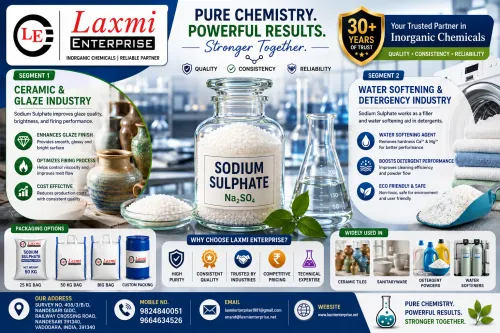
Packaging & Storage
25 kg HDPE bags with inner liner
Jumbo bags for bulk buyers
Stored in dry, ventilated conditions
Proper packaging prevents moisture absorption and contamination.
Why the Manufacturing Process Matters
A well-controlled Sodium Sulphate manufacturing process ensures:
✔ Consistent quality
✔ Better industrial performance
✔ Lower processing losses
✔ Customer satisfaction
Why Choose Laxmi Enterprise?
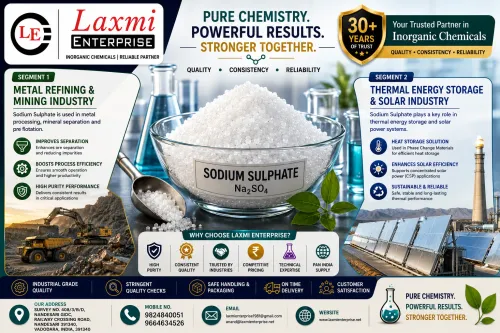
Laxmi Enterprise, Vadodara follows a systematic and quality-driven Sodium Sulphate manufacturing process, delivering:
Industrial & export-grade material
Reliable bulk supply
Competitive pricing
Timely delivery
Conclusion
The Sodium Sulphate manufacturing process is a balance of chemical precision, process control, and quality assurance. When manufactured correctly, it becomes a cost-effective and high-performance industrial chemical for multiple industries.