

Sodium Sulphate Manufacturing Process: Natural Sources, Synthetic Production Methods, Process Technology, Quality Control, and Industrial Applications
Introduction
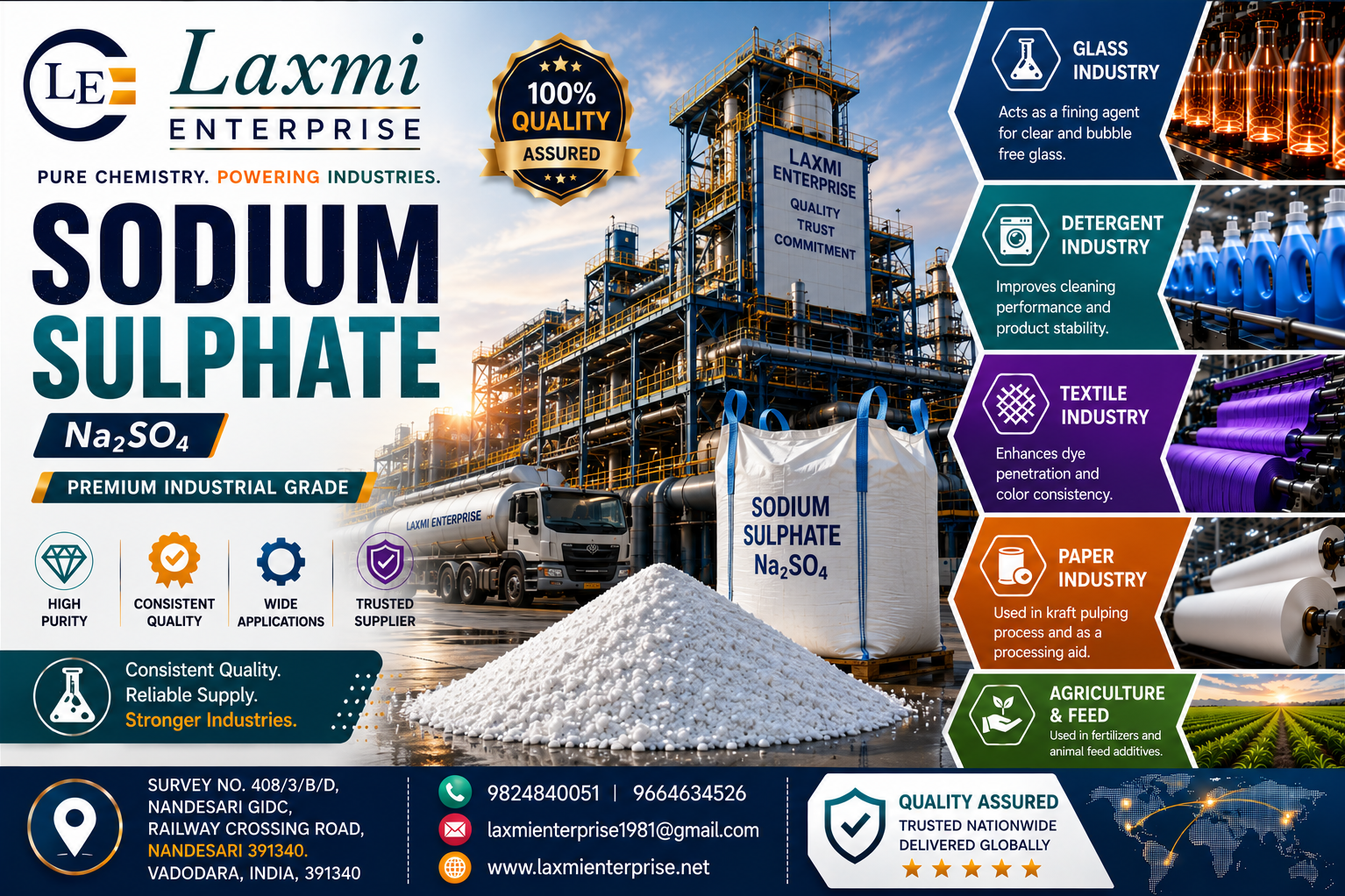
Sodium sulphate (Na₂SO₄) is one of the world's most widely used inorganic salts, serving as a raw material or process chemical in industries such as detergents, glass manufacturing, textile dyeing, kraft pulp and paper, thermal energy storage, chemical processing, and specialty industrial formulations. Despite its simple chemical composition, the methods used to produce sodium sulphate vary considerably depending on the source of raw materials, required purity, and intended industrial application.
Globally, sodium sulphate is produced through two principal routes: natural recovery from mineral deposits and saline lakes, and synthetic production as either a primary product or a by-product of other chemical manufacturing processes. Both routes are commercially important, and each offers distinct advantages in terms of production cost, purity, availability, and environmental impact.
Natural sodium sulphate is commonly obtained from evaporite mineral deposits or brine resources where sodium sulphate occurs in significant concentrations. After extraction, the material undergoes purification, crystallization, drying, and grading before being supplied to industrial users.
Synthetic sodium sulphate, on the other hand, is generated through controlled chemical reactions or recovered as a by-product from selected industrial processes. Depending on the manufacturing route, additional purification may be required to achieve the quality standards expected by detergent manufacturers, glass producers, textile dye houses, and other industrial consumers.
For industrial buyers, understanding how sodium sulphate is manufactured is valuable because production technology directly influences product consistency, impurity profiles, particle size distribution, moisture content, and overall suitability for specific applications. Procurement decisions are therefore based not only on price but also on manufacturing reliability, quality assurance, and the supplier's ability to maintain consistent specifications across multiple production batches.
This guide provides a comprehensive overview of the major manufacturing routes for sodium sulphate, the technologies used in modern production facilities, quality control practices, process equipment, and the key considerations industrial buyers should evaluate when sourcing sodium sulphate.
Global Sources of Sodium Sulphate
Commercial sodium sulphate originates from two broad categories of sources.
Natural Sources
Natural production is based on geological deposits formed over millions of years through the evaporation of mineral-rich water bodies.
Common natural sources include:
Evaporite mineral deposits.
Salt lakes.
Brine deposits.
Natural crystalline minerals.
Seasonal evaporation ponds.
Countries with significant natural sodium sulphate resources have historically supplied large volumes to international markets.
Synthetic Sources
Synthetic production involves chemical manufacturing processes in which sodium sulphate is intentionally produced or recovered as a valuable by-product.
The specific process depends on the chemistry of the parent reaction and the desired product quality.
Understanding Natural Sodium Sulphate Deposits
Natural sodium sulphate occurs in several mineral forms.
Among the best-known are:
Thenardite – the anhydrous form of sodium sulphate.
Mirabilite (Glauber's Salt) – sodium sulphate decahydrate containing ten molecules of water of crystallization.
Environmental conditions such as temperature and humidity influence which mineral form is stable during extraction and storage.
Commercial producers often convert recovered material into the form required by downstream industries through controlled drying and processing operations.
Natural Production Process
Although production methods differ from one location to another, the general sequence includes:
Resource Evaluation
Geological surveys determine the quality, reserve size, and economic feasibility of extraction.
Extraction
Depending on the deposit, sodium sulphate may be recovered through:
Surface mining.
Brine pumping.
Controlled evaporation.
Seasonal harvesting.
Initial Separation
Undesirable materials such as sand, clay, and insoluble minerals are removed through physical separation techniques.
Purification
The recovered solution or solid material is treated to reduce impurities before crystallization.
Crystallization
Carefully controlled cooling or evaporation promotes the formation of sodium sulphate crystals with the desired size and purity.
Dewatering
Excess liquid is removed using filtration or centrifugation.
Drying
Industrial dryers reduce moisture to meet customer specifications.
Screening and Classification
The dried product is separated into required particle size ranges.
Packaging
The finished material is packed according to customer requirements before shipment.
Synthetic Production Routes
Synthetic sodium sulphate can be manufactured using several different industrial processes.
The choice of production route depends on:
Available raw materials.
Existing chemical manufacturing infrastructure.
Product purity requirements.
Market demand.
Environmental regulations.
Economic considerations.
Some production facilities manufacture sodium sulphate specifically for sale, while others recover it as a commercially valuable co-product.
Major Synthetic Manufacturing Routes
Commercial synthetic production commonly includes the following categories.
Recovery from Chemical Manufacturing
Several industrial chemical processes generate sodium sulphate as a recoverable by-product.
Instead of treating it as waste, manufacturers recover, purify, and process the material for commercial sale.
Neutralization Processes
Certain manufacturing routes involve controlled neutralization reactions between sodium-containing compounds and sulphur-based chemicals.
Following purification and crystallization, sodium sulphate is recovered as the final product.
Integrated Chemical Plants
Large integrated chemical complexes often recover sodium sulphate from internal process streams, improving resource efficiency while reducing waste generation.
Why Manufacturing Route Matters
The production method has a direct influence on several product characteristics important to industrial users.
These include:
Chemical purity.
Moisture content.
Chloride concentration.
Iron content.
Water-insoluble matter.
Particle size distribution.
Bulk density.
Flow characteristics.
Product consistency.
Industrial buyers frequently specify acceptable ranges for these properties based on their manufacturing requirements.
Common Process Equipment
Modern sodium sulphate production facilities use specialized equipment designed to ensure efficient processing and consistent product quality.
Typical equipment includes:
Storage tanks.
Reaction vessels.
Clarifiers.
Filtration units.
Centrifuges.
Crystallizers.
Multiple-effect evaporators.
Rotary dryers.
Fluidized-bed dryers.
Vibratory screens.
Bucket elevators.
Screw conveyors.
Storage silos.
Automatic bagging machines.
Bulk loading systems.
The configuration varies according to the manufacturing route and plant capacity.
Importance of Crystallization
Crystallization is one of the most critical operations in sodium sulphate production.
Proper control of this stage influences:
Crystal purity.
Particle size.
Product appearance.
Filtration efficiency.
Drying performance.
Storage behavior.
Customer acceptance.
Temperature, concentration, residence time, and cooling rate are carefully monitored to produce consistent crystals.
Drying and Moisture Control
After crystallization and dewatering, sodium sulphate typically undergoes controlled drying.
The objectives include:
Reducing residual moisture.
Improving storage stability.
Preventing caking.
Enhancing free-flowing properties.
Meeting customer specifications.
The choice of drying technology depends on production capacity, energy efficiency, and desired product characteristics.
Importance of Particle Size Distribution
Different industries often require different particle size ranges.
For example:
Detergent manufacturers may require free-flowing granules.
Glass manufacturers often prefer uniform particle sizes for consistent batch mixing.
Textile dye houses may prioritize rapid dissolution.
Chemical formulators may specify narrow particle size distributions for blending consistency.
Controlling particle size is therefore an essential aspect of production quality.