Specifications, Grades, Quality Standards, Packaging, Storage & Quality Control
Industrial Specifications of Sodium Acetate
Industrial buyers should always purchase Sodium Acetate based on the required specification rather than price alone. The appropriate specification depends on the intended application, regulatory requirements, and process conditions.
Different industries require different purity levels, moisture limits, particle sizes, and documentation. Textile manufacturers may prioritize buffering performance and consistency, while laboratories may require analytical-grade material and pharmaceutical or food applications may require compliance with additional quality standards.
Typical Product Specifications
Parameter Sodium Acetate Anhydrous Sodium Acetate Trihydrate Industrial Importance
Chemical Name Sodium Acetate Anhydrous Sodium Acetate Trihydrate Product identification
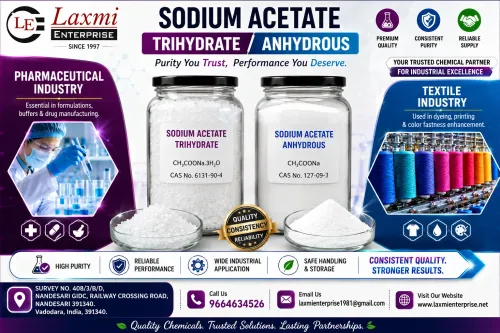
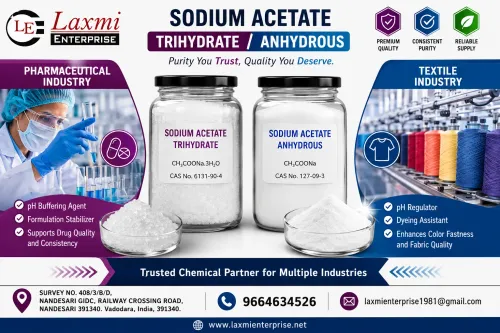
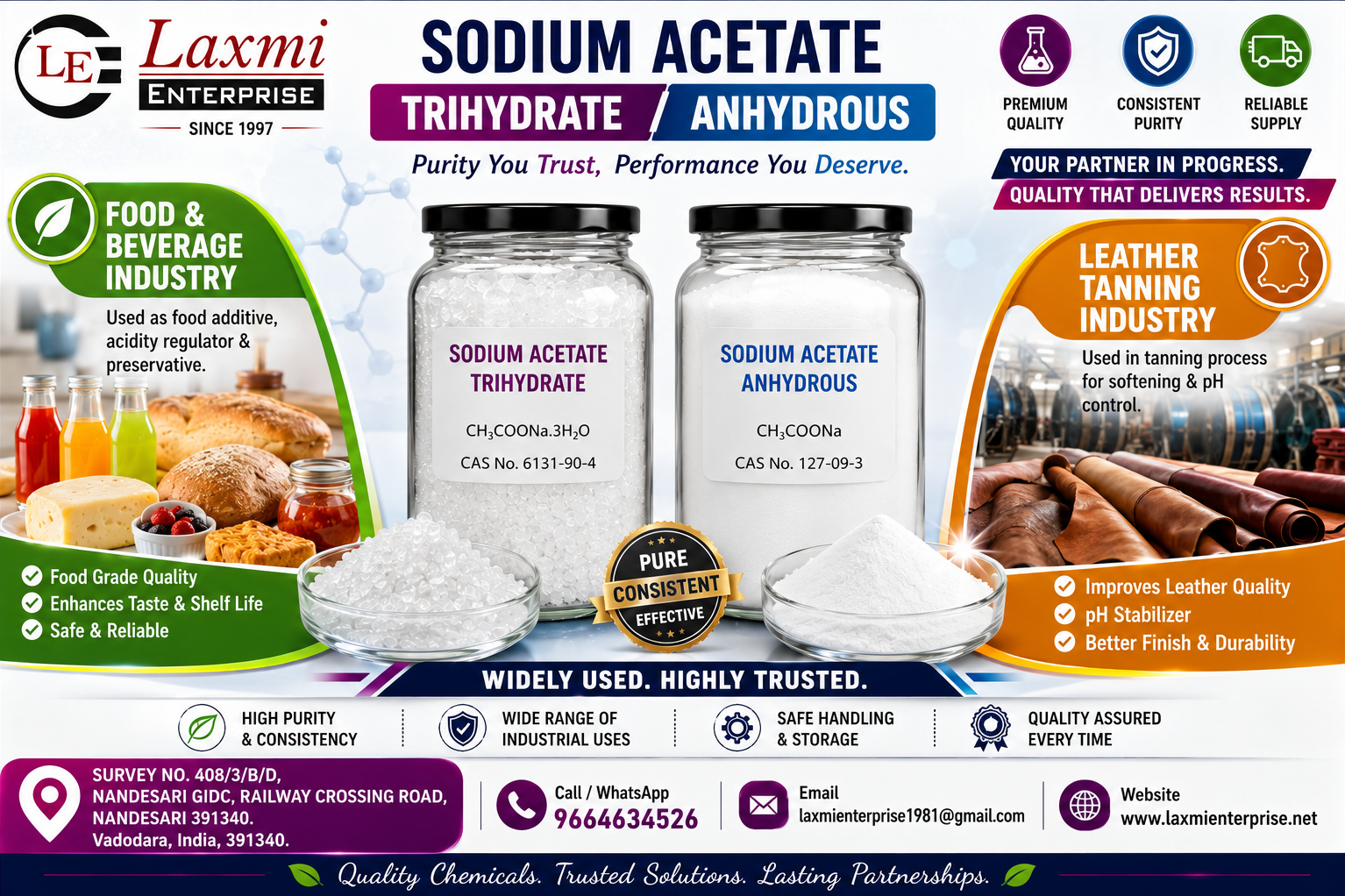
Chemical Formula CH₃COONa CH₃COONa·3H₂O Chemical identity
CAS Number 127-09-3 6131-90-4 International identification
HSN Code 2915 2915 GST & customs classification
Appearance White crystalline powder White crystalline crystals Visual quality inspection
Solubility Highly soluble in water Highly soluble in water Process efficiency
Storage Dry, cool place Dry, cool place Product stability
Packaging Industrial bags Industrial bags Safe transportation
Note: Exact specification values depend on grade, manufacturer, and customer requirements. Always verify the latest Certificate of Analysis (COA).
Available Grades
Sodium Acetate is manufactured in multiple grades to meet the quality requirements of different industries. Selecting the correct grade helps improve process consistency and ensures compliance with customer specifications.
Comparison of Available Grades
Grade Typical Applications Key Characteristics
Industrial Grade Textile, leather, chemicals, water treatment Cost-effective for industrial processing
Technical Grade Manufacturing, chemical processing Consistent industrial quality
Laboratory Grade (LR) Educational and routine laboratory work Suitable for general laboratory use
Analytical Reagent (AR) Grade Analytical laboratories Higher purity for analytical procedures
Food Grade* Food applications (where permitted) Manufactured to applicable food specifications
Pharmaceutical Grade* Pharmaceutical applications (where applicable) Manufactured according to applicable pharmaceutical quality requirements
* Availability depends on manufacturer capability, regulatory requirements, and customer specifications.
How to Select the Right Grade
Choosing the right Sodium Acetate grade is one of the most important purchasing decisions.
Grade Selection Guide
Industry Recommended Grade Reason
Textile Dyeing Industrial / Technical Process consistency
Garment Processing Industrial / Technical Buffering applications
Chemical Manufacturing Technical Reliable manufacturing
Research Laboratory AR / LR Laboratory accuracy
Universities LR Grade Educational testing
Food Industry Food Grade* Regulatory compliance
Pharmaceutical Industry Pharmaceutical Grade* Controlled quality requirements
Water Treatment Industrial Grade Cost-effective industrial use
Engineering Insight
Using a grade that exceeds your process requirement may unnecessarily increase costs, while using a lower grade than required may affect product quality, regulatory compliance, or process performance.
Packaging Standards
Packaging protects Sodium Acetate from moisture, contamination, and physical damage during transportation and storage.
Common Industrial Packaging
Packaging Type Typical Capacity Applications
HDPE Bag with Inner Liner 25 kg Standard industrial supply
Woven PP Bag with Liner 25 kg Bulk industrial distribution
Jumbo Bag (FIBC) 500–1000 kg Large manufacturing plants
Customized Packaging As required OEM and export requirements
Good packaging reduces handling losses and supports longer storage stability.
Packaging Inspection Checklist
Receiving personnel should inspect every shipment before accepting delivery.
Inspection Item What to Verify
Package Integrity No tears or punctures
Product Label Correct product name
CAS Number Matches purchase specification
Batch Number Clearly printed
Net Weight Matches ordered quantity
Moisture Protection Inner liner intact
Manufacturing Details Available where applicable
Documentation COA, TDS, SDS received
Storage Recommendations
Proper storage preserves product quality throughout its intended shelf life.
Recommended Storage Conditions
Storage Requirement Recommendation Purpose
Storage Area Clean and dry warehouse Prevent contamination
Moisture Protect from humidity Maintain product quality
Packaging Keep tightly sealed Reduce moisture absorption
Pallet Storage Store above floor level Improve warehouse hygiene
Inventory Method FIFO (First In, First Out) Better inventory management
Inspection Periodic warehouse checks Ensure continued quality
Warehouse Insight
Most quality issues associated with Sodium Acetate arise from improper storage rather than manufacturing defects. A dry warehouse and good inventory practices help maintain product performance.
Shelf Life
When stored under recommended conditions and in its original packaging, Sodium Acetate generally offers excellent storage stability.
However, shelf life may vary depending on:
Product grade
Packaging quality
Warehouse conditions
Temperature
Humidity
Handling practices
Always follow the manufacturer's storage recommendations and inventory control procedures.
Transportation Guidelines
Sodium Acetate is transported throughout India and international markets by road, rail, sea, and multimodal logistics.
Transportation Best Practices
Transport Factor Best Practice
Loading Protect bags from physical damage
Moisture Keep cargo dry throughout transport
Stacking Avoid excessive compression
Documentation Carry complete shipping documents
Vehicle Condition Clean and weather-protected
Delivery Inspection Check packaging before unloading
Certificate of Analysis (COA)
A Certificate of Analysis (COA) provides batch-specific quality information.
Typical COA Information
Section Purpose
Product Name Product identification
Grade Product classification
Batch Number Batch traceability
CAS Number Chemical identification
Test Parameters Verified quality characteristics
Test Results Batch-specific results
Approval Quality department authorization
The COA helps buyers verify that the supplied batch meets agreed specifications.
Technical Data Sheet (TDS)
The Technical Data Sheet (TDS) explains the product's technical characteristics and recommended applications.
Typical sections include:
TDS Section Information Provided
Product Description General overview
Chemical Identity Formula and CAS Number
Physical Properties Appearance and characteristics
Applications Typical industrial uses
Storage Recommended storage conditions
Packaging Available pack sizes
Safety References Related SDS guidance
Safety Data Sheet (SDS)
The Safety Data Sheet (SDS) provides information on safe handling, storage, first aid, and emergency response.
Every industrial user should ensure that current SDS documents are available to employees handling the product.
Incoming Material Inspection
Professional manufacturers generally verify incoming Sodium Acetate before production.
Incoming Inspection Checklist
Inspection Item Inspection Objective
Product Identity Confirm correct material
Packaging Verify package condition
Batch Number Maintain traceability
COA Verification Confirm specification compliance
Visual Appearance Check for abnormalities
Storage Condition Confirm proper transportation
Documentation Complete quality records
Quality Control Philosophy
Leading manufacturers understand that quality begins before production starts.
A strong quality control system includes:
Approved suppliers
Incoming inspection
Laboratory verification
Batch traceability
Documentation control
Warehouse management
Customer feedback
Continuous improvement
Reliable quality systems reduce production variability and strengthen customer confidence.
Keywords