Sodium Sulphate Chemical & Physical Properties – Complete Technical Guide (2026)
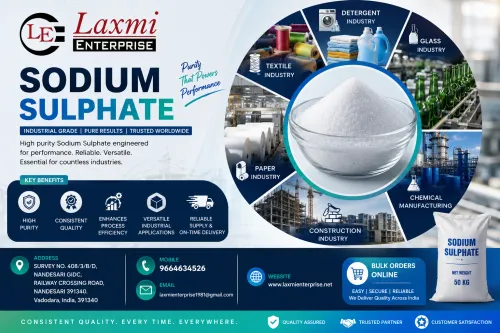
The chemical and physical properties of Sodium Sulphate determine how it performs in industrial applications such as glass manufacturing, detergent production, textile dyeing, paper processing, ceramics, and chemical manufacturing. Understanding properties like purity, molecular structure, crystal form, solubility, density, thermal stability, particle size, and moisture behavior helps buyers choose the correct grade and optimize manufacturing performance.
Table of Contents
Introduction
What is Sodium Sulphate?
Chemical Identity
Molecular Structure
Crystal Structure
Physical Properties
Chemical Properties
Solubility Characteristics
Thermal Properties
Hygroscopic Behaviour
Particle Size Distribution
Bulk Density
Flow Characteristics
Purity & Industrial Performance
Important Impurities
Property Comparison by Industry
Storage & Stability
Laboratory Testing
Industrial Buyer Checklist
Frequently Asked Questions
Conclusion
Introduction
Sodium Sulphate is one of the most widely used inorganic salts in industrial manufacturing. Although it appears to be a simple white crystalline powder, its chemical and physical properties directly influence production efficiency, product quality, storage stability, and manufacturing costs.
For procurement managers, quality engineers, laboratory personnel, and production teams, understanding these properties is essential when selecting the right grade for a specific application.
Industrial suppliers such as Laxmi Enterprise, based in Nandesari GIDC, Vadodara, Gujarat, support customers across Pan India by supplying Sodium Sulphate with specifications suited to diverse industrial requirements.
What is Sodium Sulphate?
Sodium Sulphate is an inorganic salt consisting of sodium ions (Na⁺) and sulfate ions (SO₄²⁻). It is chemically stable under normal industrial conditions and is available in two principal forms:
Anhydrous Sodium Sulphate (Na₂SO₄) – the most common industrial form.
Sodium Sulphate Decahydrate (Na₂SO₄·10H₂O) – commonly known as Glauber's Salt.
The anhydrous grade is widely used because of its stability, ease of storage, and compatibility with many manufacturing processes.
Chemical Identity
Property Value
Chemical Name Sodium Sulphate
Common Name Salt Cake
Chemical Formula Na₂SO₄
Molecular Weight 142.04 g/mol
CAS Number 7757-82-6
EINECS Number 231-820-9
Appearance White crystalline powder or granules
Odour Odourless
Chemical Nature Neutral inorganic salt
Crystal System Orthorhombic (anhydrous form)
These identifiers are commonly referenced in technical documents, Certificates of Analysis (COA), Safety Data Sheets (SDS/MSDS), and procurement specifications.
Molecular Structure
Quick Answer
Sodium Sulphate consists of two sodium ions bonded ionically to one sulfate ion. This ionic structure contributes to its chemical stability, water solubility, and suitability for industrial applications requiring a non-reactive inorganic salt.
The sulfate ion has a tetrahedral geometry, with sulfur centrally bonded to four oxygen atoms. Sodium ions are held by electrostatic forces rather than covalent bonds, allowing the compound to dissolve readily in water.
This structure explains why Sodium Sulphate functions effectively as a process aid, filler, or flux rather than as a highly reactive chemical.
Crystal Structure
Anhydrous Sodium Sulphate crystallizes in the orthorhombic crystal system. Crystal structure affects:
Mechanical strength
Flow behaviour
Packing efficiency
Dissolution rate
Particle stability
Storage performance
Controlled crystallization during manufacturing helps achieve consistent particle characteristics, which are important for automated handling and blending operations.
Physical Properties
Quick Answer
The physical properties of Sodium Sulphate—such as appearance, density, particle size, flowability, and moisture content—are critical for transportation, storage, dosing, and performance in industrial manufacturing.
Property Typical Characteristic
Appearance White crystalline powder or granules
Odour Odourless
State Solid
Water Solubility High
Flowability Good when dry
Density Application-dependent
Bulk Density Varies with particle size
Particle Shape Crystalline
Industrial users often specify acceptable ranges for these properties based on process requirements.
Chemical Properties
Sodium Sulphate is valued for several chemical characteristics:
High chemical stability under normal conditions.
Non-flammable and non-combustible.
Compatible with many inorganic systems.
Neutral salt with broad industrial applicability.
Resistant to decomposition at ordinary storage temperatures.
Because of these properties, it is used where a stable inorganic material is required without introducing unwanted chemical reactions.
Solubility Characteristics
Quick Answer
Sodium Sulphate is highly soluble in water, making it suitable for applications requiring dissolution or dispersion. Solubility varies with temperature, which is an important consideration in certain industrial processes.
Solubility influences:
Dye bath preparation
Chemical formulations
Process efficiency
Cleaning operations
Product consistency
Proper mixing and temperature control help ensure complete dissolution where required.
Thermal Properties
Sodium Sulphate exhibits good thermal stability under normal industrial conditions. Key considerations include:
Stable during standard storage and handling.
Suitable for elevated-temperature processes such as glass manufacturing.
Low volatility.
Does not contribute to flammability.
Its thermal characteristics support use in industries where materials are exposed to high processing temperatures.
Hygroscopic Behaviour
Quick Answer
Anhydrous Sodium Sulphate is not strongly hygroscopic under ordinary conditions but can absorb moisture when exposed to humid environments for extended periods. Proper packaging and storage help maintain product quality.
To reduce moisture uptake:
Store in dry warehouses.
Keep bags sealed.
Avoid direct contact with water.
Protect from rain during transport.
Rotate inventory using first-in, first-out (FIFO) practices.
Particle Size Distribution
Particle size influences:
Dust generation.
Flow through conveying systems.
Mixing efficiency.
Dissolution rate.
Packaging behaviour.
Bulk handling.
Manufacturers often classify material into different size ranges depending on customer specifications.
Bulk Density
Bulk density affects:
Storage capacity.
Packaging efficiency.
Truck loading.
Container utilization.
Automated feeding systems.
Because bulk density varies with particle size and manufacturing conditions, buyers should refer to the supplier's technical specification rather than assuming a universal value.
Flow Characteristics
Good flowability supports:
Automatic bag filling.
Silo discharge.
Conveyor systems.
Screw feeders.
Uniform batching.
Excessive moisture or poor particle size control can reduce flow performance.
Purity and Industrial Performance
Quick Answer
Higher purity Sodium Sulphate generally provides more consistent performance, but the required purity depends on the application. Buyers should select a grade that matches process requirements rather than automatically choosing the highest available purity.
Examples:
Glass manufacturing may require tight control of certain impurities.
Textile dyeing emphasizes consistency and predictable dissolution.
Detergent manufacturing focuses on product uniformity and handling characteristics.
Common Impurities
Industrial specifications commonly monitor:
Chlorides
Water-insoluble matter
Iron
Moisture
Calcium compounds
Magnesium compounds
Other trace inorganic materials
The acceptable level of each impurity depends on the intended application.
Property Requirements by Industry
Industry Critical Properties
Glass Purity, iron, moisture
Detergent Particle size, flowability, purity
Textile Solubility, chloride, consistency
Paper Purity, moisture
Ceramics Particle size, consistency
Chemicals Application-specific specifications
Storage and Stability
Proper storage helps preserve product quality.
Recommended practices:
Keep material in original sealed packaging.
Store indoors in a dry, ventilated warehouse.
Avoid prolonged exposure to moisture.
Protect from physical contamination.
Inspect packaging before use.
When stored correctly, Sodium Sulphate maintains its properties for extended periods.
Laboratory Testing
Typical quality control tests include:
Purity analysis
Moisture determination
Water-insoluble matter
Chloride analysis
Iron determination
Particle size distribution
Bulk density
Visual inspection
Testing supports batch consistency and compliance with customer specifications.
Industrial Buyer Checklist
Before purchasing, verify:
Application requirements.
Required purity.
Moisture limits.
Particle size specification.
Packaging type.
COA availability.
TDS availability.
SDS/MSDS availability.
Batch traceability.
Storage recommendations.
Frequently Asked Questions
Is Sodium Sulphate acidic or alkaline?
Sodium Sulphate is generally considered a neutral inorganic salt under normal conditions.
Does particle size matter?
Yes. Particle size affects handling, blending, dissolution, dust generation, and process efficiency.
Can Sodium Sulphate deteriorate during storage?
When stored in dry, properly sealed conditions, Sodium Sulphate remains stable for long periods. Moisture exposure, however, can affect handling characteristics.
Why is bulk density important?
Bulk density influences packaging, storage, transport efficiency, and automated material handling systems.
Conclusion
The chemical and physical properties of Sodium Sulphate directly influence its suitability for industrial applications. Factors such as purity, crystal form, particle size, moisture content, solubility, and storage stability determine how the material performs in manufacturing processes across glass, detergents, textiles, paper, ceramics, and chemical industries.
For industrial buyers across Gujarat, Maharashtra, Rajasthan, Delhi NCR, Uttar Pradesh, Punjab, Haryana, Madhya Pradesh, Karnataka, Tamil Nadu, Telangana, Andhra Pradesh, West Bengal, Odisha, Chhattisgarh, Jharkhand, Assam, Kerala, and other manufacturing regions, understanding these properties supports informed procurement decisions.
Laxmi Enterprise, located in Nandesari GIDC, Vadodara, Gujarat, supplies industrial-grade Sodium Sulphate to customers across Pan India, providing technical documentation, quality-focused sourcing, and reliable logistics tailored to industrial requirements.
Keywords