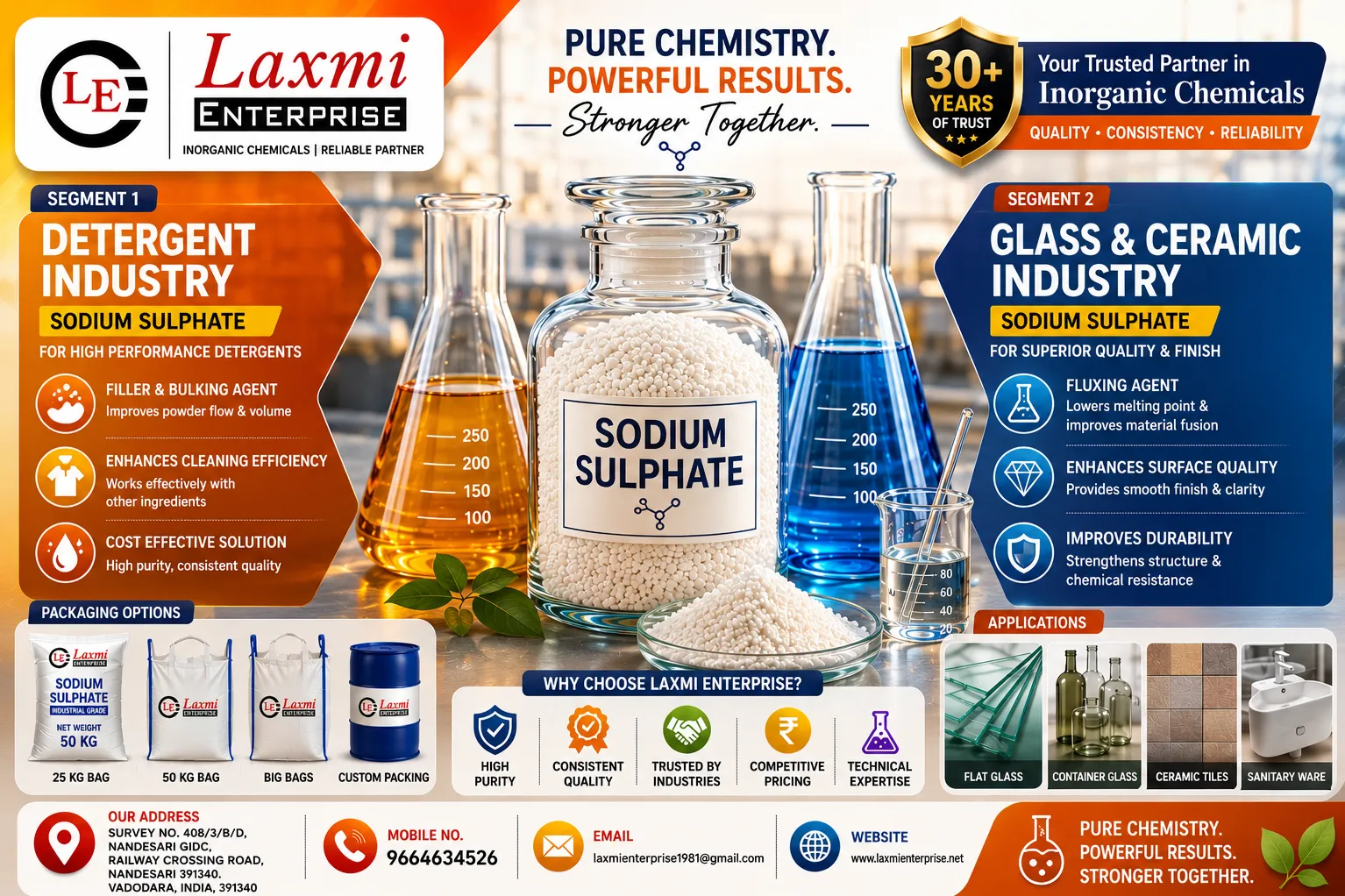
Sodium Sulphate Quality Testing Methods: A Practical Guide for Quality Control Laboratories
Every batch of raw material entering a manufacturing plant carries a responsibility.
Once approved, it becomes part of the production process.
If the material performs as expected, production continues smoothly.
If the material varies unexpectedly, the effects may be noticed in production, quality control, inventory management and even customer satisfaction.
This is why quality testing is one of the most important activities in industrial manufacturing.
For Sodium Sulphate, laboratory testing is not performed simply to complete documentation.
It helps manufacturers confirm that incoming material is suitable for production and consistent with their internal quality requirements.
A disciplined testing process reduces uncertainty, supports production planning and strengthens confidence throughout the organisation.
Quality Control Starts Before Laboratory Testing
Many people associate quality control only with laboratory analysis.
In reality, quality control begins much earlier.
It starts when the delivery vehicle reaches the factory.
Packaging is inspected.
Documentation is verified.
Labels are checked.
The condition of the shipment is observed.
Only after these activities are completed should representative samples move to the laboratory.
A structured receiving process improves the reliability of laboratory results because the material being tested accurately represents the shipment received.
The Purpose of Quality Testing
Laboratory testing serves several important objectives.
It confirms that the material meets the company's internal quality requirements.
It helps maintain consistency between deliveries.
It provides confidence before production begins.
It creates technical records for future reference.
Most importantly, it allows manufacturers to identify unusual variations before the material enters production.
Quality testing is therefore a preventive activity rather than a corrective one.
A good laboratory prevents problems.
It does not simply report them.
Develop a Standard Testing Procedure
Every manufacturing company should establish a documented procedure for incoming raw material testing.
The same inspection sequence should be followed for every shipment.
The same sampling procedure should be used.
The same laboratory methods should be applied.
The same acceptance criteria should be followed.
Consistency in laboratory practice improves confidence in the results.
Quality systems become stronger when testing procedures remain unchanged regardless of the supplier or production urgency.
Representative Sampling Is Essential
Even the most advanced laboratory cannot produce meaningful results if the sample does not represent the entire shipment.
Sampling should therefore receive the same attention as laboratory analysis.
Samples should be collected according to the company's internal quality procedures.
They should be identified clearly.
Proper records should be maintained.
Sample integrity is fundamental to reliable laboratory evaluation.
Accurate testing begins with accurate sampling.
Physical Examination Is the First Laboratory Observation
Before performing technical analysis, laboratory personnel should carefully observe the material.
Appearance.
Uniformity.
Flow characteristics.
Visible contamination.
Packaging condition.
These simple observations often provide useful information that complements laboratory analysis.
Experienced quality engineers understand that practical observations remain an important part of technical evaluation.
Consistency Between Shipments Matters More Than Individual Results
A laboratory report reflects one shipment.
Quality management evaluates performance over many shipments.
Manufacturers should maintain historical testing records.
Review long-term trends.
Compare supplier performance over time.
Observe whether quality remains stable.
Long-term consistency provides much greater confidence than isolated laboratory reports.
Reliable suppliers demonstrate consistency year after year.
Laboratory Results Should Support Production
Quality control does not operate independently.
Laboratory findings should be discussed with production teams whenever necessary.
Did the material perform as expected?
Were any process adjustments required?
Did operators report normal production behaviour?
Combining laboratory data with production experience provides a complete understanding of raw material performance.
Technical decisions become stronger when departments share information.
Maintain Proper Laboratory Documentation
Laboratory records become valuable references over time.
Every test result should be documented clearly.
Inspection dates.
Supplier information.
Internal reference numbers.
Observations.
Approval status.
Organised documentation supports traceability, supplier evaluation and future audits.
Professional laboratories maintain records with the same discipline used during testing.
Review Quality Trends Periodically
Quality should never be evaluated only shipment by shipment.
Quality managers should review supplier performance every few months.
Have laboratory results remained consistent?
Are variations increasing or decreasing?
Have packaging standards improved?
Has supplier performance remained stable?
Trend analysis helps manufacturers identify opportunities before they become production challenges.
Continuous improvement depends on regular review.
Laboratory Equipment Requires Regular Verification
Reliable testing depends on reliable equipment.
Laboratory instruments should be maintained according to the company's quality management procedures.
Routine verification improves confidence in analytical results.
Well-maintained equipment supports consistent testing and reduces the possibility of incorrect decisions.
Laboratory discipline extends beyond analytical methods.
It includes maintaining the tools used for quality evaluation.
Quality Culture Begins with People
Even the best procedures require disciplined people.
Quality engineers.
Laboratory technicians.
Warehouse inspectors.
Production supervisors.
Each person contributes to the overall quality system.
Training, communication and shared responsibility create stronger manufacturing organisations.
Quality is not created by a laboratory alone.
It is created by the people who follow disciplined systems every day.
How Laxmi Enterprise Supports Customer Quality Assurance
At Laxmi Enterprise, we understand that every shipment we supply becomes part of our customer's quality management process.
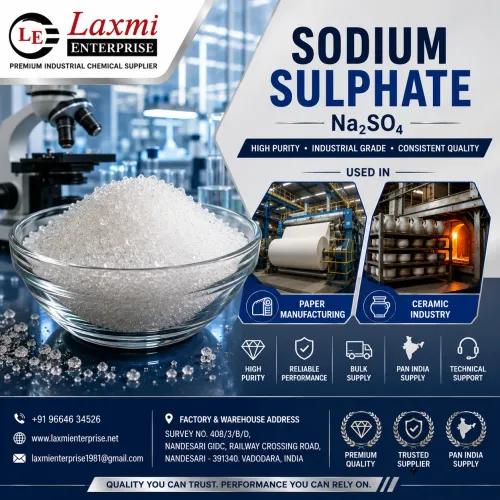
Operating from Nandesari GIDC, Vadodara, we supply Sodium Sulphate and other industrial chemicals to manufacturers across India.
Our focus is on maintaining consistent product quality, organised documentation, professional packaging and dependable deliveries because we know these elements simplify quality control at our customers' facilities.
We believe that strong supplier relationships are built through consistency, transparency and technical confidence.
Every shipment reflects our commitment to supporting efficient manufacturing and dependable quality systems.
Final Thoughts
Quality testing is far more than a laboratory routine.
It protects production.
It strengthens procurement.
It improves supplier evaluation.
It supports customer satisfaction.
Manufacturers who develop disciplined testing procedures build stronger quality systems and more reliable manufacturing operations.
Consistent quality begins with consistent testing.
Reliable production begins with reliable quality control.
Frequently Asked Questions
Why is Sodium Sulphate quality testing important?
Quality testing helps manufacturers verify consistency, reduce production risks and ensure incoming material is suitable for manufacturing.
What is the first step before laboratory testing?
The first step is inspecting the shipment, verifying documentation, checking packaging and collecting representative samples according to the company's quality procedures.
Why is representative sampling important?
A representative sample ensures that laboratory results accurately reflect the overall shipment and support reliable quality decisions.
Should production teams be involved in quality evaluation?
Yes. Production feedback helps quality teams understand how the material performs under actual manufacturing conditions.
Why do manufacturers across India choose Laxmi Enterprise?
Manufacturers choose Laxmi Enterprise because we provide consistent-quality Sodium Sulphate supported by dependable packaging, organised documentation and reliable deliveries. Operating from Nandesari GIDC, Vadodara, we help manufacturers strengthen their quality assurance systems through professional industrial chemical supply.
About Laxmi Enterprise
Laxmi Enterprise is a trusted manufacturer, supplier and distributor of industrial chemicals based in Nandesari GIDC, Vadodara, Gujarat. We supply Sodium Sulphate, Sodium Nitrate, Sodium Acetate, Tri Sodium Phosphate and other industrial chemicals to detergent, textile, glass, paper, ceramic, construction, water treatment and chemical processing industries across India.
With decades of industrial experience, we are committed to supporting manufacturers through consistent product quality, dependable logistics, professional technical support and long-term customer partnerships. Our objective is to help industries achieve reliable production, efficient quality management and sustainable business growth.
Every batch of raw material entering a manufacturing plant carries a responsibility.
Once approved, it becomes part of the production process.
If the material performs as expected, production continues smoothly.
If the material varies unexpectedly, the effects may be noticed in production, quality control, inventory management and even customer satisfaction.
This is why quality testing is one of the most important activities in industrial manufacturing.
For Sodium Sulphate, laboratory testing is not performed simply to complete documentation.
It helps manufacturers confirm that incoming material is suitable for production and consistent with their internal quality requirements.
A disciplined testing process reduces uncertainty, supports production planning and strengthens confidence throughout the organisation.
Quality Control Starts Before Laboratory Testing
Many people associate quality control only with laboratory analysis.
In reality, quality control begins much earlier.
It starts when the delivery vehicle reaches the factory.
Packaging is inspected.
Documentation is verified.
Labels are checked.
The condition of the shipment is observed.
Only after these activities are completed should representative samples move to the laboratory.
A structured receiving process improves the reliability of laboratory results because the material being tested accurately represents the shipment received.
The Purpose of Quality Testing
Laboratory testing serves several important objectives.
It confirms that the material meets the company's internal quality requirements.
It helps maintain consistency between deliveries.
It provides confidence before production begins.
It creates technical records for future reference.
Most importantly, it allows manufacturers to identify unusual variations before the material enters production.
Quality testing is therefore a preventive activity rather than a corrective one.
A good laboratory prevents problems.
It does not simply report them.
Develop a Standard Testing Procedure
Every manufacturing company should establish a documented procedure for incoming raw material testing.
The same inspection sequence should be followed for every shipment.
The same sampling procedure should be used.
The same laboratory methods should be applied.
The same acceptance criteria should be followed.
Consistency in laboratory practice improves confidence in the results.
Quality systems become stronger when testing procedures remain unchanged regardless of the supplier or production urgency.
Representative Sampling Is Essential
Even the most advanced laboratory cannot produce meaningful results if the sample does not represent the entire shipment.
Sampling should therefore receive the same attention as laboratory analysis.
Samples should be collected according to the company's internal quality procedures.
They should be identified clearly.
Proper records should be maintained.
Sample integrity is fundamental to reliable laboratory evaluation.
Accurate testing begins with accurate sampling.
Physical Examination Is the First Laboratory Observation
Before performing technical analysis, laboratory personnel should carefully observe the material.
Appearance.
Uniformity.
Flow characteristics.
Visible contamination.
Packaging condition.
These simple observations often provide useful information that complements laboratory analysis.
Experienced quality engineers understand that practical observations remain an important part of technical evaluation.
Consistency Between Shipments Matters More Than Individual Results
A laboratory report reflects one shipment.
Quality management evaluates performance over many shipments.
Manufacturers should maintain historical testing records.
Review long-term trends.
Compare supplier performance over time.
Observe whether quality remains stable.
Long-term consistency provides much greater confidence than isolated laboratory reports.
Reliable suppliers demonstrate consistency year after year.
Laboratory Results Should Support Production
Quality control does not operate independently.
Laboratory findings should be discussed with production teams whenever necessary.
Did the material perform as expected?
Were any process adjustments required?
Did operators report normal production behaviour?
Combining laboratory data with production experience provides a complete understanding of raw material performance.
Technical decisions become stronger when departments share information.
Maintain Proper Laboratory Documentation
Laboratory records become valuable references over time.
Every test result should be documented clearly.
Inspection dates.
Supplier information.
Internal reference numbers.
Observations.
Approval status.
Organised documentation supports traceability, supplier evaluation and future audits.
Professional laboratories maintain records with the same discipline used during testing.
Review Quality Trends Periodically
Quality should never be evaluated only shipment by shipment.
Quality managers should review supplier performance every few months.
Have laboratory results remained consistent?
Are variations increasing or decreasing?
Have packaging standards improved?
Has supplier performance remained stable?
Trend analysis helps manufacturers identify opportunities before they become production challenges.
Continuous improvement depends on regular review.
Laboratory Equipment Requires Regular Verification
Reliable testing depends on reliable equipment.
Laboratory instruments should be maintained according to the company's quality management procedures.
Routine verification improves confidence in analytical results.
Well-maintained equipment supports consistent testing and reduces the possibility of incorrect decisions.
Laboratory discipline extends beyond analytical methods.
It includes maintaining the tools used for quality evaluation.
Quality Culture Begins with People
Even the best procedures require disciplined people.
Quality engineers.
Laboratory technicians.
Warehouse inspectors.
Production supervisors.
Each person contributes to the overall quality system.
Training, communication and shared responsibility create stronger manufacturing organisations.
Quality is not created by a laboratory alone.
It is created by the people who follow disciplined systems every day.
How Laxmi Enterprise Supports Customer Quality Assurance
At Laxmi Enterprise, we understand that every shipment we supply becomes part of our customer's quality management process.
Operating from Nandesari GIDC, Vadodara, we supply Sodium Sulphate and other industrial chemicals to manufacturers across India.
Our focus is on maintaining consistent product quality, organised documentation, professional packaging and dependable deliveries because we know these elements simplify quality control at our customers' facilities.
We believe that strong supplier relationships are built through consistency, transparency and technical confidence.
Every shipment reflects our commitment to supporting efficient manufacturing and dependable quality systems.
Final Thoughts
Quality testing is far more than a laboratory routine.
It protects production.
It strengthens procurement.
It improves supplier evaluation.
It supports customer satisfaction.
Manufacturers who develop disciplined testing procedures build stronger quality systems and more reliable manufacturing operations.
Consistent quality begins with consistent testing.
Reliable production begins with reliable quality control.
Frequently Asked Questions
Why is Sodium Sulphate quality testing important?
Quality testing helps manufacturers verify consistency, reduce production risks and ensure incoming material is suitable for manufacturing.
What is the first step before laboratory testing?
The first step is inspecting the shipment, verifying documentation, checking packaging and collecting representative samples according to the company's quality procedures.
Why is representative sampling important?
A representative sample ensures that laboratory results accurately reflect the overall shipment and support reliable quality decisions.
Should production teams be involved in quality evaluation?
Yes. Production feedback helps quality teams understand how the material performs under actual manufacturing conditions.
Why do manufacturers across India choose Laxmi Enterprise?
Manufacturers choose Laxmi Enterprise because we provide consistent-quality Sodium Sulphate supported by dependable packaging, organised documentation and reliable deliveries. Operating from Nandesari GIDC, Vadodara, we help manufacturers strengthen their quality assurance systems through professional industrial chemical supply.
About Laxmi Enterprise
Laxmi Enterprise is a trusted manufacturer, supplier and distributor of industrial chemicals based in Nandesari GIDC, Vadodara, Gujarat. We supply Sodium Sulphate, Sodium Nitrate, Sodium Acetate, Tri Sodium Phosphate and other industrial chemicals to detergent, textile, glass, paper, ceramic, construction, water treatment and chemical processing industries across India.
With decades of industrial experience, we are committed to supporting manufacturers through consistent product quality, dependable logistics, professional technical support and long-term customer partnerships. Our objective is to help industries achieve reliable production, efficient quality management and sustainable business growth.
Keywords