

Below is a practical, IC-focused guide to mitigating sulfate (SO₄²⁻) interference, especially relevant for high-TDS, biopharma, environmental, and weak-acid analysis—areas you’ve been asking about recently
Dilution with Sensitivity Recovery
- Dilute sample to bring sulfate within suppressor capacity
- Use:
- Large-volume injection (LVI)
- High-capacity columns
- Typical target: SO₄²⁻ < 1–2 meq/L entering the suppressor
Inline sulfate traps
- Barium- or silver-loaded cartridges
- Installed before injector or after pump
Offline precipitation
- Add BaCl₂ → BaSO₄ precipitation
- Filter (0.2 µm) before IC
On-Guard™ Ag, Ba, or H cartridges
Dialysis or ultrafiltration (biopharma)
Column Selection
Use high sulfate-capacity columns:
- AS11-HC / AS18-HC / AS19-HC
- Smaller particle size → better peak shape under overload
- Use hydroxide gradient instead of isocratic
- Start low to resolve weak acids, ramp quickly to elute sulfate
- Avoid carbonate eluents (increase sulfate dominance)
Increase column temperature (30–40 °C)
Reduces sulfate retention and peak broadening
Suppressor Capacity Management
- Use high-capacity suppressors
- Lower flow rate if possible
- Avoid continuous sulfate overloading
Frequent regeneration cycles
Monitor:
- Background conductivity
- Noise drift
Post-Column Reaction (PCR)
- Convert target analytes to UV-active species
- Sulfate remains “invisible” in UV
- Conductivity + UV
- Quantify sulfate by conductivity, weak acids by UV
If sulfate masks acetate, formate, lactate:
- Use carbonate-free hydroxide eluent
- Lower suppressor current
- Shorter columns + gradient elution
- Consider heart-cutting 2D-IC for regulated work
Use smaller injection volume
Narrow bore columns
Reduce eluent strength
Use calibration weighted toward high range
ProblemBest StrategyHigh sulfate, weak acidsInline sulfate trap + gradientSuppressor saturationDilution + LVIBiopharma matrixDesalting + UV detectionPoor weak-acid sensitivityPCR or dual detectionRoutine sulfate-rich samplesHigh-capacity column + suppressor
Below is a clear, mechanism-level explanation of sulfate overloading effects on IC suppressors, with practical symptoms, causes, and diagnostics—tailored to the high-sulfate / weak-anion challenges you’re dealing with.
In anion IC with suppressed conductivity:
- Suppressor exchanges Na⁺ / K⁺ → H⁺
- Sulfate (SO₄²⁻) produces 2 equivalents of strong acid (H₂SO₄) per mole
- This rapidly consumes suppressor exchange capacity
Loss of Suppression Efficiency
- Incomplete Na⁺ → H⁺ exchange
- Residual sodium sulfate passes to detector
Observed as:
- Elevated background conductivity
- Loss of sensitivity for early-eluting weak acids
Weak acids (acetate, formate, lactate):
- Rely on low background + full protonation
- Are first to disappear when suppressor capacity is exceeded
Typical symptom:
- Sulfate peak looks “normal”
- Weak acids vanish or flatten
- Suppressor operates near saturation
- Regeneration cannot keep up
Observed as:
- Rising baseline during run
- Increased noise after sulfate elution
- Poor peak integration reproducibility
- Partial suppression varies with sulfate load
- Detector response becomes matrix-dependent
Result:
- Poor R² for weak acids
- Day-to-day sensitivity variation
Accelerated Suppressor Aging
- Resin exhaustion
- Membrane fouling
- Permanent capacity loss
Higher suppressor current demand
Gas bubble formation → spikes or dropouts
IndicatorMeaningHigh background conductivityIncomplete suppressionWeak acids disappearingCapacity exceededBaseline rising after sulfateRegeneration lagSignal recovers after dilutionSulfate overload confirmedSuppressor current near maxCapacity stress
- 1 mg/L sulfate ≈ 0.021 meq/L
- Suppressor capacity is rated in meq/min
If:
- Injection load > 10–20% of suppressor dynamic capacity per run
- → overload effects begin
Sulfate peak tailing or fronting
Negative dips before/after sulfate peak
Shift in retention times for late-eluting anions
Irreversible baseline offset
AnionChargeAcid strengthSuppressor stressCl⁻−1HCl (strong)ModerateNO₃⁻−1HNO₃ (strong)ModerateSO₄²⁻−2H₂SO₄ (very strong)Severe
- Sulfate overload primarily damages weak-anion detection
- Baseline drift and noise are early warning signs
- Effects may appear before sulfate peak looks abnormal
- Chronic exposure shortens suppressor life dramatically
Non-Linearity at Low Concentrations
Most common failure mode.
- Low-level standards respond normally
- Same level in sulfate-rich samples gives lower peak area
Result:
- Under-quantitation
- R² may still look acceptable → false confidence
- Increasing sulfate load flattens slope
- Slope varies day-to-day with suppressor condition
Observed as:
- Poor intermediate precision
- Failing robustness studies
- Elevated background causes:
- Positive intercept
- Apparent “blank contamination”
Analyte TypeSulfate ImpactStrong inorganic anions (Cl⁻, NO₃⁻)ModerateDivalent anions (PO₄³⁻, SO₄²⁻)HighWeak organic acids (acetate, lactate)SevereEarly-eluting anionsHighest risk
Matrix-Matched Calibration
Prepare standards with sulfate at sample-equivalent level.
- If slope changes → sulfate interference confirmed
- If linearity improves → calibration bias proven
Add analyte to real sample.
- Recovery <90% at low level → suppression artifact
- Recovery improves with dilution → sulfate-driven error
Dilute sample 2×, 5×, 10×.
- True analyte → linear response
- Sulfate-affected → disproportionate increase in response
Failing Parameters:
- Accuracy at LOQ
- Linearity near LOD
- Intermediate precision
- Robustness (flow, current)
High-Risk Applications:
- Biopharma buffers
- Injectable water
- Fermentation broths
- Environmental brines
Control Sulfate Load
- Dilution (primary)
- Inline sulfate trap
- Ba²⁺ precipitation (validated)
- SituationBest PracticeVariable sulfateMatrix-matched calibrationUnknown sulfateStandard additionRoutine QCDaily slope checkLow-level weak acidsWeighted regression (1/x)
High-capacity suppressor
Lower flow rate
Gradient elution
- Frequent suppressor regeneration
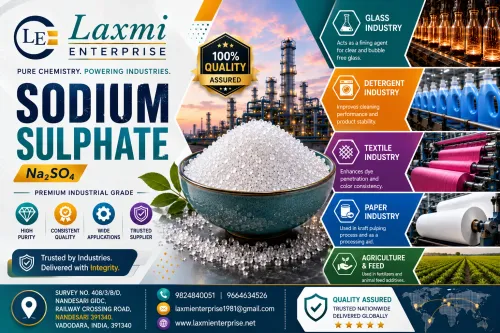
- Glauber's salt
- mirabilite
- thenardite
- sulfate of soda
- salt cake
- disodium sulfate
- sodium sulphate supplier
- sodium sulphate manufacturer
- sodium sulphate exporter