
Textile Grade Sodium Sulphate: Complete Guide for Reactive Dyeing, Quality Standards & Industrial Procurement (2026)
Primary Keyword: Textile Grade Sodium Sulphate
Secondary Keywords: Sodium Sulphate for Textile Industry, Reactive Dyeing Salt, Textile Chemical Supplier India, Sodium Sulphate Supplier Gujarat, Industrial Sodium Sulphate
Technical Product Identity
Property Details
Product Name Textile Grade Sodium Sulphate
Chemical Formula Na₂SO₄
CAS Number 7757-82-6
HSN Code (India) 2833 11 00
Molecular Weight 142.04 g/mol
EINECS Number 231-820-9
Appearance White crystalline powder or granules
Primary Application Reactive dyeing of cellulosic fibres and other application-specific textile processes
Quick Answer
Textile Grade Sodium Sulphate is widely used in many reactive dyeing processes for cotton and other cellulosic fibres, where it functions as an electrolyte that supports dye exhaustion before fixation. Textile processors generally specify consistent purity, controlled moisture, low water-insoluble matter, and reliable documentation to maintain stable production and repeatable dyeing performance.
What Is Textile Grade Sodium Sulphate?
Textile Grade Sodium Sulphate is Sodium Sulphate supplied according to specifications agreed between the supplier and the textile processor.
Depending on the application, buyers may define requirements for:
Purity.
Moisture.
Water-insoluble matter.
Chloride limits (where specified).
Particle size.
Packaging.
Documentation.
The exact specification depends on the dyeing process, dye class, fibre type, and the mill's quality standards.
Why Is Sodium Sulphate Used in Reactive Dyeing?
Quick Answer
During many reactive dyeing processes, Sodium Sulphate increases the ionic strength of the dye bath. This helps reduce electrostatic repulsion between reactive dye molecules and cellulosic fibres, supporting dye exhaustion before the fixation stage. Process performance also depends on dye selection, pH, temperature, liquor ratio, and machine settings.
Textile Processes That May Use Sodium Sulphate
Depending on the production method, Sodium Sulphate may be used in:
Cotton dyeing.
Viscose dyeing.
Modal dyeing.
Lyocell dyeing.
Yarn dyeing.
Fabric dyeing.
Knit processing.
Woven fabric processing.
Its suitability should be confirmed for each specific process.
Key Quality Parameters
Quick Answer
Textile processors evaluate multiple quality parameters because consistent raw materials contribute to stable dyeing operations. The purchase specification should match the mill's process requirements.
Parameter Importance
Purity Process consistency
Moisture Storage and handling
Water-Insoluble Matter Clean dissolution
Chloride (where specified) Process-specific requirement
Particle Size Dissolution and handling
Appearance Incoming inspection
Batch Consistency Repeatable production
Documentation Quality assurance
Acceptance limits should be agreed between the buyer and supplier.
Dissolution Characteristics
Efficient dissolution is important because Sodium Sulphate is typically introduced into aqueous dye baths.
Textile mills often prefer material that:
Dissolves consistently under process conditions.
Supports uniform preparation of dye solutions.
Is accompanied by reliable quality documentation.
The exact dissolution behaviour depends on process variables and the product specification.
Quality Control in Textile Mills
Many textile processors perform incoming quality verification before production.
Typical checks include:
Product identity.
CAS Number (7757-82-6).
Packaging condition.
Batch number.
Certificate of Analysis (COA).
Technical Data Sheet (TDS).
Safety Data Sheet (SDS/MSDS).
Laboratory testing where required.
Inspection procedures vary according to the mill's quality management system.
Packaging Options
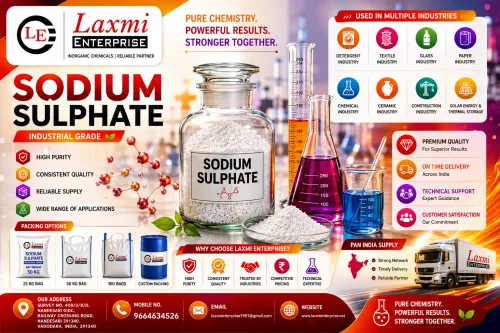
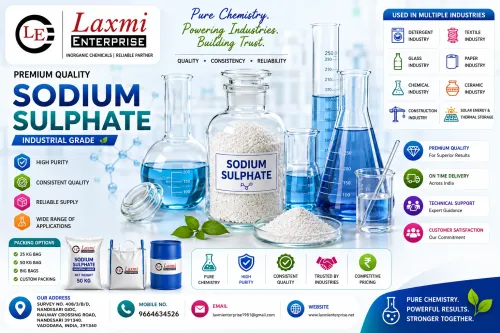
25 kg Bags
Suitable for:
Sampling.
Product development.
Small production runs.
50 kg Bags
Commonly used by:
Medium-sized textile dye houses.
Regional processing units.
500 kg FIBC
Appropriate for:
Automated material handling.
Medium- to high-volume production.
1000 kg FIBC
Often selected by:
Large textile processing plants.
Continuous dyeing facilities.
Packaging selection should be compatible with warehouse and handling equipment.
Supplier Selection Guide
Quick Answer
Textile manufacturers should evaluate suppliers based on technical capability, product consistency, documentation, logistics, and long-term reliability—not solely on price.
Technical Evaluation
Product specification.
Purity.
Water-insoluble matter.
COA.
TDS.
SDS/MSDS.
Operational Evaluation
Packaging flexibility.
Inventory availability.
Dispatch capability.
Batch traceability.
Commercial Evaluation
Transparent quotations.
Delivery reliability.
Communication.
Supply continuity.
Major Textile Manufacturing Regions in India
Significant textile processing activity exists in:
Surat (Gujarat)
Ahmedabad (Gujarat)
Bhilwara (Rajasthan)
Pali (Rajasthan)
Tiruppur (Tamil Nadu)
Erode (Tamil Nadu)
Ludhiana (Punjab)
Panipat (Haryana)
Ichalkaranji (Maharashtra)
These regions represent important markets for industrial textile chemicals.
Pan-India Supply
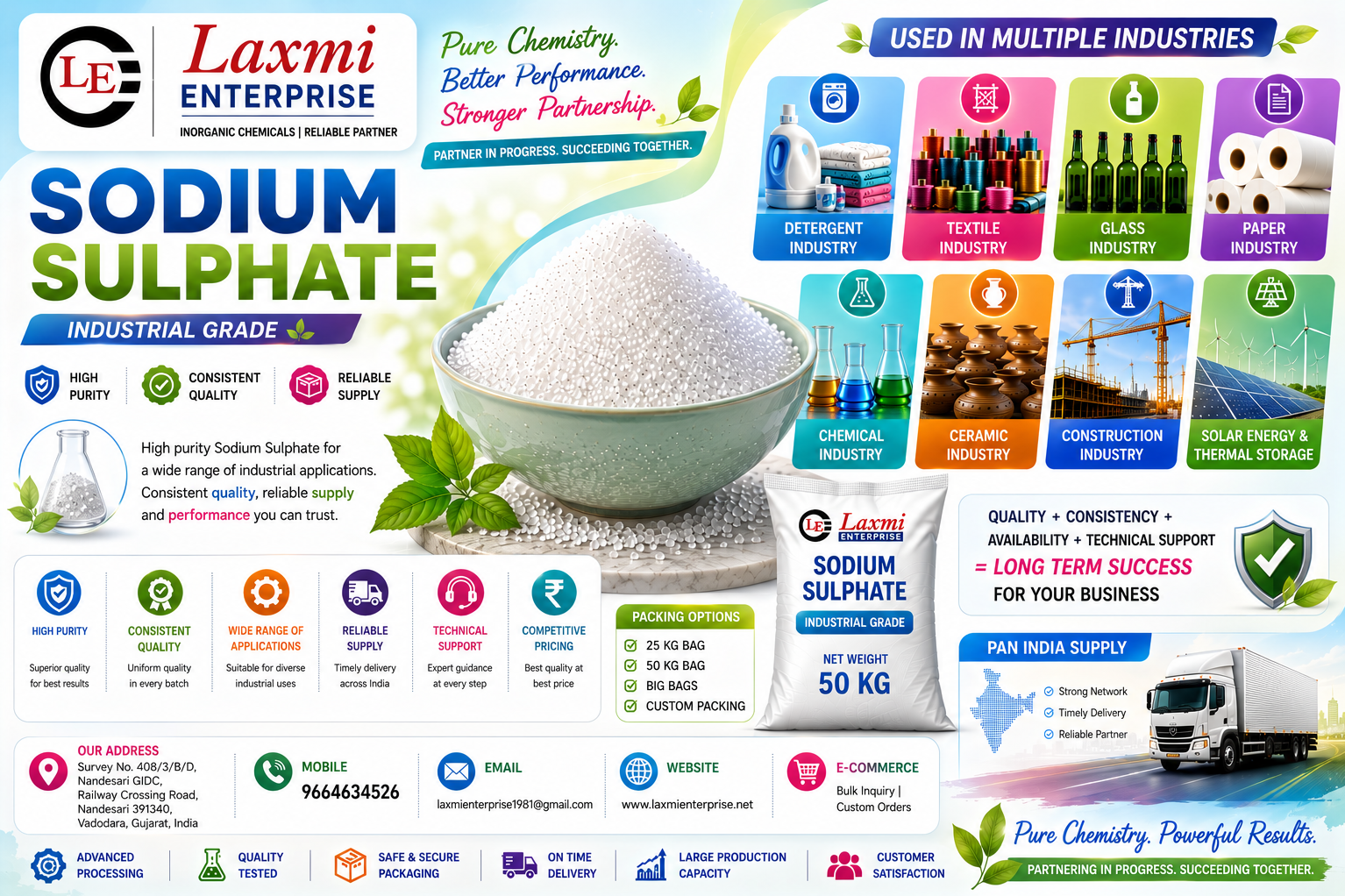
Laxmi Enterprise, located in Nandesari GIDC, Vadodara, Gujarat, supplies Textile Grade Sodium Sulphate (CAS No. 7757-82-6, HSN Code 2833 11 00) to textile manufacturers across Pan India.
The company supports customers with:
Industrial-grade Sodium Sulphate.
Technical documentation (COA, TDS, SDS/MSDS).
Flexible packaging options.
Reliable dispatch planning.
Logistics support for textile processing units.
Buyer Checklist
Before placing an order:
✔ Confirm the dyeing application.
✔ Verify CAS Number: 7757-82-6.
✔ Verify HSN Code: 2833 11 00.
✔ Define purity and impurity requirements.
✔ Specify packaging preferences.
✔ Request COA, TDS, and SDS/MSDS.
✔ Confirm delivery schedules.
✔ Review supplier capability.
Frequently Asked Questions
Is Textile Grade Sodium Sulphate used in every dyeing process?
No. It is commonly used in many reactive dyeing processes for cellulosic fibres, but its use depends on the fibre type, dye chemistry, and the mill's validated process.
Why is water-insoluble matter important?
Low water-insoluble matter supports clean dissolution and helps meet process quality requirements where complete dissolution is important.
Can one specification suit every textile mill?
No. Different mills may define different quality parameters based on their products, machinery, and customer requirements.
Why include the CAS Number and HSN Code?
The CAS Number (7757-82-6) uniquely identifies Sodium Sulphate, while the HSN Code (2833 11 00) supports commercial documentation, GST, and logistics in India.
Conclusion
Textile Grade Sodium Sulphate is an important process chemical in many reactive dyeing operations. Successful procurement depends on selecting material that matches the required technical specification and is supported by consistent quality, complete documentation, and reliable logistics.
For textile manufacturers across Pan India, Laxmi Enterprise, based in Nandesari GIDC, Vadodara, Gujarat, supplies Sodium Sulphate (CAS No. 7757-82-6, HSN Code 2833 11 00) with technical documentation, flexible packaging, and dependable supply to support efficient textile processing.