

Typical Sodium Sulphate Requirements for Textile Processing
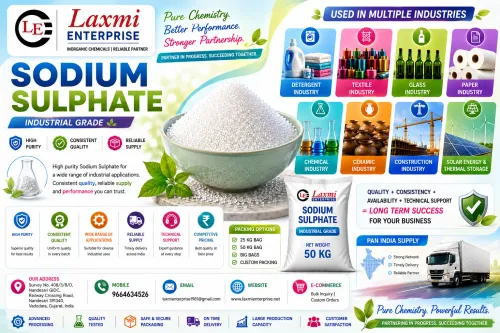
Textile dyeing units, especially those involved in reactive dyeing of cotton, viscose, rayon, and blended fabrics, generally prefer high-quality Sodium Sulphate to ensure consistent dye uptake, shade reproducibility, and process efficiency.
Recommended Specifications
Parameter Preferred Range
Sodium Sulphate (Na₂SO₄) 98.0% – 99.5%
Moisture Content ≤ 0.5%
Insoluble Matter ≤ 0.20%
Chloride (Cl) ≤ 0.30%
Iron (Fe) ≤ 50 ppm
pH (5% Solution) 6.5 – 8.5
Appearance White Free-Flowing Crystals/Powder
Particle Size Uniform & Consistent
Why These Specifications Matter
1. High Sodium Sulphate Purity (98–99.5%)
Higher purity means:
✔ Better dye exhaustion
✔ Improved dye migration
✔ More predictable dyeing performance
✔ Reduced process variation
Lower purity material may introduce unwanted contaminants that affect shade quality and process consistency.
2. Low Moisture Content
Excess moisture can cause:
❌ Caking during storage
❌ Poor flowability
❌ Difficult dosing
❌ Inconsistent salt concentration
Low-moisture Sodium Sulphate provides easier handling and more accurate dosing during dyeing operations.
3. Low Insoluble Matter
Insoluble particles may lead to:
❌ Fabric spots
❌ Filtration issues
❌ Machine deposits
❌ Quality complaints
Textile processors generally prefer Sodium Sulphate with very low insoluble content to avoid fabric defects.
4. Controlled Chloride Levels
High chloride contamination can contribute to:
❌ Equipment corrosion
❌ Process instability
❌ Dyeing inconsistencies
Controlled chloride levels improve long-term equipment reliability and process control.
5. Consistent Particle Size Distribution
Uniform particle size ensures:
✔ Faster dissolution
✔ Better solution preparation
✔ Consistent dosing
✔ Reduced operator error
This is particularly important in automated chemical dosing systems.
Benefits for Textile Manufacturers
Using high-quality Technical Grade Sodium Sulphate helps achieve:
Better dye exhaustion
Improved shade consistency
Uniform color development
Reduced reprocessing
Lower chemical consumption
Higher production efficiency
Better export-quality textile manufacturing
Trust Formula for Textile Dyeing
Consistent Sodium Sulphate + Optimized Salt Dosing + Quality Reactive Dyes = Superior Dyeing Performance
Laxmi Enterprise
Technical Grade Sodium Sulphate Supplier
Survey No. 408/3/B/D, Nandesari GIDC, Railway Crossing Road, Nandesari – 391340
Vadodara, Gujarat, India