

What Is Sodium Sulphate? The Complete Industrial Guide for Manufacturers, Procurement Teams, Engineers, and Industrial
Chemical and Physical Properties of Sodium Sulphate
Understanding the chemical and physical properties of sodium sulphate is essential for anyone involved in purchasing, storing, testing, or using the product in industrial manufacturing. These properties determine how the material behaves during production, transportation, storage, laboratory analysis, and end-use applications.
For production engineers, these characteristics influence process efficiency. For laboratory professionals, they establish testing requirements. For procurement teams, they form the basis of product specifications and supplier evaluation.
One important point often overlooked is that no industrial chemical is evaluated solely by its chemical formula. Two suppliers may both offer sodium sulphate (Na₂SO₄), yet the products can perform differently because of variations in purity, particle size, moisture content, and manufacturing consistency.
Understanding these technical properties helps buyers select material that is suitable for their specific manufacturing process rather than simply choosing the lowest-priced option.
Chemical Composition
Chemically, sodium sulphate is a neutral inorganic salt formed from sodium ions (Na⁺) and sulphate ions (SO₄²⁻). Under normal industrial conditions, it is chemically stable and does not readily decompose or react with many materials used in manufacturing.
This stability is one of the reasons sodium sulphate is widely accepted across industries. Manufacturers can store and transport it without the special precautions required for highly reactive chemicals.
Its predictable behavior also allows production engineers to develop stable manufacturing processes with fewer unexpected chemical interactions.
Why Chemical Stability Matters
Chemical stability offers several industrial advantages:
Consistent manufacturing performance
Long storage life under proper conditions
Reduced risk of unexpected reactions
Reliable laboratory testing
Predictable process control
Easier inventory management
For industries operating continuous production lines, stability means fewer production interruptions caused by raw material variation.
Physical Appearance
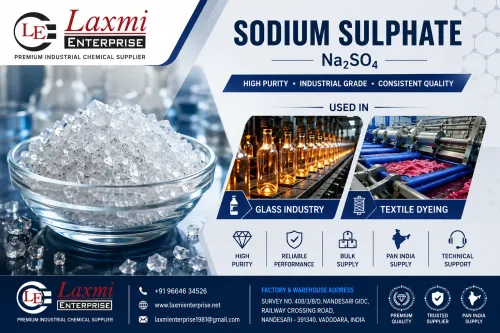
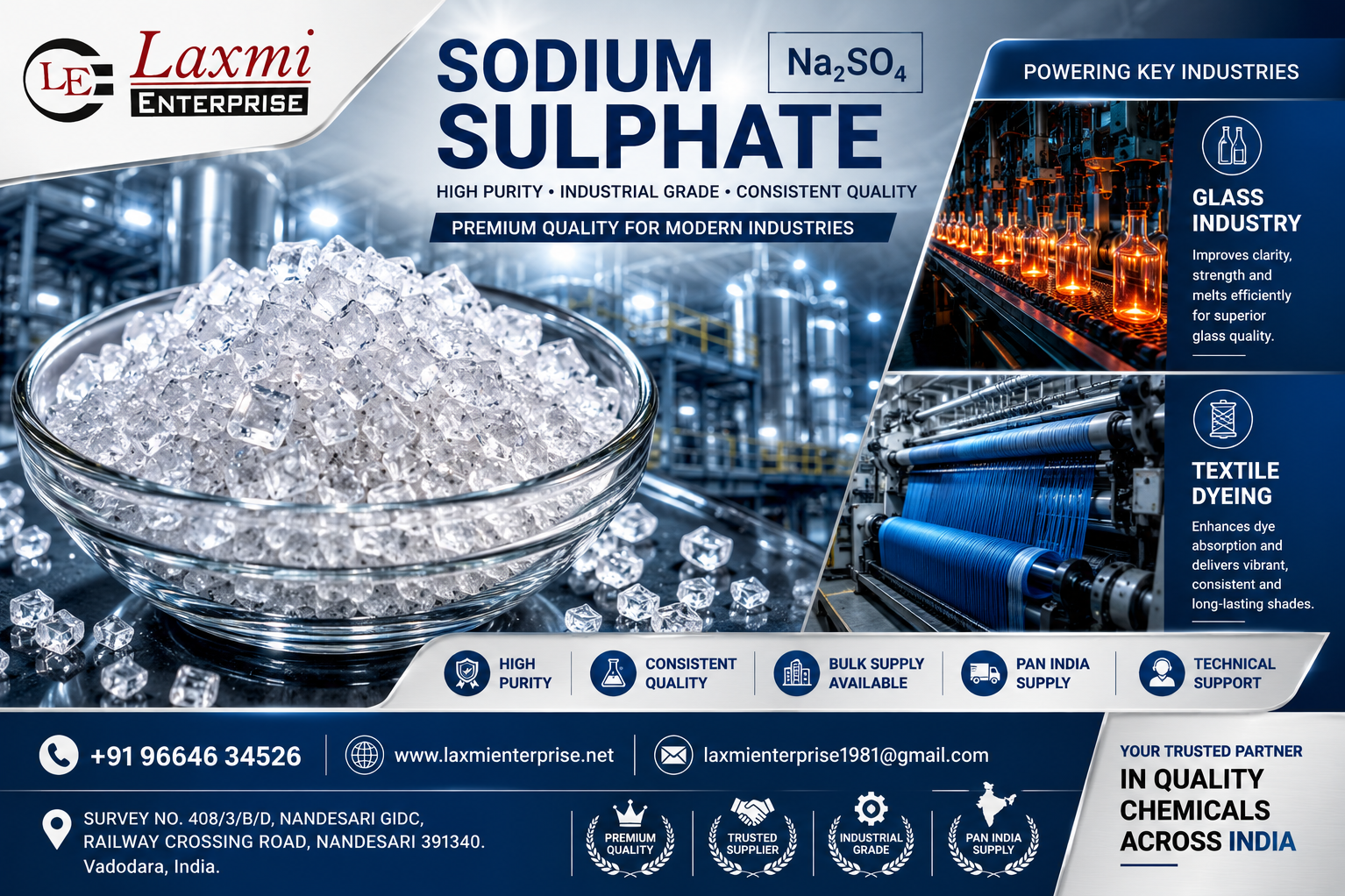
Industrial sodium sulphate generally appears as a clean white crystalline material. Depending on manufacturing methods and customer requirements, it may be supplied as:
Fine crystalline powder
Medium crystals
Coarse crystals
Granular material
The physical appearance should be consistent throughout the batch.
Although appearance alone cannot determine product quality, experienced quality inspectors often perform visual inspections before laboratory testing begins.
Visual examination may identify:
Moisture exposure
Foreign particles
Discoloration
Packaging contamination
Product caking
Particle size inconsistency
Appearance is therefore considered an important preliminary quality indicator.
Crystal Structure
One of sodium sulphate's distinguishing characteristics is its crystalline structure.
Under controlled manufacturing conditions, sodium sulphate forms regular crystals that contribute to predictable handling behavior, stable bulk density, and consistent dissolution.
Crystal structure influences:
Material flow
Storage characteristics
Dust generation
Dissolution rate
Packaging efficiency
Automated feeding systems
Manufacturers often optimize crystal formation during production to achieve the particle size preferred by their customers.
Solubility in Water
Water solubility is one of sodium sulphate's most valuable industrial properties.
The material dissolves readily in water, allowing manufacturers to incorporate it efficiently into numerous industrial processes.
Industries benefit from this property because dissolved sodium sulphate distributes more uniformly throughout production systems.
Good solubility contributes to:
Better mixing
Faster process preparation
Uniform product quality
Improved manufacturing consistency
Efficient chemical dosing
However, dissolution behavior can also be influenced by:
Water temperature
Mixing intensity
Particle size
Product purity
Presence of impurities
Understanding these factors helps optimize industrial processing.
Thermal Behavior
Sodium sulphate maintains good stability under normal industrial operating conditions.
It is non-flammable and does not contribute to combustion.
This characteristic makes storage and transportation considerably simpler compared with many reactive industrial chemicals.
Thermal stability provides advantages including:
Safe warehouse storage
Reduced transportation risk
Reliable industrial performance
Stable long-term inventory
Predictable manufacturing behavior
Although sodium sulphate remains stable under ordinary operating conditions, manufacturing processes should always follow recommended technical procedures.
Density and Bulk Density
Many people confuse density with bulk density.
In industrial manufacturing, they represent different concepts.
True density relates to the material itself.
Bulk density represents how much material occupies a given storage volume, including the air spaces between particles.
Bulk density directly affects:
Warehouse planning
Bag filling
Container utilization
Transportation efficiency
Production feeding systems
Material consumption calculations
Because different particle sizes pack differently, bulk density may vary slightly depending on manufacturing conditions.
For this reason, many industrial buyers specify acceptable bulk density ranges.
Particle Size Distribution
Particle size is far more important than many buyers initially realize.
Different industries require different particle size distributions because manufacturing processes differ considerably.
For example:
Fine particles generally dissolve faster.
Medium particles often provide balanced flowability.
Coarser particles may reduce dust during handling.
Particle size influences:
Mixing efficiency
Dissolution speed
Product uniformity
Dust generation
Conveyor performance
Feeding accuracy
Packaging behavior
Rather than asking whether one particle size is 'better, ' procurement teams should determine which size best suits their production process.
Flowability
Flowability refers to how easily sodium sulphate moves through:
Storage silos
Hoppers
Screw feeders
Conveyors
Packaging equipment
Automatic dosing systems
Poor flowability may cause:
Production interruptions
Feeding inconsistency
Increased manual handling
Material bridging
Equipment downtime
Good flowability results from:
Proper drying
Suitable particle size
Low moisture
Consistent manufacturing
Appropriate storage conditions
Hygroscopic Characteristics
A common misconception is that sodium sulphate rapidly absorbs moisture from the atmosphere.
In reality, industrial anhydrous sodium sulphate is relatively stable under recommended storage conditions.
However, prolonged exposure to:
High humidity
Rainwater
Damaged packaging
Poor warehouse conditions
can gradually affect its physical handling characteristics.
This is why professional suppliers emphasize:
Dry warehouses
Moisture-resistant packaging
Pallet storage
Covered transportation
Proper inventory management
Compatibility with Industrial Processes
One reason sodium sulphate has remained an important industrial chemical for decades is its compatibility with numerous manufacturing operations.
It performs reliably in industries requiring:
Controlled process chemistry
Consistent material quality
Stable production conditions
Reliable raw material performance
This versatility explains why sodium sulphate is used across multiple industries despite differences in manufacturing methods.
Why These Properties Matter to Industrial Buyers
Procurement teams increasingly evaluate technical performance rather than simply purchasing chemicals based on product names.
Every physical property discussed above influences one or more aspects of manufacturing.
For example:
A detergent manufacturer may prioritize particle size consistency.
A glass manufacturer may focus on purity and iron content.
A textile processor may emphasize chloride control.
A warehouse manager may consider packaging and flowability.
Understanding these differences helps buyers develop technical purchasing specifications rather than relying solely on commercial quotations.
Ultimately, the right sodium sulphate is not simply the cheapest product—it is the product that consistently supports efficient manufacturing.
Frequently Asked Questions
1. What are the most important physical properties of sodium sulphate?
Industrial users commonly evaluate appearance, particle size, moisture content, bulk density, flowability, and solubility because these properties directly influence storage, handling, and manufacturing performance.
2. Why is particle size important?
Particle size affects dissolution rate, dust generation, mixing efficiency, conveyor performance, and automated feeding systems. Different industries therefore specify different particle size ranges.
3. Does sodium sulphate dissolve easily in water?
Yes. Sodium sulphate has good water solubility, making it suitable for many industrial applications where rapid and uniform dissolution is required.
4. Is sodium sulphate combustible?
No. Sodium sulphate is a non-flammable inorganic chemical and does not support combustion under normal industrial conditions.
5. Why is appearance checked before laboratory testing?
Visual inspection provides an initial assessment of product condition and may reveal moisture exposure, contamination, discoloration, damaged packaging, or caking before laboratory analysis begins.
6. What is bulk density?
Bulk density measures the weight of sodium sulphate occupying a specific volume, including the air spaces between particles. It is important for storage planning, packaging, transportation, and automated dosing.
7. Can bulk density vary?
Yes. Particle size distribution, crystal shape, and manufacturing conditions can influence bulk density.
8. Why is crystal structure important?
Crystal structure influences material flow, dissolution, handling characteristics, packaging efficiency, and production consistency.
9. Does sodium sulphate absorb moisture?
Under recommended storage conditions, anhydrous sodium sulphate remains relatively stable. However, prolonged exposure to humid environments may affect its physical properties.
10. Why should warehouses remain dry?
Dry storage helps maintain low moisture content, good flowability, free-flowing crystals, and packaging integrity.
11. Does purity affect physical properties?
Yes. Higher purity generally supports more consistent manufacturing performance and reduces the influence of unwanted impurities.
12. Why is flowability important?
Good flowability allows sodium sulphate to move efficiently through storage bins, conveyors, feeders, and automated production systems without interruption.
13. Can damaged packaging affect product quality?
Yes. Torn or punctured bags increase the risk of moisture absorption, contamination, and product loss during storage or transportation.
14. Why do different industries require different specifications?
Each manufacturing process has unique technical requirements. A specification suitable for detergent manufacturing may not be appropriate for glass production or textile dyeing.
15. Can visual appearance replace laboratory testing?
No. Appearance provides useful information but cannot confirm purity, chloride, iron content, moisture level, or other critical quality parameters. Laboratory testing remains essential.
16. How do procurement teams use these properties?
They use them to develop technical specifications, compare suppliers, evaluate Certificates of Analysis, and ensure that incoming material is suitable for the intended manufacturing process.
17. Why is consistent quality more valuable than occasional high quality?
Manufacturing depends on predictability. Consistent batch-to-batch performance reduces process adjustments, minimizes waste, and supports stable production.
18. What should buyers prioritize besides price?
Buyers should evaluate technical specifications, laboratory testing, product consistency, packaging quality, documentation, supplier reliability, and technical support to ensure long-term manufacturing success.