

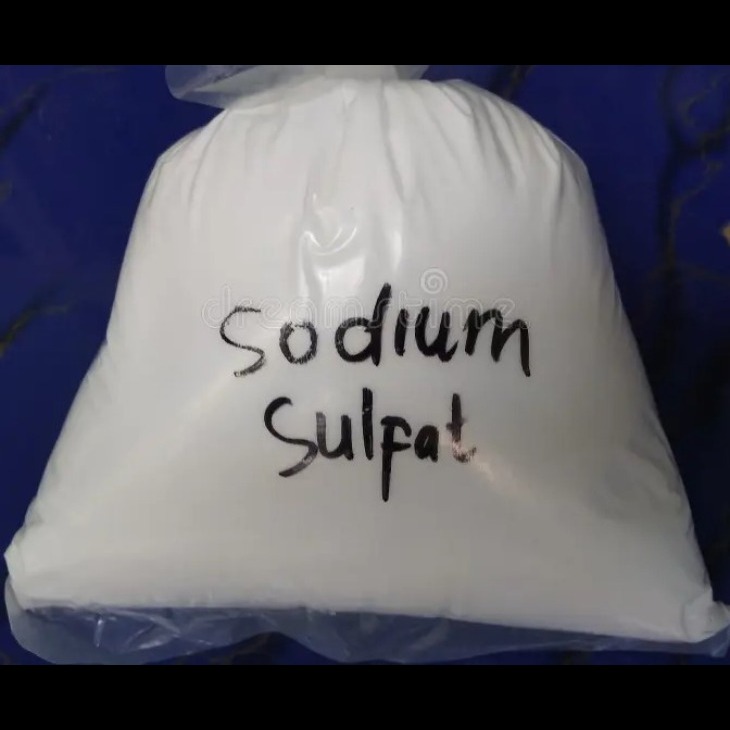
Packaging & Storage
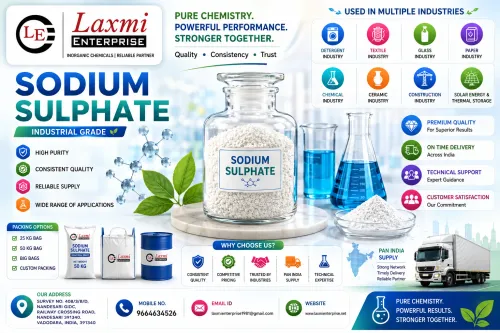
Packaging: HDPE / LDPE bags or drums, food- and pharma-grade liners.
Storage Conditions:
Store in a tightly closed container.
Keep in a cool, dry place, protected from moisture.
Avoid contact with strong acids and hygroscopic materials.
Typical Applications in Pharmaceuticals
Used as an inert filler or tablet excipient.
In manufacture of laxatives (with magnesium sulfate or other agents).
Stabilizer or bulking agent in formulations.
Used in buffered saline solutions and some ophthalmic preparations.
Product Identification
Property Specification
Chemical Name Sodium Sulfate
Chemical Formula Na₂SO₄ or Na₂SO₄·10H₂O (decahydrate)
Molecular Weight 142.04 (anhydrous)
CAS Number 7757-82-6 (Anhydrous)
Appearance White, crystalline powder or granules; odorless; hygroscopic in nature
Sodium Sulfate as a Pharmaceutical Drying Agent
1. Definition
Sodium sulfate (anhydrous) is an inorganic desiccant used in laboratory and pharmaceutical applications to remove residual water from organic solutions or to dry aqueous extracts before solvent removal.
It is a neutral, non-reactive, and relatively mild drying agent, often preferred when the product is sensitive to acidic or basic conditions.
Mechanism of Action
Anhydrous sodium sulfate absorbs water by forming hydrated crystalline forms, typically:
Na₂SO₄·10H₂O (decahydrate)
Na₂SO₄·7H₂O (heptahydrate)
This absorption effectively removes trace moisture from organic solvents or solutions during post-reaction workup.
Applications in Pharmaceuticals
Application Area Purpose
Active Pharmaceutical Ingredient (API) synthesis Used during organic extraction and purification steps to remove water from organic layers.
Solvent purification Helps achieve anhydrous solvents for moisture-sensitive reactions.
Intermediate drying Used as a mild drying agent in the purification of intermediates and reagents.
Analytical chemistry / QC Used for sample drying in analytical preparations.
Advantages as a Drying Agent
Neutral pH (non-acidic, non-basic)
Inexpensive and readily available
High capacity (can absorb up to ~3 g of H₂O per 10 g Na₂SO₄)
Non-toxic and chemically inert
Easy to separate (does not form emulsions)
Limitations
Slow action: Requires longer contact time than agents like MgSO₄ or CaCl₂
Less effective at low temperatures
Not suitable for drying very polar solvents (e.g., methanol, ethanol) or aqueous mixtures
Must be used anhydrous — store tightly closed to avoid prehydration
Storage & Handling
Store in airtight, moisture-free containers (HDPE drums or glass jars).
Avoid exposure to humid environments.
Can be re-dried before reuse by heating at 250–300 °C for 4–5 hours.
Safety
Non-toxic and generally recognized as safe (GRAS) for pharmaceutical use.
Handle using standard laboratory PPE (gloves, goggles).
Avoid inhalation of dust.
sodium sulphate
- sodium sulfate
- Na2SO4
- CAS 7757-82-6 (anhydrous)
- CAS 7727-73-3 (decahydrate)
- E514
- EC 231-820-9
- sodium sulphate SDS
- sodium sulphate MSDS
- Glauber's salt
- mirabilite
- thenardite
- sulfate of soda
- salt cake
- disodium sulfate
Sodium Sulfate in High-Sugar Fermentation
1. Context
In high-sugar fermentations (e.g., molasses-based ethanol, glucose syrup-based bioprocesses), microorganisms such as Saccharomyces cerevisiae, Aspergillus niger, or Lactobacillus face:
Osmotic stress due to high sugar concentrations
Viscosity effects reducing mass transfer
Ion imbalance and by-product inhibition
Adding small amounts of inorganic salts like sodium sulfate can help maintain ionic equilibrium and improve process stability.
Interactions and Synergies
Works synergistically with MgSO₄, KH₂PO₄, and CaCO₃ as part of fermentation mineral mix.
Too much sulfate competes with phosphate transport in some microorganisms.
Sodium sulfate is often added post-sterilization, as it is heat-stable and non-reactive.
Industrial Examples
Molasses-based ethanol fermentation (India, Brazil): Sodium sulfate is added to improve osmotic tolerance.
Citric acid fermentation (Aspergillus niger): Used in controlled ionic media to regulate metabolic flux.
Enzyme production fermenters: Acts as a stabilizing salt for extracellular enzyme
Considerations & Precautions
Must be pharmaceutical / food grade (low in heavy metals & chlorides).
Optimize dosage experimentally (start with 0.05% w/v).
Avoid in systems sensitive to sodium ions (e.g., sodium-intolerant bacterial strains).
Monitor sulfate buildup in recirculated fermenter systems (may affect pH control).
((PHARMACEUTICAL-GRADE SODIUM SULFATE SPECIFICATIONS.LAXMI ENTERPRISE.VADODRA.GUJARAT.INDIA))