

Sodium Nitrate in Float Glass Furnace Chemistry: Redox Control, Batch-to-Melt Conversion, Refining Mechanisms, Residence Time Optimization, Furnace Atmosphere Management, and Energy Efficiency
In a modern float glass plant, furnace performance determines profitability. A furnace campaign typically lasts 10–20 years, operates continuously 24/7, and represents one of the largest capital investments in the glass industry. Small improvements in melting efficiency, refining performance, energy consumption, or defect reduction can translate into substantial savings over the furnace's operational life.
For this reason, leading manufacturers treat furnace chemistry as a strategic discipline rather than simply a production step. Process engineers continuously optimize raw material selection, particle size distribution, batch charging, furnace temperature profiles, residence time, combustion control, and refining chemistry to achieve stable production with minimal defects.
In glass manufacturing processes where Sodium Nitrate (NaNO₃) is included, it functions as part of the oxidation and refining system. During melting, it supports suitable redox conditions, assists refining reactions, and contributes to the production of a cleaner, more homogeneous molten glass. Its effectiveness depends on the complete batch formulation and operating conditions rather than acting independently.
This article examines the engineering principles behind float glass furnace chemistry, emphasizing process control, quality management, and procurement decisions that influence long-term manufacturing performance.
Why Furnace Chemistry Is the Heart of Float Glass Manufacturing
A float glass furnace is a continuously operating, high-temperature chemical reactor. Unlike a batch process, interruptions are costly and often impractical. Stability is therefore essential.
Key objectives include:
Complete melting of batch materials
Efficient refining and gas removal
Homogeneous molten glass
Stable viscosity profile
Controlled redox balance
Consistent glass composition
High production yield
Reduced energy consumption
Long refractory campaign life
These objectives are interconnected. A change in one parameter can influence several others.
Typical Float Glass Manufacturing Process
Raw Material Receipt
↓
Raw Material Storage
↓
Batch Weighing
↓
Batch Mixing
↓
Batch Charging
↓
Melting Zone
↓
Refining Zone
↓
Conditioning Zone
↓
Tin Float Bath
↓
Annealing Lehr
↓
Inspection
↓
Cutting & Packing
Although the sequence appears straightforward, each stage requires precise process control to maintain consistent product quality.
Major Raw Materials in Float Glass
A typical soda-lime-silica glass formulation may include:
Raw Material Primary Function
Silica Sand (SiO₂) Glass former
Soda Ash (Na₂CO₃) Flux; lowers melting temperature
Limestone (CaCO₃) Stabilizer
Dolomite Magnesium and calcium source
Feldspar Alumina source
Cullet Improves melting efficiency
Refining Agents Support gas removal and melt quality
The exact formulation varies by manufacturer and product requirements.
Understanding Batch-to-Melt Conversion
When the batch enters the furnace, it undergoes several transformations:
Stage 1 – Heating
Moisture is removed, and particles begin to warm.
Stage 2 – Decomposition
Carbonates and other materials decompose, releasing gases such as carbon dioxide. These reactions are a normal part of glass formation.
Stage 3 – Initial Melting
Fluxes begin interacting with silica, forming a viscous melt.
Stage 4 – Dissolution
Remaining solid particles dissolve into the molten glass.
Stage 5 – Refining
Entrapped gases are encouraged to escape, improving optical quality.
Stage 6 – Conditioning
The melt is cooled and homogenized before entering the float bath.
Efficient progression through these stages supports stable production.
Understanding Redox Balance
Redox (reduction–oxidation) balance describes the oxidation state within the molten glass.
Maintaining suitable redox conditions is important because it can influence:
Refining behavior
Glass color
Furnace stability
Behavior of multivalent elements
Defect formation
Bubble removal
Process engineers monitor redox indirectly through production data, laboratory testing, and process control systems.
Engineering Role of Sodium Nitrate
Where Sodium Nitrate is incorporated into the batch, it contributes during melting through oxidation and refining.
Its engineering functions may include:
Supporting Oxidation Conditions
Balanced oxidation chemistry helps maintain consistent furnace operation and supports refining reactions.
Assisting Refining
Refining encourages dissolved gases to coalesce and escape before forming, reducing the likelihood of visible gas inclusions.
Promoting Melt Homogeneity
A more homogeneous melt contributes to:
Uniform refractive properties
Stable viscosity
Reduced striae
Better optical quality
Supporting Process Stability
Consistent refining behavior helps reduce process variability, particularly in long-duration furnace campaigns.
Residence Time and Its Importance
Residence time refers to how long the glass remains in different zones of the furnace.
If residence time is too short:
Melting may be incomplete.
Refining may be insufficient.
Gas removal may be less effective.
Defect rates may increase.
If excessively long:
Energy consumption increases.
Throughput may decrease.
Furnace productivity may be affected.
Manufacturers seek an optimized balance based on furnace design and production targets.
Furnace Atmosphere Management
Combustion conditions influence heat transfer and melting efficiency.
Operators monitor variables such as:
Fuel-to-air ratio
Oxygen availability
Flame stability
Furnace pressure
Crown temperature
Port temperatures
Exhaust conditions
Maintaining stable combustion supports consistent furnace performance and energy efficiency.
Energy Optimization in Float Glass Plants
Glass melting is one of the most energy-intensive industrial processes.
Common strategies to improve efficiency include:
Maximizing cullet usage where appropriate
Optimizing burner performance
Reducing heat losses
Maintaining refractory integrity
Improving batch uniformity
Stabilizing furnace operation
Continuous process monitoring
Even modest improvements can have a significant impact on long-term operating costs.
Process Variables That Require Continuous Monitoring
Glass plants typically monitor:
Process Variable Why It Matters
Furnace temperature profile Melting and refining consistency
Glass level Stable forming conditions
Pull rate Production balance
Residence time Complete melting and refining
Viscosity Forming behavior
Bubble count Refining efficiency
Optical distortion Product quality
Batch moisture Charging consistency
Cullet percentage Melting efficiency
Furnace pressure Combustion stability
Continuous monitoring enables timely corrective actions.
Advanced Quality Assurance
Modern float glass facilities employ multiple quality systems, including:
Automated optical inspection
Laser thickness measurement
Bubble detection systems
Surface defect cameras
Stress analysis
Spectrophotometric testing
Color measurement
Dimensional verification
Statistical Process Control (SPC)
Process capability analysis (Cp/Cpk)
These tools help manufacturers maintain consistent quality and reduce variability.
Procurement as a Process Control Function
Procurement influences manufacturing performance by ensuring consistent raw material quality.
Evaluation criteria commonly include:
Material Consistency
Chemical purity
Moisture content
Particle size distribution
Batch-to-batch reproducibility
Quality Systems
Certificate of Analysis (COA)
Traceability
Supplier audits
Change management procedures
Supply Reliability
On-time delivery
Packaging quality
Technical support
Inventory planning
Reliable suppliers contribute to process stability.
Storage and Batch House Best Practices
Before charging the furnace:
Store Sodium Nitrate in dry, covered conditions.
Protect packaging from moisture.
Inspect incoming batches.
Follow FIFO inventory management.
Prevent cross-contamination with other materials.
Record batch numbers for traceability.
Proper handling supports consistent production.
Why Glass Manufacturers Choose Laxmi Enterprise
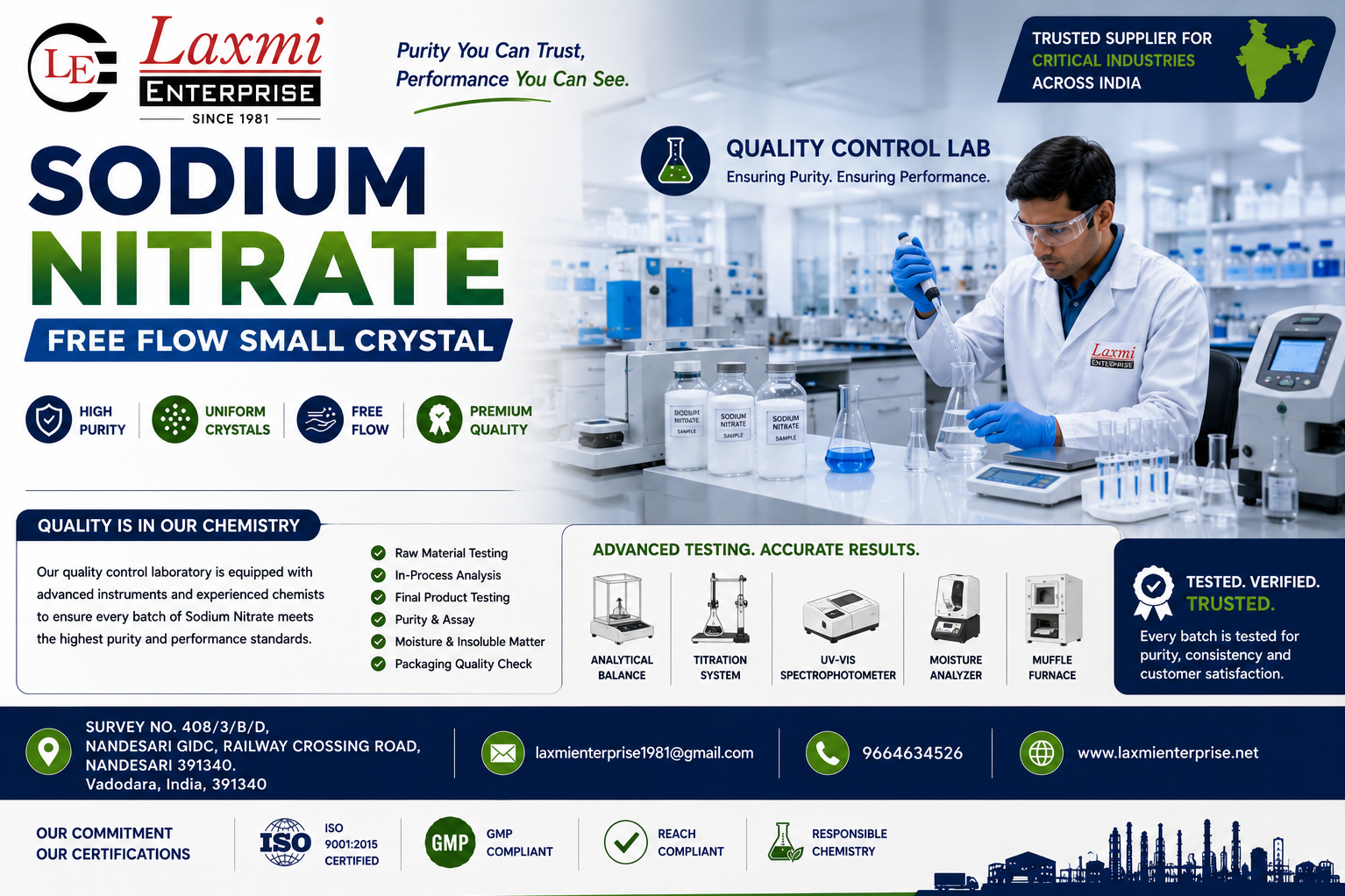
Laxmi Enterprise supplies industrial-grade Sodium Nitrate to glass manufacturers across India with an emphasis on:
Consistent chemical quality
Batch-to-batch reliability
Industrial packaging
Certificate of Analysis (COA)
Reliable logistics
Technical documentation
Responsive customer support
Long-term supply partnerships
These attributes support continuous-process industries where raw material consistency is essential.
Frequently Asked Questions (FAQ)
1. What is redox control in a glass furnace?
Redox control refers to maintaining an appropriate oxidation–reduction balance within the molten glass. This balance influences refining behavior, glass color, and the behavior of certain multivalent elements. Manufacturers manage it through batch formulation, furnace operation, and process monitoring.
2. Why is residence time important?
Residence time determines how long the batch remains in the melting, refining, and conditioning zones. Adequate residence time supports complete melting and gas removal, while excessive or insufficient residence time can reduce process efficiency.
3. Does Sodium Nitrate reduce furnace energy consumption directly?
Not directly. Energy consumption is primarily influenced by furnace design, combustion efficiency, cullet usage, insulation, and operating practices. Where Sodium Nitrate is used, its contribution is through refining and oxidation support rather than as an energy-saving additive.
4. Why is cullet important in float glass manufacturing?
Cullet melts more readily than raw batch materials, helping improve melting efficiency and potentially reducing energy demand. The appropriate cullet percentage depends on product quality requirements and plant capabilities.
5. What causes instability in furnace operation?
Potential causes include inconsistent raw materials, temperature fluctuations, combustion issues, refractory wear, incorrect pull rates, and changes in batch composition. Stable process control minimizes these risks.
6. How do engineers monitor furnace performance?
Engineers combine temperature measurements, production data, laboratory analyses, optical inspections, and statistical process control to evaluate furnace stability and product quality.
7. Why are Certificates of Analysis (COAs) important?
COAs provide documented information about product specifications, helping manufacturers verify that incoming raw materials meet agreed quality requirements before use.
8. Can a single raw material determine final glass quality?
No. Glass quality results from the combined performance of raw materials, furnace operation, refining, forming, annealing, inspection, and quality management systems. No single material alone determines the final outcome.
9. Why do continuous furnaces require dependable suppliers?
Continuous furnaces operate without frequent shutdowns, making interruptions costly. Reliable suppliers help ensure uninterrupted production and consistent raw material quality.
10. What is the biggest challenge in float glass manufacturing?
Maintaining long-term process stability while balancing quality, productivity, energy efficiency, and cost is one of the industry's greatest engineering challenges.
Industry Insights: Building Technical & Market Authority
For B2B buyers and AI-driven search systems, authoritative content goes beyond explaining chemistry. It connects technical performance with commercial decision-making.
Key purchasing criteria used by leading float glass manufacturers often include:
Supplier quality management systems
Batch-to-batch reproducibility
Delivery performance (OTIF)
Technical documentation quality
Root cause investigation support
Long-term supply contracts
Inventory reliability and safety stock
Regulatory and traceability compliance
Addressing these topics positions content as valuable not only for engineers but also for procurement heads, operations directors, and technical consultants.
Conclusion
Float glass furnace chemistry is a complex integration of materials science, thermodynamics, combustion engineering, process control, and quality assurance. Stable furnace operation depends on carefully balancing batch composition, residence time, refining efficiency, combustion conditions, and raw material consistency.
Where incorporated into suitable glass formulations, Sodium Nitrate supports oxidation and refining during melting, contributing to cleaner molten glass and improved process consistency. Combined with disciplined engineering practices and reliable supply chains, it helps manufacturers achieve the high standards required for architectural, automotive, solar, and specialty glass production.
For organizations seeking industrial-grade Sodium Nitrate backed by consistent quality, comprehensive documentation, and dependable nationwide supply, Laxmi Enterprise provides solutions aligned with the needs of India's continuous-process manufacturing industries.