

Sodium Nitrate in Solar Glass Manufacturing: Enhancing Optical Transmission, Glass Refining Efficiency, Surface Quality, and Long-Term Photovoltaic Performance
The global transition toward renewable energy has placed solar power at the center of modern infrastructure development. From large utility-scale solar farms to rooftop photovoltaic systems and building-integrated solar solutions, the demand for high-performance solar glass continues to grow. While photovoltaic cells often receive the most attention, the glass covering those cells is equally important. It protects the module from harsh environmental conditions while allowing maximum sunlight to reach the solar cells throughout its service life.
Manufacturing solar glass is significantly more demanding than producing ordinary architectural or container glass. Solar glass must achieve exceptionally high light transmission, excellent optical uniformity, low iron content, outstanding mechanical strength, and compatibility with anti-reflective coatings and tempering processes. Even small defects such as microscopic bubbles, inclusions, cords, or slight color variations can reduce module efficiency or lead to rejection during quality inspection.
One of the chemicals that supports this demanding manufacturing process is Sodium Nitrate (NaNO₃). Although used in relatively small quantities within the overall glass batch, it performs an important role during glass melting and refining. By helping maintain suitable oxidation conditions and supporting the removal of entrapped gases, Sodium Nitrate contributes to producing cleaner, more homogeneous molten glass. The result is a better foundation for manufacturing high-quality solar glass that meets the strict requirements of the photovoltaic industry.
This article explains how Sodium Nitrate contributes to solar glass manufacturing, the engineering principles behind its use, quality considerations, procurement requirements, and answers the most common questions asked by production engineers, procurement managers, and industrial buyers.
Understanding Solar Glass
Solar glass is a specially engineered low-iron glass designed to maximize the transmission of sunlight while protecting photovoltaic cells from mechanical damage, moisture, ultraviolet radiation, and environmental exposure.
Unlike conventional flat glass, solar glass is manufactured with tighter quality tolerances because every percentage of light transmission influences the electrical output of a solar panel.
Typical characteristics include:
High visible light transmission
Low iron content
Excellent optical clarity
Minimal surface defects
High mechanical strength
Thermal stability
Coating compatibility
Long service life
Resistance to weathering
Why Glass Quality Directly Affects Solar Panel Performance
A photovoltaic module converts sunlight into electricity. Before sunlight reaches the solar cells, it must first pass through the front glass.
If the glass contains optical defects, light transmission may decrease, reducing the amount of energy available to the cells.
Manufacturers therefore work to minimize defects such as:
Microscopic bubbles
Stones
Cords
Striae
Inclusions
Surface waviness
Color variation
Haze
Producing defect-free glass begins with a well-controlled melting and refining process.
The Role of Sodium Nitrate in Solar Glass Manufacturing
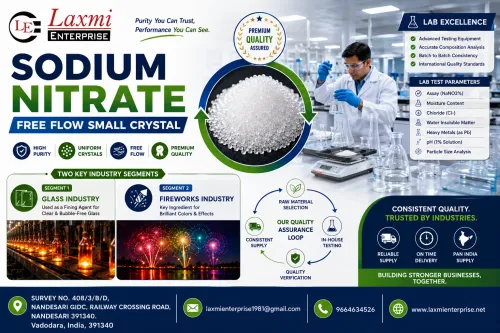
Sodium Nitrate is primarily used as an oxidizing and refining agent during glass melting.
Although it is not the largest component of the batch, it supports several important manufacturing objectives.
Its contribution includes:
Promoting an oxidizing furnace atmosphere
Supporting refining reactions
Assisting the removal of dissolved gases
Improving melt homogeneity
Reducing optical defects
Helping maintain consistent furnace conditions
These functions contribute to producing glass suitable for demanding photovoltaic applications.
Why Refining Is Critical
After the raw materials melt, the molten glass still contains tiny gas bubbles formed during chemical reactions.
If these gases remain trapped, they may create visible defects after the glass is formed.
Effective refining allows these bubbles to grow, rise, and escape before the molten glass reaches the float bath.
A well-refined melt helps manufacturers achieve:
Better transparency
Improved optical consistency
Reduced rejection rates
Higher production efficiency
Importance of Melt Homogeneity
Uniform molten glass is essential for consistent product quality.
Homogeneous glass offers:
Stable refractive index
Uniform thickness
Better coating adhesion
Consistent tempering behavior
Reduced optical distortion
Reliable downstream processing
Even slight variations in melt composition can become visible after tempering or coating.
Low-Iron Glass and Solar Applications
Most solar panels use low-iron glass because it allows more sunlight to pass through than conventional float glass.
The lower iron content reduces the green tint commonly associated with standard glass and improves light transmission.
Maintaining stable oxidation conditions during melting helps manufacturers preserve the desired optical characteristics.
Compatibility with Anti-Reflective Coatings
Many premium photovoltaic modules incorporate anti-reflective (AR) coatings to reduce surface reflection and increase the amount of light entering the solar cells.
For these coatings to perform effectively, the glass surface must be:
Smooth
Clean
Uniform
Free from significant defects
A well-refined glass melt provides a better substrate for coating application.
Surface Quality Matters
Solar glass is inspected carefully before coating and module assembly.
Typical quality checks include:
Bubble inspection
Surface scratch detection
Inclusion analysis
Edge inspection
Optical distortion measurement
Light transmission testing
High-quality refining supports better inspection results.
Tempering Requirements
Solar glass is usually tempered to improve mechanical strength and safety.
Successful tempering depends on:
Uniform glass composition
Consistent thickness
Stable thermal properties
Minimal internal defects
Glass produced from a homogeneous melt generally performs more consistently during tempering.
Common Manufacturing Challenges
Solar glass manufacturers often work to reduce:
Bubble Formation
Microscopic bubbles can reduce transparency and become visible after coating.
Stones
Unmelted raw material particles may weaken the finished glass.
Striae
Localized variations in composition can distort light passing through the panel.
Color Variations
Inconsistent furnace chemistry may affect the appearance of the finished glass.
Surface Defects
Surface imperfections can reduce coating performance and overall product quality.
Quality Control During Production
Quality assurance teams typically monitor:
Glass transparency
Optical distortion
Surface quality
Bubble count
Furnace temperature
Glass thickness
Color consistency
Batch composition
Light transmission
Product dimensions
Consistent raw materials help support predictable manufacturing performance.
Procurement Considerations
When purchasing Sodium Nitrate, solar glass manufacturers usually evaluate:
Chemical purity
Batch consistency
Moisture content
Particle size uniformity
Packaging quality
Certificate of Analysis (COA)
Supply reliability
Technical support
Delivery performance
Long-term supplier capability
A dependable supplier helps minimize production variability.
Storage Recommendations
To maintain product quality, Sodium Nitrate should generally be:
Stored in a dry environment
Protected from moisture
Kept in sealed packaging
Stored away from incompatible materials
Handled according to applicable safety procedures
Proper storage helps preserve material consistency before use.
Why Manufacturers Choose Laxmi Enterprise
Laxmi Enterprise supplies industrial-grade Sodium Nitrate to customers across India for a wide range of industrial applications.
Customers appreciate:
Consistent product quality
Reliable supply chain
Secure industrial packaging
Technical documentation support
Prompt dispatch
Competitive pricing
Customer-focused service
Long-term business relationships
Frequently Asked Questions (FAQ)
1. Why is Sodium Nitrate used in solar glass manufacturing?
Sodium Nitrate functions mainly as an oxidizing and refining agent. During glass melting, it supports suitable furnace oxidation conditions and assists in removing entrapped gases, helping manufacturers produce cleaner molten glass with fewer optical defects.
2. Does Sodium Nitrate increase the efficiency of a solar panel?
Not directly. Solar panel efficiency depends on many factors, including cell technology, module design, coatings, and glass quality. Sodium Nitrate contributes indirectly by supporting the production of high-quality glass with excellent optical clarity.
3. Why is low-iron glass preferred for solar panels?
Low-iron glass allows more sunlight to pass through because it contains less iron than conventional glass. Higher light transmission helps photovoltaic cells generate more electricity.
4. Can poor glass quality reduce solar module performance?
Yes. Optical defects such as bubbles, inclusions, haze, or excessive color variation may reduce light transmission or affect the appearance and reliability of the finished module.
5. Does Sodium Nitrate remove bubbles completely?
No refining agent can guarantee the complete elimination of bubbles. However, when used as part of a well-controlled glass formulation and refining process, Sodium Nitrate supports efficient gas removal and helps reduce bubble-related defects.
6. Is Sodium Nitrate suitable for low-iron glass production?
Yes. High-purity Sodium Nitrate is commonly used in glass manufacturing where consistent refining and oxidation control are important. The exact formulation depends on the manufacturer's production process.
7. What is the importance of melt homogeneity?
A homogeneous melt helps produce glass with consistent optical properties, improved coating adhesion, predictable tempering behavior, and reduced manufacturing defects.
8. Which industries use solar glass?
Solar glass is used in photovoltaic module manufacturing, solar farms, rooftop solar systems, building-integrated photovoltaics (BIPV), solar greenhouses, and various renewable energy applications.
9. How do manufacturers evaluate Sodium Nitrate suppliers?
Industrial buyers generally consider product purity, batch consistency, packaging quality, logistics capability, technical documentation, delivery reliability, and long-term supply performance.
10. Can moisture affect Sodium Nitrate quality?
Excessive moisture can affect storage and handling characteristics. Manufacturers therefore prefer dry storage conditions and properly sealed packaging to maintain product consistency.
11. What documents should accompany an industrial shipment?
Most buyers expect a Certificate of Analysis (COA), product specifications, batch identification, packing details, safety documentation where applicable, and commercial shipping documents.
12. Why is supplier consistency important?
Consistent raw materials help manufacturers maintain stable furnace conditions, predictable refining behavior, and uniform product quality over long production campaigns.