
What is Sodium Sulphate? Complete Chemical & Physical Properties, Specifications, CAS Number, HSN Code and Buyer Reference Guide
Sodium Sulphate is an inorganic sodium salt with the chemical formula Na₂SO₄. For industrial buyers, the most important parameters include chemical identity, purity, moisture, particle size, bulk density, solubility, and other application-specific specifications.
The anhydrous compound has a molecular weight of 142.04 g/mol, CAS Number 7757-82-6, a melting point of approximately 884°C, and a density of about 2.67 g/cm³.
What is the Chemical Formula of Sodium Sulphate?
The chemical formula is:
Na₂SO₄
This means one Sodium Sulphate molecule contains:
2 Sodium (Na) atoms
1 Sulphur (S) atom
4 Oxygen (O) atoms
In aqueous solution, Sodium Sulphate dissociates into sodium ions and sulphate ions.
Chemical identity table
Parameter Sodium Sulphate
Chemical Name Sodium Sulphate
Alternative Spelling Sodium Sulfate
Formula Na₂SO₄
Molecular Weight 142.04 g/mol
CAS Number 7757-82-6
Physical Form White crystalline solid / powder
Odour Odourless
Anhydrous Form Yes
Main Ions in Water Na⁺ and SO₄²⁻
Important: Sodium Sulphate should not be confused with Sodium Bisulphate, Sodium Sulphite, Sodium Metabisulphite, or Sodium Thiosulphate. These are chemically different products with different applications.
What is the CAS Number of Sodium Sulphate?
The CAS Number of anhydrous Sodium Sulphate is:
CAS No. 7757-82-6
CAS identification is particularly useful when communicating with:
Procurement departments
Chemical traders
Laboratories
International suppliers
Customs agents
Regulatory teams
Logistics companies
Using the CAS number in an RFQ can reduce confusion between similarly named sodium compounds.
PubChem identifies 7757-82-6 as the CAS number for Sodium Sulphate.
What is the HSN Code of Sodium Sulphate in India?
For Indian trade classification, HSN/CTH 28331100 is commonly identified with Sodium Sulphate / disodium sulphate. Current trade databases also show 28331100 being used for Sodium Sulphate and anhydrous Sodium Sulphate.
Commercial Reference Information
Product Sodium Sulphate
HS Heading 2833
Sodium Sulphates Subheading 283311
Common Indian 8-digit code 28331100
CAS 7757-82-6
Buyer note: HSN classification can depend on the exact product and applicable tariff interpretation. Importers, exporters, GST teams and customs professionals should verify the current classification before filing commercial or customs documentation.
This is particularly important for international shipments because tariff classification can affect customs procedures and duties.
What Does the Molecular Structure of Sodium Sulphate Look Like?
Sodium Sulphate consists of two sodium ions associated with one sulphate ion:
2Na⁺ + SO₄²⁻
The sulphate ion contains sulphur surrounded by four oxygen atoms.
A simplified representation is:
O
||
O — S — O
||
O
SO₄²⁻
+ Na⁺ + Na⁺
This is a simplified conceptual representation rather than a precise crystallographic structure.
The PubChem record provides the molecular formula, canonical structure information, InChI and SMILES representation for Sodium Sulphate.
What Does Industrial Sodium Sulphate Look Like?
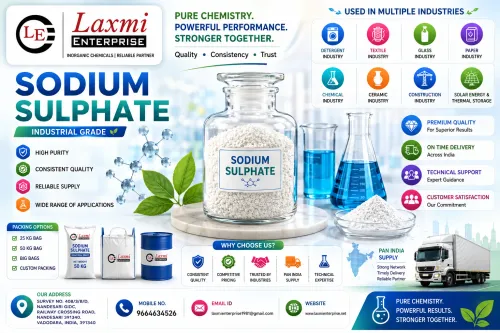
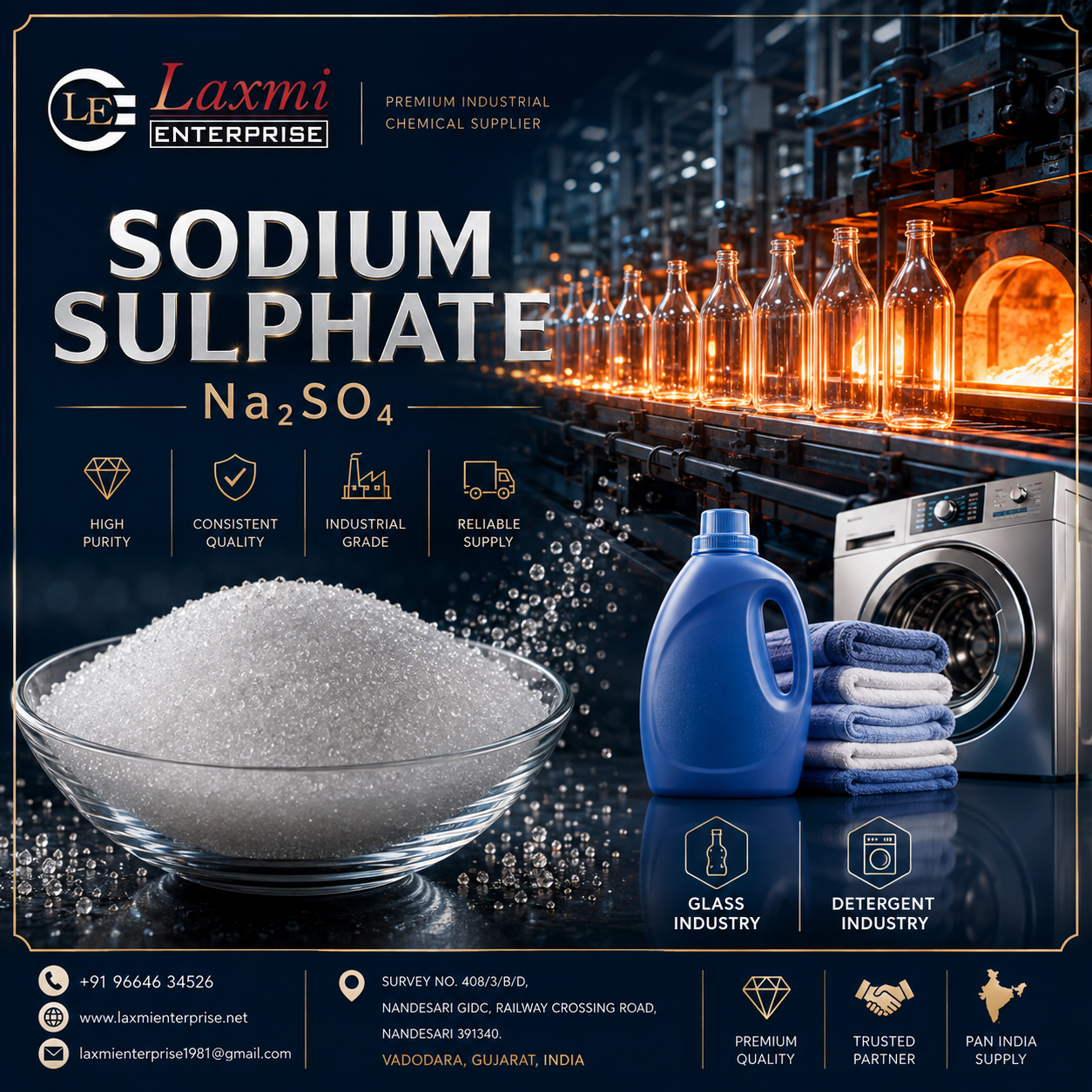
Industrial Sodium Sulphate is generally supplied as a white crystalline material, powder, granules, or crystals, depending on manufacturing and processing conditions.
The physical appearance may vary with:
Particle size
Crystal formation
Manufacturing route
Screening
Drying
Handling
Packaging
Therefore, appearance alone should not be used as the only quality criterion.
Laboratory testing and the agreed product specification provide a more reliable basis for quality evaluation.
What Is the Melting Point of Sodium Sulphate?
Anhydrous Sodium Sulphate has a reported melting point of approximately:
884°C
Some reference sources report values close to 888°C depending on the reference and measurement conditions.
This high melting point reflects the strong ionic character of the compound.
For ordinary industrial procurement, melting point is generally a reference property, rather than the primary incoming-quality parameter.
What Is the Density of Sodium Sulphate?
The reported density of anhydrous Sodium Sulphate is approximately:
2.67 g/cm³
PubChem's referenced experimental data reports approximately 2.671 g/cm³.
However, industrial buyers should distinguish between:
True Density
The density of the material itself.
Bulk Density
The mass of Sodium Sulphate occupying a given volume, including the spaces between particles.
Bulk density can vary with:
Particle size
Particle shape
Packing
Moisture
Handling
Compaction
Therefore, a product can have a relatively constant true density while its measured bulk density varies.
How Soluble Is Sodium Sulphate in Water?
Sodium Sulphate is water-soluble.
One referenced value reports approximately 28.1 g of Sodium Sulphate per 100 g of water at 25°C. Other sources report solubility using different units and temperatures, so test conditions should always be specified when comparing values.
Solubility is influenced by:
Temperature
Concentration
Hydration state
Presence of other dissolved salts
Test methodology
For industrial users, the relevant question is often not simply 'Is Sodium Sulphate soluble?' but:
How does its dissolution behaviour fit my manufacturing process?
What Are the Important Physical Properties for Industrial Buyers?
A procurement team should consider more than the basic chemical formula.
Property Why It Matters
Appearance Initial quality and identity check
Purity Determines chemical quality
Moisture Important for storage and process consistency
Particle Size Influences handling and dissolution
Bulk Density Important for feeding, storage and packaging
Solubility Relevant to process performance
Insoluble Matter Indicates unwanted insoluble material
Chloride Important where chloride limits apply
Iron Important for applications sensitive to iron contamination
Packaging Protects product during storage and transport
Not every parameter is required for every application. The buyer and supplier should agree on the appropriate specification.
What Are the Typical Industrial Specifications for Sodium Sulphate?
There is no single universal industrial specification that applies to every Sodium Sulphate application.
This is an important point for procurement teams.
A detergent manufacturer may have different requirements from a glass manufacturer, textile processor, paper mill, ceramic producer, or chemical manufacturer.
Specifications can include:
Assay / purity
Moisture
Chloride
Iron
Water-insoluble matter
Particle size
Bulk density
Appearance
A professional purchase specification should therefore be based on the actual application.
Why Should Buyers Not Purchase Sodium Sulphate Only on Purity?
Suppose two products both show similar assay values.
They may still behave differently because of:
Moisture
Particle size
Insoluble matter
Chloride
Iron
Bulk density
Packaging
Batch consistency
This is why an industrial buyer should evaluate the complete quality profile, not only the headline purity percentage.
Sodium Sulphate vs Other Industrial Sodium Salts
Procurement teams sometimes confuse Sodium Sulphate with other sodium-based industrial chemicals.
Chemical Formula Main Difference
Sodium Sulphate Na₂SO₄ Sulphate salt
Sodium Sulphite Na₂SO₃ Sulphite salt
Sodium Bisulphite NaHSO₃ Acid sulphite salt
Sodium Metabisulphite Na₂S₂O₅ Metabisulphite salt
Sodium Thiosulphate Na₂S₂O₃ Thiosulphate salt
Sodium Carbonate Na₂CO₃ Carbonate salt
Sodium Bicarbonate NaHCO₃ Bicarbonate salt
Sodium Chloride NaCl Chloride salt
Never substitute one product for another simply because the names sound similar.
Application compatibility must be established from the process specification.
Why Is Sodium Sulphate Sometimes Called Salt Cake?
In industrial chemical terminology, salt cake can refer to Sodium Sulphate, particularly in historical and industrial contexts.
However, buyers should always confirm the exact chemical identity before purchasing because commercial terminology can vary between industries and regions.
For an RFQ, using:
Sodium Sulphate / Sodium Sulfate — Na₂SO₄ — CAS 7757-82-6
is considerably clearer.
30+ Buyer-Focused Frequently Asked Questions
1. What is Sodium Sulphate?
Sodium Sulphate is an inorganic sodium salt with the chemical formula Na₂SO₄.
2. What is the CAS number of Sodium Sulphate?
The CAS number of anhydrous Sodium Sulphate is 7757-82-6.
3. What is the chemical formula of Sodium Sulphate?
The chemical formula is Na₂SO₄.
4. What is the molecular weight of Sodium Sulphate?
The molecular weight is approximately 142.04 g/mol.
5. What is the HSN code of Sodium Sulphate in India?
28331100 is commonly used for Sodium Sulphate under the sodium sulphates classification. Buyers should verify the current tariff classification for their exact product and transaction.
6. What is the purity of industrial Sodium Sulphate?
Purity depends on the product grade and agreed specification. Buyers should request the supplier's current specification and batch COA rather than assuming one universal purity.
7. What does Sodium Sulphate look like?
It is generally a white crystalline solid, powder, or granular material.
8. Is Sodium Sulphate soluble in water?
Yes. It is water-soluble, with solubility dependent on temperature and test conditions.
9. What is the melting point of Sodium Sulphate?
Anhydrous Sodium Sulphate has a reported melting point of approximately 884°C.
10. What is the density of Sodium Sulphate?
The reported density of anhydrous Sodium Sulphate is approximately 2.67 g/cm³.
11. Is Sodium Sulphate a powder or crystal?
It can be supplied as powder, crystals, or granules depending on the product and processing specification.
12. Is Sodium Sulphate the same as Sodium Sulfate?
Yes. 'Sulphate' is the British/Indian spelling and 'sulfate' is the American spelling.
13. Is Sodium Sulphate the same as Sodium Sulphite?
No. Sodium Sulphate is Na₂SO₄, while Sodium Sulphite is Na₂SO₃.
14. Is Sodium Sulphate the same as Sodium Chloride?
No. Sodium Chloride is NaCl, commonly known as common salt.
15. Which industries use Sodium Sulphate?
Common industrial users include detergent, glass, textile, paper and pulp, ceramic, and chemical manufacturing sectors.
16. What grade of Sodium Sulphate should I buy?
Choose the grade according to your process specification, quality requirements, and application.
17. Can I use detergent-grade Sodium Sulphate for glass manufacturing?
Do not assume interchangeability. The glass manufacturer's specification should determine the appropriate material.
18. Why is moisture important in Sodium Sulphate?
Moisture can influence handling, storage behaviour, product consistency, and certain manufacturing processes.
19. Why is particle size important?
Particle size can affect flowability, dissolution, blending, feeding, and material handling.
20. What is bulk density of Sodium Sulphate?
Bulk density is the mass of Sodium Sulphate occupying a unit volume including the void spaces between particles. It is different from true density.
21. Why should I ask for a COA?
A batch-specific Certificate of Analysis provides analytical information that can be compared against the agreed specification.
22. What is a TDS?
A Technical Data Sheet provides general technical and product information for a chemical.
23. What is an SDS?
A Safety Data Sheet provides information relevant to safe handling, storage, hazards, emergency response, and related safety practices.
24. Can Sodium Sulphate be stored for long periods?
It should be stored according to the applicable supplier SDS and recommended storage conditions, with protection from contamination and unsuitable environmental exposure.
25. Does Sodium Sulphate absorb moisture?
Its behaviour depends on form and environmental conditions. Storage should therefore follow the supplier's documented recommendations.
26. What packaging is available for industrial Sodium Sulphate?
Packaging may include bags, jumbo bags/FIBCs, or other agreed industrial formats depending on supplier capability and order requirements.
27. Can Sodium Sulphate be supplied in bulk?
Bulk supply may be possible depending on the supplier's logistics, customer quantity, and packaging/transport arrangements.
28. Where can I buy Sodium Sulphate in India?
Industrial buyers can source it from manufacturers, distributors, traders, and specialized industrial chemical suppliers.
29. Why is Gujarat important for Sodium Sulphate buyers?
Gujarat has a large chemical manufacturing and distribution ecosystem with strong industrial and logistics infrastructure.
30. Why is Vadodara important for chemical procurement?
Vadodara is an established industrial and chemical hub with access to major manufacturing clusters and transport networks.
31. Can Laxmi Enterprise supply Sodium Sulphate across India?
Laxmi Enterprise, based in Nandesari, Vadodara, serves industrial customers across India, subject to product availability, order requirements, and logistics arrangements.
32. How can I request a Sodium Sulphate quotation?
Provide the required grade/specification, quantity, packaging preference, application, and delivery location so the supplier can prepare an appropriate commercial offer.
33. What should I compare when evaluating Sodium Sulphate suppliers?
Compare quality consistency, specification compliance, COA documentation, packaging, delivery capability, commercial terms, technical support, and supplier reliability—not only price.
34. What information should appear on my Sodium Sulphate purchase specification?
It should normally identify the chemical, grade, required quality parameters, packaging, quantity, documentation requirements, and applicable acceptance criteria.
Quick Technical Reference for Buyers
Parameter Sodium Sulphate Reference
Chemical Name Sodium Sulphate
Formula Na₂SO₄
CAS No. 7757-82-6
Molecular Weight 142.04 g/mol
HSN / Common Indian Classification 28331100
Appearance White crystalline solid / powder
Odour Odourless
Melting Point Approximately 884°C
Density Approximately 2.67 g/cm³
Water Solubility Temperature-dependent; approximately 28.1 g/100 g water at 25°C in one reference
Main Industrial Parameters Purity, moisture, chloride, iron, insoluble matter, particle size, bulk density
Major Markets Detergent, glass, textile, paper & pulp, ceramics, chemicals
Physical-property values above are reference values for anhydrous Sodium Sulphate; commercial specifications can differ by grade and application.
Buyer Decision: What Should You Ask a Sodium Sulphate Supplier?
Before placing a purchase order, ask:
What grade are you supplying?
What is the agreed purity specification?
Can you provide a batch-specific COA?
What are the moisture limits?
What particle-size range is available?
What packaging options are available?
What is the minimum order quantity?
Can you support regular monthly requirements?
What is the delivery location and expected lead time?
Can you provide TDS and SDS documentation?
These questions transform a simple price enquiry into a professional supplier evaluation.
Laxmi Enterprise — Industrial Sodium Sulphate Supply
Laxmi Enterprise, based in Nandesari, Vadodara, Gujarat, focuses on supplying industrial chemicals to manufacturers and industrial buyers across India.
For Sodium Sulphate procurement, buyers should communicate:
Required application
Grade
Quantity
Packaging
Delivery location
Technical specification
Documentation requirement
This allows the supplier to provide a more relevant product and commercial proposal.
Product information: Laxmi Enterprise
Internal Links Recommended for the Laxmi Enterprise Website
This article should connect to the entire Sodium Sulphate topical cluster:
What Is Sodium Sulphate?
↓
Manufacturing Process
↓
Industrial Grades
↓
Quality Testing
↓
Laboratory Analysis
↓
Industry Applications
↓
Buyer Guide
↓
Price & Market Trends
↓
Packaging & Storage
↓
COA / TDS / SDS Guides