
Sodium Sulphate as a Fining Agent in Glass Production – Why Consistency Matters
Sodium Sulphate: A Critical Fining Agent for High-Quality Glass Manufacturing
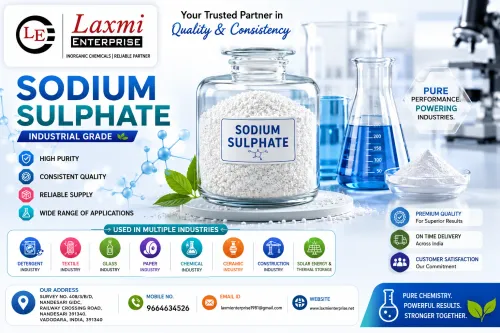
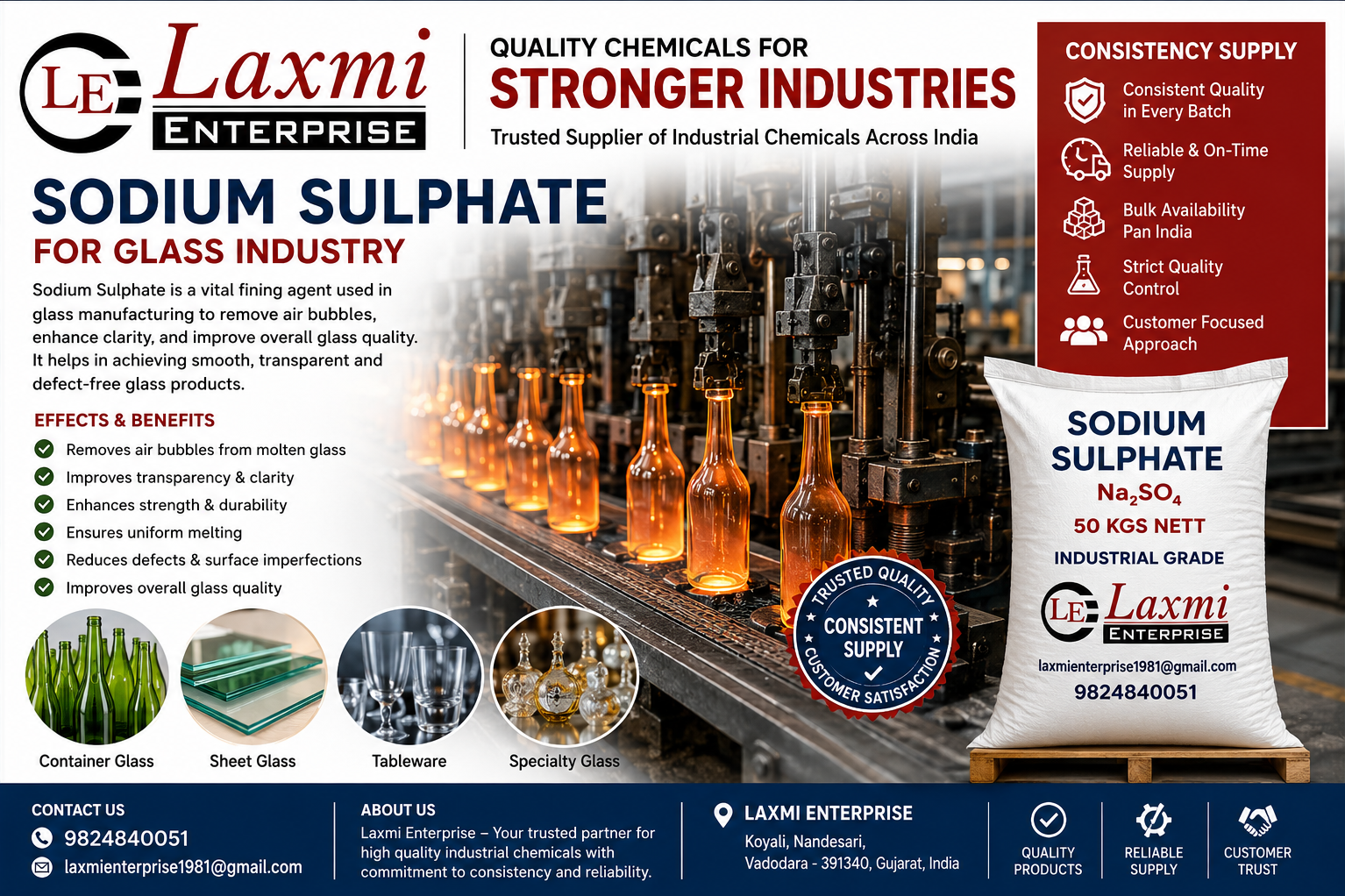
In modern glass manufacturing, Sodium Sulphate (Na₂SO₄) plays a crucial role as a fining agent and refining additive. It is widely used in the production of container glass, float glass, sheet glass, decorative glass, fiberglass, and specialty glass products. The primary function of Sodium Sulphate is to improve glass clarity by removing entrapped gas bubbles from the molten glass mass, resulting in a uniform, defect-free, and high-quality finished product. generated during melting, allowing manufacturers to achieve superior glass quality and improved production consistency. . Established in 1997, the company serves glass manufacturers across India with a focus on quality, consistency, and dependable supply. supply capabilities across India.
Certificate of Analysis (COA) and product specifications are available to support customer quality requirements.
Glass Bottles and Jars
Architectural Glass
Decorative Glass
Fiberglass Manufacturing
Specialty Glass Products helping glass manufacturers achieve better clarity, reduced defects, and stable production performance. 391340, Vadodara, Gujarat, India.
Sodium Sulphate (Na₂SO₄) is a critical fining (refining) agent used in glass manufacturing to remove micro-bubbles and ensure optical clarity. Choosing an industrial chemical pioneer like Laxmi Enterprise (based at Survey No. 408/3/B/D, Nandesari GIDC, Vadodara) ensures that the structural and chemical integrity of the glass melt remains flawless during high-temperature operations.The Importance of Sodium Sulphate as a Fining AgentDuring the glass melting stage, raw components like silica sand, soda ash, and limestone release large volumes of trapped gases (CO₂, SO₂). If these micro-bubbles remain, the final glass structural safety and optical quality are deeply compromised. Sodium sulphate solves this through a multi-step chemical reaction:Gas Scavenging: At furnace temperatures above 1200°C to 1450°C, sodium sulphate decomposes into sodium oxide (Na₂O), sulphur dioxide (SO₂), and oxygen (O₂).Bubble Coalition: The released gases form rapidly expanding large bubbles. As these large bubbles rise swiftly to the surface of the molten glass melt, they absorb and sweep away the tiny, stubborn micro-bubbles.Fluxing and Homogeneity: Beyond fining, the component helps lower the melting temperature of silica, acting as an secondary fluxing agent that drastically improves batch melting speed and thermal efficiency.Why Chemical Consistency from Laxmi Enterprise is CriticalGlass furnaces operate continuously for years at extreme temperatures. Any slight chemical fluctuation in the batch can result in catastrophic structural flaws or factory downtime. Procurement from Laxmi Enterprise (Vadodara) provides key technical advantages:Critical RequirementWhy Laxmi Enterprise Meets This NeedImpact on Glass ProductionStrict High Assay (99.5%+)Laxmi Enterprise manufactures standard high-purity Sodium Sulphate Anhydrous with an assay profile minimizing moisture variability.Prevents batch recalculation errors, unreacted sludge, or uncontrolled foaming inside the melter.Ultra-Low Iron (Fe) ImpuritiesTheir chemical processing methods stringently limit heavy metal traces like iron or chromium.Eliminates accidental green or amber color tinting, preserving pristine glass transparency.Strict Particle Size ControlsTheir Nandesari GIDC plant regulates the granulation profile of the supply.Ensures the powder dissolves uniformly with silica sand rather than blowing out through exhaust systems.Continuous Bulk SupplyBacked by a dedicated scientific warehousing facility and logistics network out of Vadodara.Ensures continuous glass factories avoid supply-chain shocks, which can cause multi-million dollar furnace freezing.By aligning with Laxmi Enterprise, glass plants secure high chemical purity along with direct door-to-door logistical transport across industrial corridors.Would you like to draft a Request for Quotation (RFQ) for a specific mesh size or volume requirement to email to laxmienterprise1981@gmail.com? I can also provide details on their packaging options (e.g., HDPE bags vs. jumbo bags) if required.